Blog
 Public
- 24 Oct, 2026
Tripo P2.0 and the Astra Workflow: Generating and Integrating 3D Assets in Blender and Unity
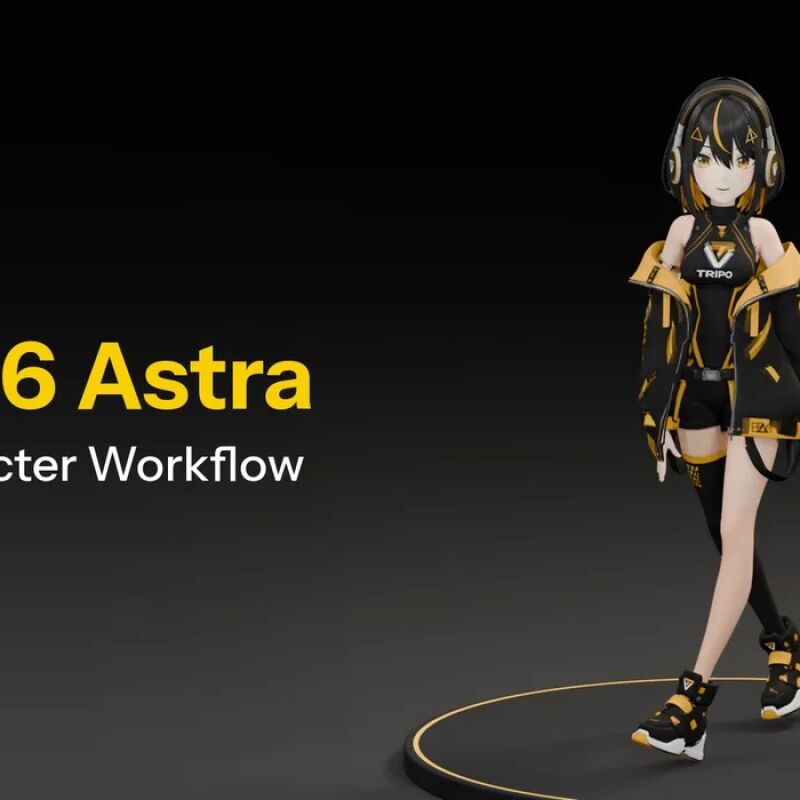
Generative 3D workflows are evolving from isolated model creation to integrated asset pipelines. Tripo's latest 3D-native foundation model, P2.0, is designed to generate triangle or quad-based meshes with features such as adjustable polygon density, part separation, Smart UVs, and regional mesh editing. When paired with Astra, these assets can be assembled, rigged, animated, and integrated into interactive scenes using professional software like Blender and Unity. This division of labor allows creators to focus on specific components while Astra handles the coordination of downstream tasks, ensuring that the generated geometry supports rigging, animation, and real-time production requirements effectively.Post on X: https://twitter.com/luccacerf/status/2096308567863079420The workflow operates by generating individual parts separately to give creators precise control over shape and detail. For example, a creator can generate a character's body, head, and hair as distinct assets using Tripo P2.0 or the H3.1 model, which focuses on high-fidelity details. Astra then assists in assembling these components within Blender, managing the transition to rigging and animation. This modular approach allows users to refine or regenerate specific components without restarting the entire asset generation process. Astra's capability stems from reasoning about 3D tasks and executing code or scripts to manipulate assets, making it a powerful tool for coordinating complex multi-step processes in established 3D environments.Post on X: https://twitter.com/Stefan_3D_AI/status/2096481425050743048Practical applications of this workflow have already emerged in the community. Creator Ring Hyacinth used Nano Banana for reference images, Tripo P2.0 for modeling, and Codex to build an Alice in Wonderland scene with effects and interactions. Similarly, Lucca Cerf, who has no background in game development or design, used an Astra to Tripo P2.0 to Blender to Unity pipeline to build a World of Warcraft fan game. By relying on just three prompts, Cerf completed the project in approximately 90 minutes. These examples demonstrate that the combination of Tripo and Astra enables individuals without prior 3D experience to quickly create complex, interactive scenarios and playable prototypes.The technical specifications of Tripo's models are tailored for production readiness. The P series optimizes mesh structure, topology, and editability, while the H series prioritizes fidelity for complex shapes. Users can manage polygon density, choose between triangle or quad topology via Smart Mesh, and generate textures and materials. Automatic rigging and animation features are available for characters, and export settings allow for precise control over scale, orientation, and pivot points when moving assets into Blender or game engines. This level of control ensures that the generated assets meet the technical standards required for real-time engines and professional DCC applications.Quality control remains a critical aspect of the workflow, as AI accelerates creation but does not eliminate the need for artistic judgment. After assembly, creators must review proportions, alignment, silhouettes, and connections between components. Animation requires evaluating deformation in areas such as the shoulders, elbows, knees, and facial expressions. While the workflow fits early-to-mid production stages like ideation, prototyping, and previz, professional studios may still refine hero assets in DCC tools. The goal is to make high-quality 3D generation accessible without requiring every creator to become a 3D specialist, allowing artists to focus on creative direction and integration into cohesive artistic systems.

- Public
- 24 Oct, 2026
JetBrains GameDev Day 2026 Recordings Released: Key Technical Solutions for Modern Game Development
The complete archive of JetBrains GameDev Day 2026 is now accessible on YouTube, offering developers a comprehensive resource for addressing real-world production challenges. Held on September 28, the event brought together industry experts to discuss tools and methodologies shaping the current landscape of game engineering. The sessions focus heavily on practical applications, ranging from integrating Entity Component Systems (ECS) into live games to leveraging AI for procedural content generation. Developers who attended watch parties in Belgrade or Limassol, or those who missed the live event, can now review the material at their own pace to gain insights into modern development workflows and tooling.A significant portion of the technical content addresses the integration of AI into existing development pipelines. One key session demonstrates how TeamCity's Model Context Protocol support and Command Line Interface (CLI) bring continuous integration workflows directly into the development environment. Using a Unity project as a case study, the presentation shows how to investigate build failures and interact with CI pipelines without constantly switching between different tools. Additionally, another talk explores agentic workflows tailored specifically for Unreal Engine, using Rider, ACP, and engine-specific skills. These demos illustrate how AI agents can navigate complex engine architectures, generate C++ code, investigate crashes, and automate various development tasks, moving beyond simple code assistance to more autonomous problem-solving.For teams working with large-scale assets, the session on Epic Games' open-source Lore VCS provides crucial insights into managing multi-gigabyte files that change daily. Unlike traditional version control systems built for code, Lore splits files into content-addressable fragments, ensuring that only the changed parts of an asset are transferred. The discussion covers how edge caches can be filled on demand rather than pre-seeded, and it includes instructions on deploying the system using the Lore module within the AWS Cloud Game Development Toolkit. This approach addresses a major bottleneck in modern game development, where asset management often slows down collaboration and build processes. Understanding these mechanics is essential for studios looking to optimize their infrastructure and reduce storage and bandwidth costs.Performance optimization and debugging remain central themes, with detailed sessions on Unreal Engine profiling and cross-language debugging. One presenter uses live profiling to show how small engineering decisions accumulate into gameplay bottlenecks, demonstrating practical optimization workflows using Unreal Insights and Rider. Another session tackles the complex scenario where the client is written in C# and the server in C++, showing how to debug both runtimes simultaneously with Rider and CLion. This approach allows developers to read data crossing the protocol boundary and determine which runtime is causing issues. The emphasis is on the boundary between runtimes as a critical area for investigation, providing a structured method for resolving bugs that span multiple languages and environments.The event also featured deep dives into specific engine integrations and UI automation. A notable session presented a Figma-to-Unity pipeline that has evolved over years of production use, now running through an AI agent over MCP. The presenters covered the design foundations that make such automation possible, lessons learned from building the system, and a benchmark of which UI integration tasks the agent can handle today versus those still requiring human intervention. Another talk focused on bringing ECS into a mass-market live game without rewriting the engine, discussing staged migration strategies, compromises on memory layout, and the benefits of a hybrid approach combining ECS with legacy code. These sessions provide actionable strategies for modernizing existing codebases while maintaining stability in live products.

- Public
- 24 Oct, 2026
NVIDIA TensorRT 11.1: Global Performance Tuner for Automatic Accuracy-Aware Engine Optimization
Deploying neural networks is fundamentally a compilation challenge where a single optimal strategy does not exist for all models. When NVIDIA TensorRT builds an inference engine, it makes interdependent decisions regarding graph transformations, kernel fusion, memory placement, and quantization. This process, known as scheduling, significantly impacts final inference performance. Different scheduling choices can preserve model semantics while yielding vastly different speed results. Because these effects are coupled and model-dependent, they often only become apparent after the complete engine is built and measured. This makes predicting the best strategy increasingly difficult as models and deployment environments diversify.Figure 1. A single fixed recipe does not scale to conflicting customer preferencesHistorically, TensorRT relied on internal Key Performance Indicator (KPI) models to identify optimizable patterns, which were then encoded as heuristics in the default scheduling strategy. While this allowed users to automatically benefit from expert knowledge, it created a scaling problem. A heuristic designed for one type of model could cause performance regressions in another, requiring additional exceptions. This made the scheduling logic complex and hard to extend. The Global Performance Tuner, released in TensorRT 11.1, solves this problem by moving away from a single fixed recipe. Instead, it treats the compiler pipeline as a base recipe with configurable "seasonings", allowing the system to adapt its optimization path to the specific characteristics of each input model, such as an ONNX graph or a network created via the TensorRT API.Figure 2. Tune the flavor for each customerTo formalize this approach, the system uses a mathematical framework that separates the generation of candidate solutions from their selection. The model space consists of all possible inputs, while the solution space contains all executable outputs, such as TensorRT engines or serialized GPU kernel sequences. A builder algorithm maps a model to a set of candidate solutions, constrained by an accuracy tolerance threshold. This threshold ensures that the input-output pairs remain within acceptable limits, preventing aggressive optimizations that violate application requirements. The builder's goal is to generate a rich set of candidates that includes the optimal solution, defined as the fastest feasible execution that meets the accuracy criteria. This abstraction allows for rigorous analysis of how different build routes affect the final runtime.A searching algorithm then operates on this candidate set to select the best solution. Ideally, this algorithm would perform a brute-force evaluation of every candidate to find the one with the minimum runtime. However, in practice, build time budgets often limit the depth of this search. The overall compiler is thus represented as a tuple of a builder and a searcher. The challenge lies in constructing an optimal builder that makes the globally optimal solution reachable. Since no single universal build route works for all models, the system must support customizable build routes. This means the sequence of compiler passes, which transform intermediate representations into final executables, can vary. Different models may achieve their best performance through different sequences of transformations, even on the same target GPU.The Global Performance Tuner leverages these customizable build routes to perform automatic performance tuning. For each candidate solution generated by different build routes, the tuner validates the outputs against the specified accuracy criterion. It then measures the end-to-end inference performance of the feasible solutions. Among all candidates that satisfy the accuracy requirements, the system selects the one with the lowest runtime. This approach ensures that performance gains do not come at the cost of model fidelity. By treating the compilation process as a search over multiple possible build routes rather than a single fixed path, TensorRT 11.1 provides a scalable method for optimizing deep learning workloads across diverse models and hardware configurations.This methodology addresses the core limitation of previous approaches where a change for one model could degrade performance for another. By keeping the base pipeline stable but making the scheduling decisions configurable, the system can handle new models with unknown preferences effectively. It offers different optimization variations, rejects those that fail accuracy checks, and retains the best-performing configuration. This is analogous to a chef offering free samples to a new customer to find the preferred seasoning combination, rather than forcing a single standard recipe. The result is a more robust compilation process that adapts to the specific needs of each neural network, ensuring that developers receive the highest possible inference speed without compromising the required precision of their applications.

- Public
- 23 Oct, 2026
Structural Barriers to Mass Adoption of Optical See-Through AR Glasses
The optical see-through augmented reality sector is currently undergoing a significant strategic pivot. For years, the industry attempted to derive AR capabilities from high-end virtual reality headsets, aiming for wide fields of view and complex features that resulted in bulky, expensive devices. This approach has largely stalled. The modern trajectory involves building up from audio-only AI glasses, such as the Meta Ray-Ban Wayfarers, which have reached a critical inflection point of approximately ten million units in annual shipments. This volume is a key benchmark for mass market adoption. In contrast, VR headset shipments have declined from the ten-million-unit peak in 2021 to between 3.5 and 6 million units in 2026, indicating that moving beyond enthusiast segments remains a formidable hurdle for immersive hardware.A major, often underappreciated barrier to consumer adoption is the integration of prescription lenses. For users who require vision correction, current AR glasses present a logistical and ergonomic nightmare. Unlike non-display AI glasses, which can accommodate standard prescription lenses cut locally to fit the frame, display-based AR devices typically require factory-glued prescription lenses onto waveguides. This process creates a unique SKU for every customer, leading to long lead times measured in weeks. Furthermore, these integrated prescriptions often fail to adequately correct astigmatism or bifocal vision. Aftermarket clip-in solutions exist but are too bulky to function as normal eyewear, limiting their utility to enterprise or VR contexts rather than everyday consumer use.The display technology required for viable AR glasses faces significant stagnation. Full-color MicroLED displays, which are essential for high-quality outdoor readability, are slow to reach mass production. Current rumors suggest that while some manufacturers may begin production in the near term, the resolution remains low, typically hovering around 640 by 480 pixels. This VGA-class resolution is comparable to personal computer standards from the 1980s and is insufficient for high-fidelity text or media consumption. The lack of high-resolution, full-color microdisplays means that current AR devices cannot compete with the visual clarity users expect from modern smartphones or tablets, further limiting their appeal to the general public.Component supply chains are under increasing pressure due to the explosive demand for AI infrastructure. The massive consumption of semiconductors by AI data centers has absorbed spare manufacturing capacity, leaving fewer resources for consumer electronics manufacturers. This scarcity affects the availability of processors, memory, and other critical components needed for AR glasses. Additionally, the inclusion of cameras introduces a complex trade-off. While cameras enable advanced features like simultaneous localization and mapping (SLAM), they significantly increase power consumption, size, and weight. A camera module can consume as much power as the display itself, making it difficult to maintain the form factor of normal eyeglasses while providing all-day battery life.The industry must avoid the trap of focusing on a single metric, such as cost, to drive adoption. While price is a factor, it is secondary to functionality and usability. Historical examples, such as the Apple II and the original Macintosh, show that high initial prices are acceptable if the product offers unique value. Attempting to build a low-cost device with limited functionality is a misallocation of resources. The challenge is systemic: solving one technical issue, such as display brightness, often exacerbates others, such as power consumption or heat generation. There are roughly seventeen to twenty major barriers that must be solved simultaneously, including transparency, eye glow, grating artifacts, and outdoor dimming.For all-day wearability, the device must function as normal glasses when powered off. If the device causes distortion or poor vision correction when inactive, it fails the basic requirement of being eyewear. Users are unwilling to remove their glasses and store them in a protective case, which defeats the purpose of a wearable device. Furthermore, the integration of the display with the real world inherently degrades the quality of both images. The physical presence of optics between the eye and the world introduces reflections and artifacts. Therefore, the development of AR glasses requires a holistic approach that addresses optical fidelity, ergonomic comfort, prescription compatibility, and component availability as a single, interconnected system rather than a series of isolated problems.

- Public
- 23 Oct, 2026
A Strategic Guide for XR Developers Entering the Chinese Market
The immersive reality sector is currently defined by two primary powerhouses: the United States and China. While the US market is well-documented, China remains shrouded in mystery for many Western developers due to the Great Firewall and a prevalence of misinformation. Western tech media often circulates inaccurate narratives, such as the existence of a universal social credit score system or a WeChat-based metaverse, neither of which are factual realities for those operating within the country. With a population of 1.4 billion, including 870 million individuals aged 15 to 59, China represents a massive opportunity for skilled teams. However, success requires moving beyond hearsay and understanding that the local ecosystem operates under fundamentally different principles than those in the West.Created using an image provided by PicoUnlike the West, China never had a "Quest moment," when a single consumer headset combined an affordable price with a rich content library and drove mass adoption. Meta is prohibited from selling there, and Pico, the closest competitor, shifted its strategic focus shortly after the release of the Pico 4, leaving a near-vacuum in the consumer VR market. As a result, a hit game designed for home use, like Beat Saber, may not find a viable audience in the domestic consumer segment. Instead, commercial success in China, mirroring broader East Asian trends, is driven by out-of-home arcade experiences. These VR attractions are everywhere: they can be found in malls in almost all major cities, ranging from simple seated setups to room-scale zombie shooting arenas. While the hardware in these arcades is not always the latest generation, the sheer density and accessibility of these venues make them the primary revenue driver for VR content.In addition to traditional arcades, large-scale VR installations have gained significant traction. These venues feature large rooms where multiple users play solo experiences simultaneously, using white silhouette avatars to navigate around each other without collisions. The B2B sector also remains active, with VR training receiving particular attention, though investment has cooled as the initial metaverse hype has subsided. Currently, the industry focus is shifting toward smart glasses, which are gaining prestige as VR headsets lose some investor attention. Major corporations like Huawei and Alibaba are heavily involved; the latter recently launched glasses with eye tracking to enhance AI capabilities. Established players like Rokid and RayNeo are expanding their device lineups, while numerous startups enter the market with niche products, from AI assistants to specialized use cases such as swimming.The rise of smart glasses is closely tied to the explosive growth of AI in China, where companies like ByteDance are developing frontier models comparable to OpenAI's offerings, with DouBao serving as a local equivalent of ChatGPT. It remains unclear how developers can fully capitalize on this smart glasses push, but the infrastructure is being laid. For developers planning to enter this market, the most important advice is to find a local partner or a network of trusted contacts. A local partner understands the regulatory landscape, unwritten market rules, and cultural nuances that can make or break a product launch. They can help with IP protection, marketing, and adapting content to specific regional requirements. There are specialized firms that can take a Western VR game, adapt it for the Chinese audience, and handle distribution, including adapting it for arcade environments if necessary.Courtesy of Antony VitilloFurthermore, various accelerators and incubators, such as those in Hangzhou, are actively welcoming Western entrepreneurs, sometimes offering regional funds or subsidized office spaces to help them navigate the complex tech ecosystem. Trust is paramount in these relationships; it is advisable to seek introductions through trusted networks rather than cold outreach. Equally important is the localization of content. Distributing content in English is ineffective in China; games, presentations, and social media videos must be in Mandarin. While AI translation tools are improving, they remain clunky and prone to errors, making human Mandarin speakers indispensable for face-to-face interactions, especially at trade show booths. Cultural subtleties also matter, as demonstrated by the success of skipping tutorials in favor of immediate gameplay during a 2019 showcase in Nanchang, proving that local insights into user preference are vital for engagement.
- Public
- 23 Oct, 2026
VRChat Adds Native SDK-Level Face Tracking in Open Beta
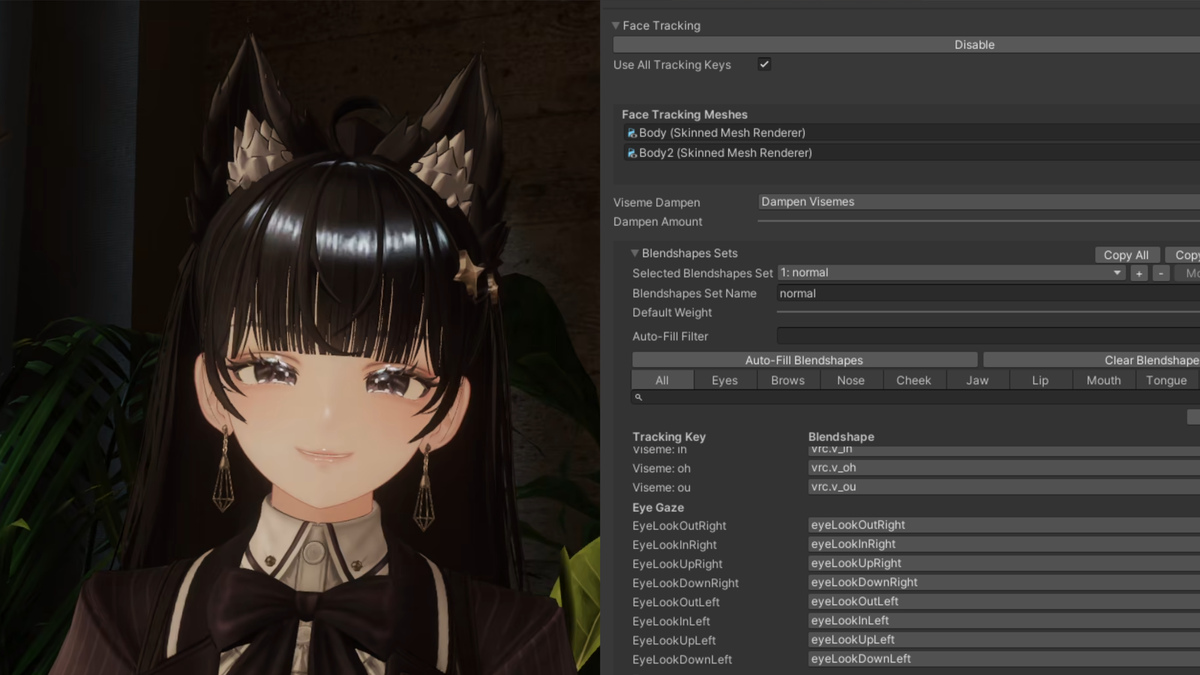
VRChat has introduced native SDK-level Face Tracking support for avatars in its Open Beta client and Avatars SDK beta. While the platform technically supported Eye and Face Tracking for years via Open Sound Control and the community-made VRCFaceTracking app, avatars previously lacked native full facial tracking capabilities. Users were forced to configure add-ons to achieve detailed expression, as native support was limited to basic gaze and eyelid movement using Eye Tracking data. This new implementation removes that dependency, allowing for more direct and efficient facial animation handling within the core software structure.The latest Open Beta client on Steam and Avatars SDK Version 3.10.6-beta.1 enable SDK-level authoring of Face Tracking, initially termed High Fidelity Face Tracking. Creators can now set up facial expressions through a dedicated section in the Avatar Descriptor component. The system maps expressions to blendshapes and animator parameters while supporting the Unified Expressions standard from VRCFT. It integrates seamlessly with VRChat's audio-driven visemes, eye look, and eyelids, though it currently does not support Blended Shapes or Simplified Parameters. This native integration streamlines the creation process and ensures better compatibility across different avatar setups without requiring complex external configurations.A significant advantage of this update is network-synced Face Tracking that does not consume the avatar's synced parameter budget. This reduction in synced parameter load leads to better overall performance and more visually consistent facial expressions for other users in the shared space. The system supports various input methods, including OSC protocols like VRCFT in its latest beta release on Steam. It also integrates with VRChat's Selfie Expression feature, which allows users to mirror facial expressions to their avatars on desktop PC and Android devices using a webcam or front-facing camera, enhancing accessibility for those without dedicated VR headsets.Hardware compatibility varies, with few headsets currently offering both hardware support and third-party APIs for Eye Tracking and camera-based Face Tracking. Popular options include the Pico 4 Pro and Enterprise, Meta Quest Pro, and Samsung Galaxy XR. Open-source and community-built solutions exist for other devices like the Meta Quest 3 and 3S, while VRCFT can pass data from eye-tracking-only devices such as the Bigscreen Beyond 2e. Creator Hash has updated several popular Booth avatar packages with beta variants that utilize this new SDK functionality, allowing existing owners to switch to the improved tracking system immediately.The upcoming Meta VR Glasses feature hardware support for both Eye and camera-based Face Tracking, utilizing dedicated sensors for eyes and downward-facing cameras for facial signals. However, Meta will not provide third-party API access to the visual Face Tracking data source at launch, unlike the Meta Quest Pro. Developers will only have access to Eye Tracking and must rely on audio-driven data sources known as Audio to Expressions. Camera-based Face Tracking will be restricted to first-party usage, such as realistic Hologram avatars. This limitation has caused frustration among developers, with Meta Developer Advocate Dilmer Valecillos acknowledging the feedback. A request for a camera-based API on the Meta VR Developer website is currently backlogged, indicating a future but undefined timeline for third-party access.

- Public
- 23 Oct, 2026
Apple lets organizations and schools purchase subscriptions in volume
Organizations and educational institutions can now purchase auto-renewable app subscriptions in volume through multiseat purchasing. This capability is designed for entities using Apple Business or Apple School Manager, allowing them to discover and buy subscriptions directly. By purchasing the required number of seats via a single Apple In-App Purchase, organizations can then assign and manage access using their existing device management tools. The system provides flexibility, enabling administrators to add or remove seats at any time to match current operational needs without complex renegotiations or separate transactions for each individual user.Multiseat purchasing for subscriptions is enabled by default in App Store Connect, making your subscription available through Apple Business, Apple School Manager, and the standard App Store simultaneously. Developers retain full control and can adjust these availability options at any time to suit their distribution strategy. The platform also supports subscriptions for groups, introducing a new layer of flexibility for consumer and small team usage. Starting October 28, 2026, developers can configure and test group purchases within their Sandbox Apple Account to prepare for the upcoming launch. This winter, group purchases will become available on the App Store, allowing users to buy multiple seats and invite others to access the subscription, thereby expanding the reach of subscription-based business models.
- Public
- 23 Oct, 2026
Vector Gear: a fully open-source VR headset for makers and enthusiasts
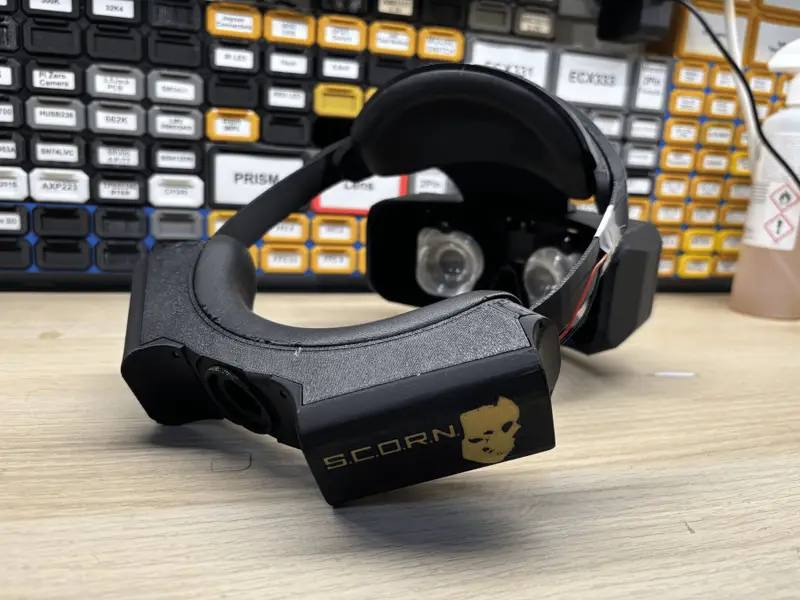
Walker Industries, a team of VR enthusiasts from Japan, has launched a Kickstarter campaign for the Vector Gear, a fully open-source mid-range VR headset. The project aims to create a device that can be fully customized: both the hardware and the software are available to the public. This approach lets developers and users modify every aspect of the system, from the underlying operating system to the physical components. The company describes the project as the realization of a long-held dream: to build a headset not constrained by proprietary restrictions and to offer a transparent platform for innovation and experimentation in the XR space.The Vector Gear is positioned as the flagship device in the lineup, working both standalone and as a PC-tethered headset. Alongside it, the campaign offers the Andromeda, designed exclusively for PC-VR and available in two versions: a budget model and one with a higher resolution. The Vector Gear's specifications are comparable to current market leaders like the Quest 3, with similar resolution and chipset capabilities. Although the device is being developed by a small team with a limited budget, it offers a wide range of features that compete with those from large corporations. The goal is to deliver high performance without the huge costs usually associated with developing this kind of hardware.A distinguishing feature of the Vector Gear is its built-in face tracking system called "Shinra Meisin," developed in-house by the team. This system is designed to animate user avatars in social VR platforms such as VRChat, transmitting data via OSC. In addition, the headset and controllers use a proprietary tracking system called "AstroSLAM." Unlike standard inside-out tracking, the controllers are equipped with their own cameras, which allows flexible positioning, even when they are behind the head or used to track objects on props. This tracking system is fully compatible with SteamVR, ensuring broad compatibility with existing PC-VR games and providing a solid foundation for developing new applications.The software ecosystem is just as ambitious and is built around a custom operating system called XRUIOS, based on Arch Linux. Created specifically for VR, this OS lets users arrange 3D objects to build personalized home environments, run widgets, and launch applications from both Steam and Walker's own launcher. FEX is integrated into the system, which makes it possible to run standard x86 applications on the ARM64 Linux architecture. One notable widget is an MS-DOS emulator, which lets users run old games. The system also includes the "Yuuko Protocol," a cross-platform tool that creates a cohesive experience across devices and allows users to seamlessly continue media playback or file access between their headset, smartphone, and PC.The Vector Gear costs $980, while the Andromeda models are available for $650 and $1,250, with discounts on self-assembled devkit versions. Worldwide delivery is expected by May 2027, though delays are possible. The project is aimed at makers, hardcore enthusiasts, and research institutions that need full customization capabilities and data privacy guarantees. While Steam Frame offers a similar but less open alternative, the Vector Gear stands out by being designed for complete disassembly and modification. This level of openness makes it a unique tool for those who want to dive deep into the hardware and software layers of virtual reality, supporting a community-driven approach to XR development.

- Public
- 22 Oct, 2026
Unity MethodReload: Faster Iteration by Bypassing Domain Reload
Unity has released MethodReload, an experimental package designed to eliminate the wait times associated with domain reloads during development. Traditionally, modifying gameplay code in the Editor forces a complete teardown and re-initialization of the Mono AppDomain, a process that can drain creative momentum. On devices, the situation is even more severe, as IL2CPP does not support domain reloads at all, requiring a full player rebuild for every change. MethodReload addresses this by allowing developers to update specific method bodies instantly, turning long compilation waits into a matter of seconds. This capability is now available for immediate use, aiming to streamline the iteration loop for both editor-based and on-device testing.The package, currently at version 0.7.0-exp.1, is distributed within the com.unity.pipeline namespace and requires Unity 6.0 or later. To use this feature, developers must tag specific methods with the [MethodReload] attribute before entering Play Mode or building a player. This attribute must be present at compile time because the dispatch logic is woven directly into the method's bytecode. Only public instance or static methods that return void or IEnumerator are eligible for this treatment; any other signatures are skipped during the build process with a warning. This pre-compilation requirement ensures that the runtime can correctly identify which methods are candidates for live updates without interfering with the standard compilation pipeline.Once the attributes are in place, the workflow involves starting the MethodReload Watcher, found in Project Settings under Pipeline and Editor. In the Editor, entering Play Mode activates the system, allowing any changes to tagged code to be compiled and injected in real time. For on-device testing, developers must build a development player with the runtime Pipeline driver enabled and connect via the Profiler or Console window. When a file containing a tagged method is saved, the Editor compiles it using the player's preprocessor defines and pushes the update to all connected devices. This process requires no restart of the application, enabling a seamless feedback loop. Additionally, Unity CLI commands are available for terminal-based workflows, allowing users to trigger reloads for specific files or folders directly from the command line.Despite its speed advantages, MethodReload operates within strict limitations. It only modifies the bodies of tagged methods, leaving call sites, fields, and type layouts untouched. Consequently, developers cannot add new fields or classes through a reload. The interpreter executes a subset of C#, excluding certain complex features, though it supports primitives, loops, delegates, and coroutines. A Roslyn analyzer included in the package flags unsupported syntax in the IDE. On IL2CPP devices, the interpreter can only call APIs already referenced in the build; missing members will result in exceptions. Furthermore, interpreted code runs slower than compiled code, a trade-off that only affects development builds. Release builds do not include the interpreter, ensuring no performance impact in production.Under the hood, MethodReload combines IL interpretation with compile-time weaving. Each tagged method contains a prologue that checks a registry for an available override. If an override exists, the interpreter executes the new IL bytecode; otherwise, the original compiled code runs. This architecture allows the interpreter to be compiled by IL2CPP alongside the rest of the game, enabling it to run on devices without external servers or open ports. While existing Asset Store tools offer full C# support in the Editor, they fail on IL2CPP builds. MethodReload fills this gap, providing a viable solution for on-device iteration. For developers whose pain points lie primarily in the Editor, existing tools may still be preferable, but for those targeting IL2CPP devices, MethodReload offers a unique and powerful path to faster development cycles.
- Public
- 22 Oct, 2026
Unity CLI: More Than 200 Million Events from AI Agents
The Unity CLI functions as a single binary that installs and manages Unity from the terminal. With the addition of the Pipeline package, it allows scripts, continuous integration systems, and coding agents to drive a running Editor instance. Since July, more than 226,000 logged-in users have used the tool, generating over 200 million events. The data indicates a clear workflow pattern: developers configure the environment manually, while the bulk of the operational work is delegated to automated agents.Between July 20 and October 13, 2026, approximately 98% of CLI executions originated from coding agents and other automation tools. Human typing at a terminal accounted for only 0.2% of events, while CI pipelines represented 0.3%. The remaining small share of runs falls outside these specific categories. This distribution highlights a shift in development habits: the terminal is now used primarily for initial setup and configuration rather than continuous manual interaction with the engine.When developers do interact manually, their actions are focused on preparation. Typical tasks include installing the Pipeline package, opening a project with the correct Editor version, signing in, and configuring the agent to point at Unity. After setting up the CLI skill, developers hand over control to the agent. This approach ensures that Unity integrates seamlessly into the specific agent ecosystem a developer has already chosen, allowing the AI to take over subsequent tasks without friction.The unity command itself accounts for more than 80% of all recorded events. The CLI is predominantly used to execute actions within a live Editor, with occasional checks on its state. Developers have initiated over 1.3 million MCP sessions, which is the mode agents use to connect to Unity via the CLI, and have opened projects more than 150,000 times. This volume of interaction underscores the CLI's role as the central bridge between AI-driven workflows and the Unity development environment.Usage surged following the release of official Unity plugins for Claude Code, Codex, and recently Grok. These plugins provide agents with skills written by Unity teams, including specific capabilities to drive the CLI. The command unity setup claude installs the necessary plugin for Claude Code, which also works within the VS Code extension. Agents without official plugins, such as Cursor and Cline, can still operate through the CLI. Claude Code is the most frequently used agent, followed by Codex, with the largest user bases located in the United States, Japan, South Korea, and Germany.

- Public
- 22 Oct, 2026
Accelerating Data Loading into GPUs with NVIDIA KvikIO and GPUDirect Storage
NVIDIA Magnum IO GPUDirect Storage (GDS) solves the bottleneck of moving large datasets from storage to accelerators by enabling a direct data path that bypasses CPU memory staging. As AI models and training datasets grow exponentially, efficient data movement is critical for keeping GPUs supplied. While the primary interface to GDS is the cuFile C API, Python remains the dominant language for modern AI development. NVIDIA KvikIO bridges this gap by providing high-level, idiomatic Python and C++ interfaces for high-performance file I/O. It sits above cuFile, offering additional controls over how I/O requests are executed, allowing developers to manage the data path without dropping down to low-level C code.Figure 1. Successful KvikIO read execution flowThe architecture involves two distinct decision points for data path selection. First, KvikIO determines whether to send a request through cuFile or use its own POSIX compatibility path, which stages data through host memory. This choice is influenced by the compat_mode setting, which can be AUTO, ON, or OFF. In AUTO mode, KvikIO attempts to use cuFile but falls back to POSIX if it is unavailable. Second, once cuFile receives the request, it decides whether to use the accelerated GDS path or its own CPU-staged compatibility path, based on system support and configuration. Therefore, reaching the cuFile API only confirms KvikIO's selection; it does not guarantee that the accelerated GDS path was used. Developers must verify the final path to ensure optimal performance.To begin, set up a Python environment and install the CUDA 13 build of KvikIO using pip install kvikio-cu13, which includes CuPy as a dependency. Before performing I/O, inspect the active configuration using the KvikIO defaults API. Key settings include compat_mode, which reports the active mode, and gds_threshold, the minimum request size sent to cuFile. On the test system, the threshold is 16 KiB, meaning smaller reads use the KvikIO POSIX path directly. These settings can be controlled via environment variables such as KVIKIO_COMPAT_MODE and KVIKIO_GDS_THRESHOLD. Additionally, the gdscheck.py script can be used to verify the installed GDS components, supported file systems, and active cuFile configuration on the platform.To read data into GPU memory, allocate a CuPy array of the appropriate size and use the kvikio.CuFile context manager to perform the read. For example, reading a 1 GiB file involves creating a 1 GiB CuPy buffer and passing it to the read method. To verify the data path, enable cuFile runtime statistics by setting the environment variable CUFILE_STATS_LEVEL=3 and running the script in interactive mode. Then, use gds_stats to inspect the counters. In the per-GPU output, nvfs counts operations that use the nvidia-fs kernel module (accelerated path), while posix counts operations that use the compatibility path. With default settings, a 1 GiB read is divided into 256 operations of 4 MiB each, all showing nvfs=256 and posix=0, which confirms that the accelerated path was used.Further control is possible by changing KvikIO and cuFile settings independently. Setting KVIKIO_COMPAT_MODE=off forces KvikIO to use cuFile, while CUFILE_FORCE_COMPAT_MODE=true forces cuFile to use its compatibility path, resulting in posix counts in the statistics. Conversely, KVIKIO_COMPAT_MODE=on bypasses cuFile entirely, using KvikIO's CPU-staged backend. Beyond path selection, execution parameters in cufile.json control how requests are processed. KvikIO splits large operations into tasks based on KVIKIO_TASK_SIZE, which are then sent to cuFile. cuFile may further divide these requests based on its internal thread pool and min_io_threshold_size_kb. For instance, a 1 GiB request with a 4 MiB task size results in 256 separate cuFile requests, each handled as a single piece.If KvikIO sends a single large request (for example, 1 GiB) to cuFile, cuFile may split it into smaller pieces for parallel processing, limited by the number of worker threads and max_request_parallelism. In a configuration with four worker threads, a 1 GiB request is split into four pieces of 256 MiB each. Since the destination buffer is not registered for storage DMA, cuFile uses a registered GPU bounce buffer, copying data in slabs of no more than 16 MiB. The min_io_threshold_size_kb setting affects how requests are scheduled; for example, a 16 MiB request may be split into two 8 MiB pieces to meet the threshold. KvikIO is part of the CUDA-X libraries and has been used in cuDF, cuCIM, and cuPhoton to accelerate data ingestion for Parquet, ORC, and scientific images. Understanding these layers allows developers to tune I/O performance for specific workloads.