Tripo P2.0 and the Astra Workflow: Generating and Integrating 3D Assets in Blender and Unity
 Public
- 24 Oct, 2026
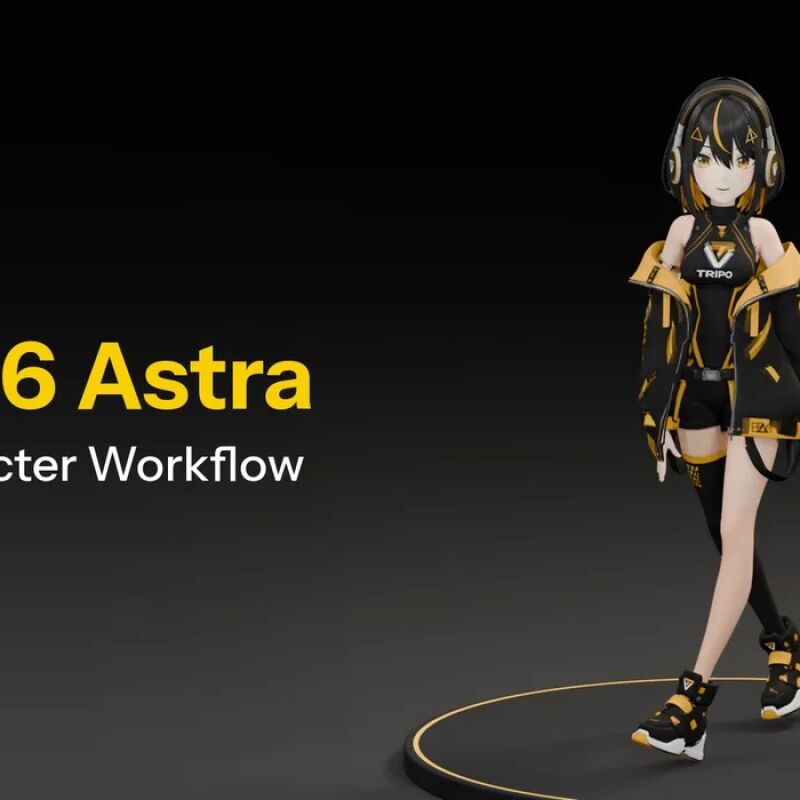
Generative 3D workflows are evolving from isolated model creation to integrated asset pipelines. Tripo's latest 3D-native foundation model, P2.0, is designed to generate triangle or quad-based meshes with features such as adjustable polygon density, part separation, Smart UVs, and regional mesh editing. When paired with Astra, these assets can be assembled, rigged, animated, and integrated into interactive scenes using professional software like Blender and Unity. This division of labor allows creators to focus on specific components while Astra handles the coordination of downstream tasks, ensuring that the generated geometry supports rigging, animation, and real-time production requirements effectively.
Post on X: https://twitter.com/luccacerf/status/2096308567863079420
The workflow operates by generating individual parts separately to give creators precise control over shape and detail. For example, a creator can generate a character's body, head, and hair as distinct assets using Tripo P2.0 or the H3.1 model, which focuses on high-fidelity details. Astra then assists in assembling these components within Blender, managing the transition to rigging and animation. This modular approach allows users to refine or regenerate specific components without restarting the entire asset generation process. Astra's capability stems from reasoning about 3D tasks and executing code or scripts to manipulate assets, making it a powerful tool for coordinating complex multi-step processes in established 3D environments.
Post on X: https://twitter.com/Stefan_3D_AI/status/2096481425050743048
Practical applications of this workflow have already emerged in the community. Creator Ring Hyacinth used Nano Banana for reference images, Tripo P2.0 for modeling, and Codex to build an Alice in Wonderland scene with effects and interactions. Similarly, Lucca Cerf, who has no background in game development or design, used an Astra to Tripo P2.0 to Blender to Unity pipeline to build a World of Warcraft fan game. By relying on just three prompts, Cerf completed the project in approximately 90 minutes. These examples demonstrate that the combination of Tripo and Astra enables individuals without prior 3D experience to quickly create complex, interactive scenarios and playable prototypes.
The technical specifications of Tripo's models are tailored for production readiness. The P series optimizes mesh structure, topology, and editability, while the H series prioritizes fidelity for complex shapes. Users can manage polygon density, choose between triangle or quad topology via Smart Mesh, and generate textures and materials. Automatic rigging and animation features are available for characters, and export settings allow for precise control over scale, orientation, and pivot points when moving assets into Blender or game engines. This level of control ensures that the generated assets meet the technical standards required for real-time engines and professional DCC applications.
Quality control remains a critical aspect of the workflow, as AI accelerates creation but does not eliminate the need for artistic judgment. After assembly, creators must review proportions, alignment, silhouettes, and connections between components. Animation requires evaluating deformation in areas such as the shoulders, elbows, knees, and facial expressions. While the workflow fits early-to-mid production stages like ideation, prototyping, and previz, professional studios may still refine hero assets in DCC tools. The goal is to make high-quality 3D generation accessible without requiring every creator to become a 3D specialist, allowing artists to focus on creative direction and integration into cohesive artistic systems.