Blog
 Public
- 28 Oct, 2026
Narrative Depth: A Practical Guide for Game Developers
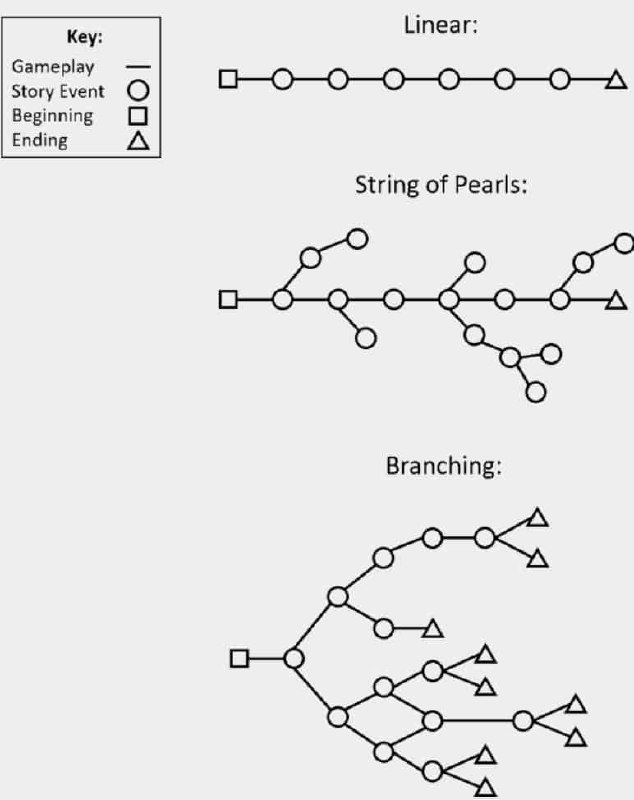
Developers often worry about whether a game requires a complex plot, but story is not a binary choice; it is a spectrum. While "story" typically implies plot with events and dialogue, games also rely on worldbuilding, which includes setting, tone, rules, and history. Even without a traditional narrative, visual elements like colors, names, and sound effects communicate context to players. This distinction is crucial because every game possesses a world, regardless of whether it features a structured beginning, middle, and end. Understanding this difference allows creators to decide intentionally how much narrative depth their specific project actually requires.Environmental storytelling is a unique tool for video games, allowing narrative delivery purely through space and setting rather than dialogue or narration. For instance, the arrangement of objects in a room can reveal a character's history or urgency without a single line of text. This approach lets players infer details, such as a hasty departure, simply by observing the environment. Successful games use various points on the narrative spectrum, where each level builds upon the previous one. A full narrative still demands a consistent theme, while even a discovered story requires a clear premise. Choosing the right level ensures that the narrative elements support the gameplay without becoming a burden on the development pipeline.Increasing narrative complexity significantly impacts planning across writing, art, and logic. Writing demands escalate with branching paths: every meaningful choice requires multiple versions of subsequent events. Art requirements grow as well, necessitating distinct locations, character expressions, and scene-specific assets. A discovered story needs objects that feel personal, while a full narrative requires art for every scene. Logic systems must track when story elements appear and what the game remembers. In traditional engines, this involves scenes, triggers, and saved variables. Even when using AI tools, developers must explicitly define these rules, such as displaying specific dialogue only if a key has been found, to ensure a consistent player experience.Before building, developers should answer key questions about their narrative scope to avoid scope creep. There is no single correct amount of story, only the amount appropriate for the specific game. The recommended approach is to sketch the world on a single page and determine the necessary narrative depth before starting production. This pre-planning helps align writing, art, and technical logic from the start. If players want more content later, additional story elements can be added in updates. By making a deliberate choice about narrative depth, developers can create a cohesive experience that balances creative vision, technical feasibility, and resource constraints.

- Public
- 28 Oct, 2026
Game Terrain Basics: Tiles, Heightmaps, Voxels, and Procedural Generation
Video game terrain serves as the foundational surface for player movement and environmental context. It is not just visual scenery but a critical design tool. It dictates navigation paths, visual horizons, and the overall mood of the game world. While terrain often mimics natural surfaces like rock, sand, and soil, it can also represent human-made structures such as cracked pavement. Effective landscape design involves the purposeful shaping of land to support specific player experiences and movement dynamics. This makes terrain an essential component of level architecture rather than a static background element.In two-dimensional game development, terrain is typically constructed using a tile-based system. This approach utilizes small, regular images arranged in a grid to form the complete level map. Individual tiles, such as grass, dirt, or water, are reusable assets that define both the visual appearance and the functional properties of the environment, including walkability and collision boundaries. This method is particularly efficient for top-down and side-view games, allowing developers to build complex levels quickly from a limited set of components. The grid structure ensures that each tile snaps into place, providing a consistent and manageable framework for level design and asset management.Three-dimensional terrain frequently relies on heightmaps, which are grayscale images where pixel brightness corresponds to elevation. In this system, white pixels represent high points, black pixels indicate low areas, and gray values denote intermediate heights. The game engine interprets this data to deform a flat grid into hills and valleys. While heightmaps are computationally efficient and easy to edit, they possess a significant structural limitation: each map point can only hold a single height value. Consequently, heightmaps cannot represent complex geometries such as caves, tunnels, or overhangs where ground exists above other ground, restricting their use to open, non-overlapping landscapes.For environments requiring caves, overhangs, or destructible ground, voxel systems offer a more flexible solution. Voxels treat the world as a three-dimensional grid of tiny cells, each designated as either solid or empty. This structure enables the creation of floating islands, underground tunnels, and terrain that can be dug or destroyed. Historically, voxel systems were avoided due to their high computational complexity and performance costs. However, recent advancements in AI-assisted tools are beginning to make these approaches more accessible, reducing the technical barrier for implementing complex, interactive terrain in modern game engines.Surface detailing is achieved through splatmaps, hidden textures that dictate material placement and blending. A splatmap typically uses four color channels, each assigned to a specific material like grass, soil, rock, or sand. The intensity of each channel determines the visibility of that material, allowing for smooth transitions between surfaces where channels overlap. Many development tools automate this process by applying materials based on terrain rules, such as placing rock on steep slopes. Furthermore, systems can automatically decorate regions with themed sets of plants and textures, creating distinct biomes without manual painting.Procedural generation utilizes mathematical noise to create terrain via code. Noise provides smooth, random-looking values that can be interpreted as heights to generate hills. Layering multiple noise scales combines broad hills with smaller bumps for a more natural appearance. Additional noise patterns can determine moisture levels, influencing the placement of forests, deserts, or snow. This method allows for infinite world generation, calculating areas only as the player approaches. However, noise-based terrain lacks spatial coherence between distant areas, often requiring significant tweaking to avoid repetitive patterns. This makes it best suited as a starting point for smaller projects or game jams.
- Public
- 28 Oct, 2026
Super Mario 64 Mixed Reality Mod for Pico: AI and True Stereoscopic Rendering
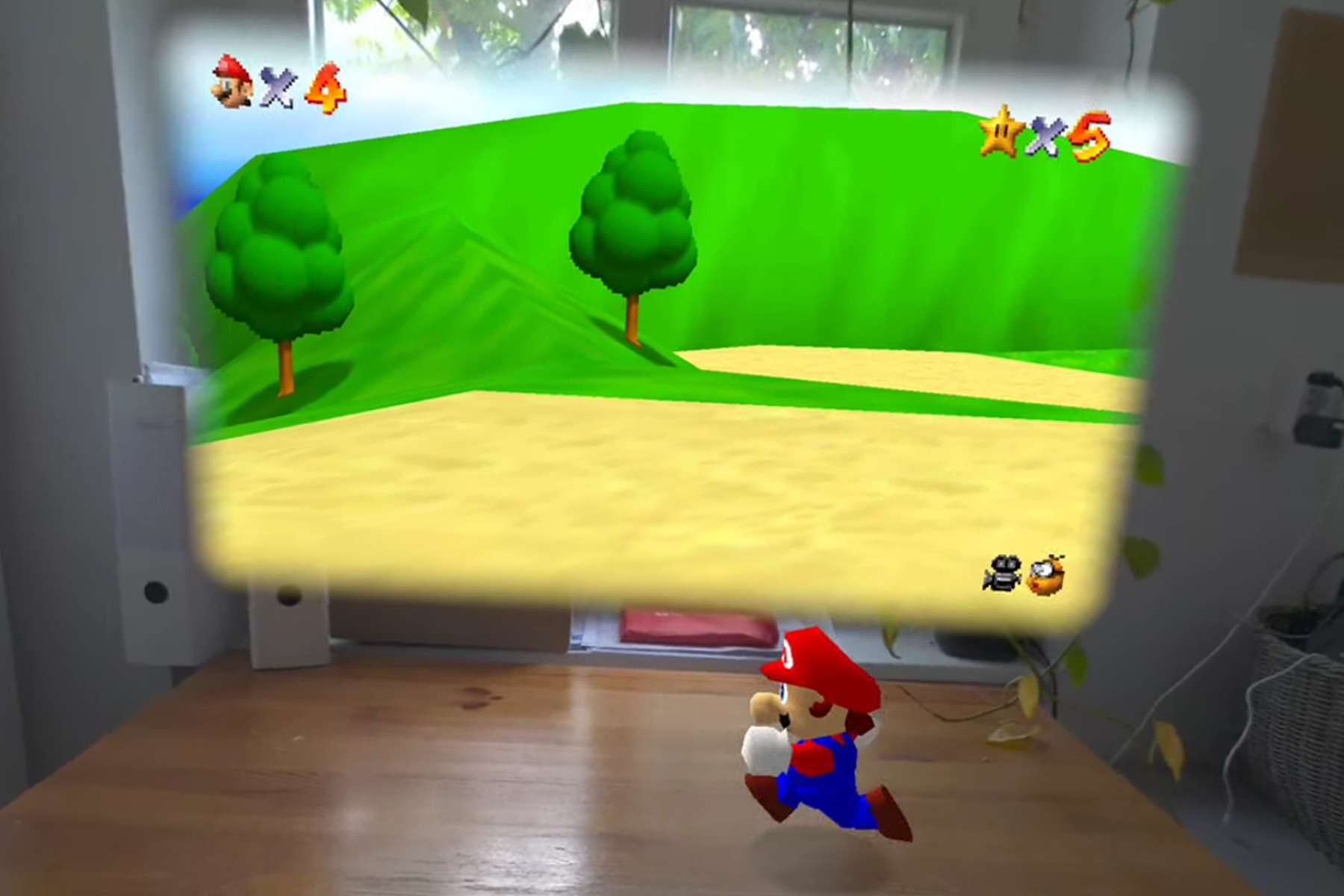
XR creative technologist Lucas Martinic has demonstrated a mixed reality mod of Super Mario 64 running on Pico headsets. The project transforms the 1996 classic into a floating 3D window. Users can physically interact with the game world: for example, pick up Mario from the Mushroom Kingdom and place him on a real-world table. The effect relies on AI-assisted coding and a decompiled version of the original game. This creates a seamless bridge between the digital platformer and physical space. The mod is a significant step toward making legacy 3D games accessible on modern spatial computing hardware, without relying on traditional, often flawed, porting techniques.Photo: Lucas MartinicThe development process began by referencing Jonas Jakobi's 2023 Super Mario 64 implementation for Quest 3, but Martinic chose to start from scratch using a decompiled version of the source code. He used Claude's Opus 5.5 model alongside PICO CLI, a command-line toolkit that connects AI coding assistants to Pico's spatial computing and XR development tools. A key technical advantage is the absence of stereoscopic hacks such as alternate frame rendering or depth buffer extrapolation. These techniques are common in VR ports but often yield suboptimal visual results. Instead, the mod achieves true stereoscopic rendering and runs natively at 90fps. No specific release date has been announced, but Martinic said he will share more details on his website and GitHub soon.
- Public
- 28 Oct, 2026
GPU Memory Limits per Workload in Kubernetes with CUDA 13.4 and KAI Scheduler
AI workloads often require only a fraction of a GPU, yet assigning entire devices leads to idle capacity and inefficient infrastructure use. NVIDIA GPUs support various sharing mechanisms, including Multi-instance GPU (MIG) for hardware isolation, time-slicing for sequential process execution, and Multi-Process Service (MPS) for concurrent execution in separate address spaces. While MPS allows compute sharing, it previously lacked strict memory boundaries. CUDA 13.4 addresses this gap by introducing a new time-sharing mode that enforces memory limits transparently to the application, ensuring that each workload operates within defined memory constraints without requiring code changes.Figure 1. Time-slicing shares GPU time. SM-sharing shares its streaming multiprocessors (SMs)Implementing these capabilities in a Kubernetes cluster requires node-level coordination independent of the scheduler. The open-source gpu-fractioning operator, hosted under the KAI Scheduler organization on GitHub, runs alongside the NVIDIA GPU Operator to handle this configuration. It performs three critical functions: reading pod annotations to determine memory and compute requirements, configuring the assigned GPUs to enforce these limits, and managing the transition between different sharing modes. This operator ensures that the hardware respects the logical boundaries defined by the cluster scheduler, bridging the gap between high-level scheduling decisions and low-level GPU execution.The workflow begins with developers specifying resource requirements and modes via pod YAML annotations. The scheduler then selects appropriate GPUs, records the memory allocation and compute-sharing mode in per-container pod annotations, and assigns the workload. The gpu-fractioning operator reads these annotations and configures the GPUs accordingly. Any Kubernetes scheduler capable of writing these annotations can enforce GPU fractions, provided it adheres to two rules: selecting GPUs with sufficient free memory and avoiding the mixing of compute modes on a single device. KAI Scheduler is the first to integrate this feature, introducing a GPU-sharing mode called NvFractions starting with version v0.18.0.KAI Scheduler's NvFractions mode allows administrators to define fractional workloads using four key annotations that address memory requests, growth limits, compute sharing modes, and device count. Memory requests can be specified as absolute sizes using standard Kubernetes units or as portions of a GPU using the gpu-fraction annotation. A new capability allows workloads to declare a guaranteed minimum request and a maximum burst limit, which is optional and defaults to the request value if omitted. Portion limits must exceed the gpu-fraction and remain below 1. Compute sharing is now explicit and set per container, allowing choices between sm-sharing and time-slicing.A shared GPU operates in only one compute mode at a time, so KAI Scheduler prevents placing workloads with different modes on the same GPU, though a single node can host both modes across different devices. For multi-GPU setups, the gpu-fraction-num-devices annotation specifies how many devices the workload spans, with the memory request applying to each device individually. For example, a 40Gi request with four devices allocates 40Gi on each GPU. This setup is ideal for inference servers that need guaranteed memory per GPU and can burst when neighbors are idle, utilizing sm-sharing for trusted workloads that run concurrently in a single error domain.Conversely, time-slicing is suitable for development or batch jobs such as notebooks and small fine-tuning runs, where isolation is preferred. In this mode, each workload gets its own error domain, meaning that a crash in one job does not affect the others. A workload can request half of two GPUs with a limit to grow to 80% when memory is available. Running nvidia-smi inside the container will display the fractional memory share for each assigned GPU. Both KAI Scheduler and the gpu-fractioning operator are available on GitHub under the KAI Scheduler organization, with detailed installation and configuration guides for all sharing mechanisms.
- Public
- 27 Oct, 2026
Material Maker 1.8 Released with New Trimsheet and Auto Export Nodes
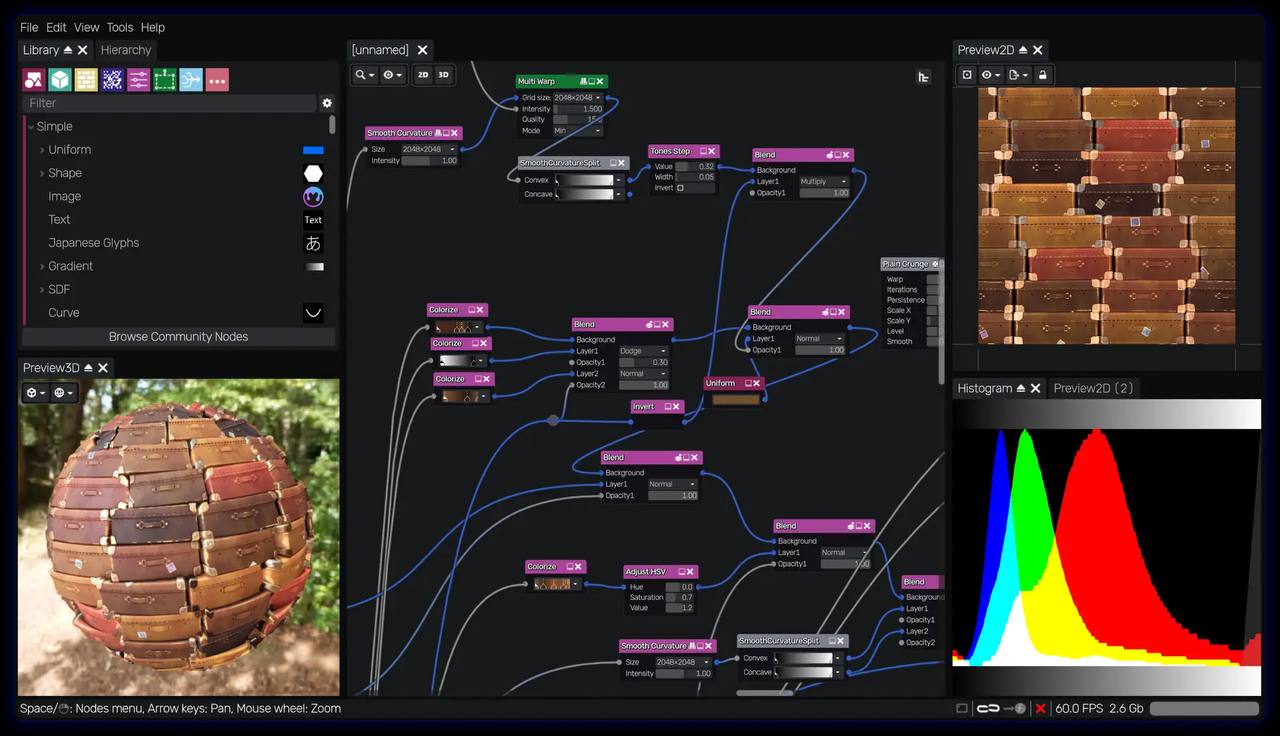
Rod Zilla has released version 1.8 of Material Maker, an open-source node-based software designed for procedural material authoring and 3D texture painting. Built on the Godot engine, this tool serves as a free alternative to industry standards like Substance 3D Designer. The update focuses on enhancing workflow efficiency for game artists by introducing specialized nodes that streamline the creation and export of texture assets directly into game engines.The primary addition in this release is the Trimsheet node, which allows users to generate trim sheet textures specifically for game applications. This feature addresses a common need in game art pipelines where repetitive textures are packed into single maps for efficient rendering. Alongside this, the new Auto Export node automatically re-exports texture maps whenever the underlying node graph is updated. This automation removes the manual step of triggering exports after every change, significantly speeding up the iterative design process for developers working with complex procedural setups.Additional improvements include a Crop node and a high-quality Gaussian Blur node, expanding the library of available tools for texture manipulation. The user interface has also been refined: search now works not only across top-level nodes but also within sub-nodes, which makes navigating complex graphs easier. A new UI theme with a custom base color option provides further customization. The software continues to support exporting PBR texture maps with ready-made templates for Unity, Unreal Engine, and Godot, ensuring seamless integration into major game development environments.Material Maker 1.8 is available for download on Windows, Linux, and macOS. The source code is hosted on GitHub under the MIT license, which guarantees full transparency and allows the community to contribute to the project. Compiled binaries can be downloaded for free from the developer's itch.io page. Ongoing development can be supported through Patreon or by purchasing the software on Steam. The tool remains a robust option for artists seeking a capable, free solution for procedural texture generation and 3D painting without proprietary licensing restrictions.

- Public
- 26 Oct, 2026
GHARP enables real-time 3D head animation on mobile devices
Apple researchers have introduced GHARP, a novel method for animating 3D human heads in real time using a few input images and a driving expression signal. The core innovation lies in splitting the process into two stages: an offline identity stage that builds a detailed representation of the subject's geometry and appearance, and a runtime animation stage that predicts expression-dependent residuals. This separation allows the identity stage to be computationally expensive, while the animation stage uses a lightweight network optimized for mobile devices. This creates a favorable trade-off between visual fidelity, quality, and runtime performance.The animation stage operates within a semantically structured latent space derived from a pretrained reconstruction model. This approach ensures that expression changes remain spatially contained, making the prediction of residuals highly efficient. The reconstruction prior provides a consistent spatial layout, which facilitates the fusion of multiple input views into a compact, fixed-size canonical Gaussian representation. By leveraging this structured space, the system can process complex facial movements without requiring heavy computational resources during the rendering phase, maintaining the high frame rates needed for interactive applications.A significant challenge in expression-driven avatar methods is that expression codes typically describe only the face, omitting body pose and clothing position. This omission leaves these regions underspecified, leading to an ill-posed mapping where the animation network might resort to averaging conflicting body appearances, resulting in visual blur and temporal flicker. To address this, GHARP incorporates a body alignment network that learns to align the person's body in the target image with the input reference images. This alignment removes ambiguity from the training signal, ensuring that non-facial elements remain stable and consistent during animation.The method achieves state-of-the-art quality on the Ava-256 benchmark while significantly improving efficiency. On an A100 GPU, GHARP runs up to 13 times faster than comparable methods while utilizing 8 times fewer Gaussians. This reduction in computational load and increase in speed makes the technology viable for real-time applications on consumer hardware. The combination of high-quality reconstruction and efficient runtime processing positions GHARP as a practical solution for developers seeking to integrate realistic, real-time head animations into mobile and XR platforms without compromising performance.

- Public
- 26 Oct, 2026
Adobe Substance 3D Painter 12.2: New Cage Painting and Polygon Fill Features
Adobe has released Substance 3D Painter 12.2, the latest version of its professional 3D texture painting software designed for games, animation, motion graphics, and VFX. The update focuses on improving the texture baking process with a new brush-based workflow built specifically for resolving baking cage issues. The main goal is to streamline how artists handle high-poly assets that extend beyond the boundaries of the automatically generated cage. The new correction method is more intuitive and precise than the previous global adjustment settings.The core innovation in this release is the cage painting workflow, which allows users to paint directly onto the mesh to adjust the cage fit. Instead of relying solely on changing a global distance offset, artists can now use the Paint, Eraser, and Polygon Fill tools to modify the cage geometry locally. This makes it significantly easier to fix specific areas where parts of the high-poly model fall outside the cage during baking. It is worth noting that this is the second major workflow improvement Adobe has introduced this year, following version 12.1, which enabled artists to paint to control normal direction and fix artifacts in baked maps.Significant updates have also been applied to the Polygon Fill tool, which now features two new selection modes for polygon loops. The "Polygon loop fill" mode allows users to fill a complete loop of quads with a single click, while the "Partial polygon loop fill" mode enables dragging out a rectangular patch of quads on the mesh surface. Furthermore, the tool now supports all blending modes available in the layer stack, providing greater flexibility in texture application. The interface has been reworked to improve workflow efficiency, with a key change being that non-visible polygons are discarded by default. This prevents accidental filling of the back side of the mesh, reducing common errors during the texturing phase.Additional workflow improvements include a feature that highlights the corresponding geometry in the 3D viewport when hovering over an entry in the Texture Set list, aiding in navigation and selection. The real-time viewport now supports order-independent transparency, which effectively prevents the flickering that often occurs where transparent or translucent surfaces overlap. Substance 3D Painter 12.2 is available for Windows 11, RHEL 8.6/9.2+, Ubuntu 22.04+ Linux, and macOS 15.0+. Perpetual licenses are available via Steam for $199.99. The software is also accessible through Adobe Creative Cloud subscriptions, with the Substance 3D Texturing plan costing $24.99/month or $249.99/year, and the Substance 3D Collection costing $59.99/month or $599.99/year.
- Public
- 26 Oct, 2026
NVIDIA Minerva AIOps Platform Connects AI Factory Telemetry to Maximize GPU Efficiency
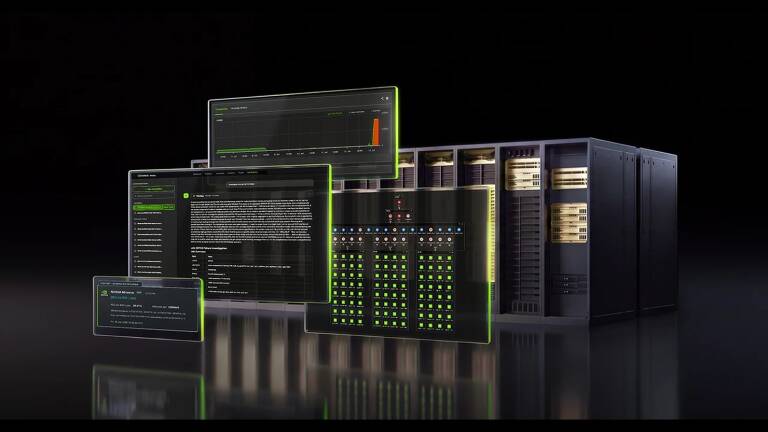
AI factories represent some of the most complex operational environments ever built, where hundreds of thousands of GPUs, NVIDIA Spectrum-X Ethernet fabrics, NVLink scale-up networks, and distributed schedulers operate in continuous lockstep. In synchronous distributed training, the entire job advances at the pace of its slowest rank, meaning a single degraded GPU, interface, or switch path can waste useful time across many healthy resources. The failures that hurt yield are often subtle, such as a GPU running slightly hotter than its peers, an NVMe device losing performance under sustained load, or a switch generating pause-frame storms. These signals rarely cross static thresholds individually but collectively create stragglers, extended step times, and delayed checkpoints, leading to significant production losses.Figure 1. NVIDIA Minerva AIOps observability platformDiagnosis is further complicated because evidence is split across different teams: network operators see interface counters, compute operators see node health, and ML teams see changing step times. This fragmentation turns triage into a chain of dashboard searches and cross-team handoffs, potentially turning a contained fault into days of lost production time. NVIDIA Minerva addresses these gaps by collecting telemetry across the entire stack and mapping infrastructure to active jobs in a dynamic knowledge graph. It applies purpose-built machine learning to correlate dependent symptoms into high-fidelity incidents. An AI agent-powered assistant and an MCP server connected to external agentic tools provide a conversational path through this live evidence, with the primary goal of preserving effective GPU hours and keeping model training moving smoothly.Figure 2. NVIDIA Minerva topology graphRule-based monitoring struggles with "gray failures" where components remain available but exhibit issues only under load or in comparison with peers. Absolute thresholds often miss these shifts, while aggressive thresholds generate noise during normal workload changes. Scale amplifies this problem, as one physical fault can produce interface errors, congestion indicators, and GPU utilization changes that appear as unrelated events on separate dashboards. Minerva ingests metrics, logs, and topology from GPUs, Spectrum-X and NVLink switches, SuperNICs, DPUs, storage, NCCL, and schedulers. Auto-discovery supplies relationships that raw telemetry lacks, creating a knowledge graph that maps infrastructure, scheduler, and workload elements. This graph updates dynamically as jobs start, stop, or nodes are replaced, supporting navigation from a factory-wide view down to an individual interface.Figure 3. Proactive SuperNIC maintenanceThe topology graph transforms the investigation path by allowing operators to trace anomalies from an interface to its node, fabric path, and current job placement. Conversely, ML engineers can trace a job ID through GPU, host, NIC, and switch evidence. Minerva processes billions of metric and log data points per hour using supervised and unsupervised models. Supervised detection identifies known critical error patterns and associates them with remediation guidance, while unsupervised models learn normal patterns for hardware or logical components and compare them with relevant peers. Peer comparison is crucial because a measurement may look acceptable in isolation but anomalous in context, such as a GPU temperature within specification but significantly hotter than sibling GPUs under the same load. Multivariate models combine temperature, power, clocks, and utilization to detect degradation before outright failure.Logs receive similar treatment, with NLP-based anomaly detection surfacing previously unseen patterns and supervised matching identifying known critical errors. Detections can feed scheduler workflows to drain affected nodes before new jobs land on them or at safe checkpoint intervals. Topology-aware correlation connects detection to operator action by leveraging the knowledge graph to determine which events share a dependency path. Downstream symptoms are grouped into a single incident rather than competing for attention, collapsing redundant events and related metric series into one signal with affected topology and workloads attached. NVIDIA testing shows significant reductions in notified events and tickets for supported scenarios, allowing operators to begin with a much smaller search space for root-cause analysis.NVIDIA Minerva includes a native AI agent called Sherlock, grounded in live telemetry and the knowledge graph, which allows operators to query the system for root-cause analysis in human language. Sherlock can present supporting evidence and recommend remediation without requiring operators to know specific metrics or query languages, providing a route to domain knowledge that traditionally required specialist escalation. Additionally, Minerva's MCP server lets external agentic tools query the same operational context, enabling teams to incorporate live AI factory evidence into their own workflows. Mitigation actions can remain human-approved or be automated according to local policy and risk assessment. In a large AI data center, Minerva identified a single NVLink connection out of 400,000 interfaces losing bandwidth, allowing an SRE to drain affected nodes and restore full speed in minutes rather than hours.

- Public
- 26 Oct, 2026
Meta confirms decline in Quest sales and shifts its VR strategy toward breakthrough releases
Meta's latest quarterly report shows a notable decline in Quest headset sales, which led to a 6% drop in revenue for the Reality Labs division in the third quarter of 2026. The segment's total revenue came to $443 million. This decrease was partially offset by steady growth in AI glasses revenue, which points to a clear shift in consumer demand and corporate priorities. The financial data highlights that while VR hardware sales are slowing, the new AI-focused wearables are gaining traction, changing the revenue structure of Reality Labs.Based on materials from MetaIn response to these trends, Meta has officially changed its approach to developing VR hardware. CEO Mark Zuckerberg stated that the company will now ship new VR devices only after "major breakthroughs," similar to those seen in the Meta VR Glasses released this year. This strategy departs from the previous model of regular generational updates for consumer headsets. By tying releases to significant technological leaps rather than annual cycles, Meta is effectively stepping back from iterative improvements in favor of more impactful, albeit less frequent, product launches.Meta VR Glasses | Source: MetaThe company is currently prioritizing the path toward personal superintelligence and AI advancements, which have taken precedence over expanding VR hardware. Zuckerberg emphasized that while he believes VR is the necessary precursor to a future holographic experience blending the physical and digital worlds, the pace of investment in this area will be adjusted. The focus is now on delivering AI capabilities first, with VR serving as a foundational step rather than the primary immediate goal. This strategic pivot means that resources are being redirected from consumer VR content and hardware to the development of advanced AI systems and wearables.Looking ahead, the Meta VR Glasses, scheduled for launch in Spring 2027, are positioned as a key product for prosumers and professionals at a price of $1,300. The device is viewed less as a traditional VR headset and more as a stepping stone toward augmented reality. Meanwhile, the future of the game-focused Quest platform remains uncertain, as Meta holds off on iterative VR releases. Although potential discounts on Quest 3 and 3S models during the holiday season could provide a temporary sales boost, the company has already pulled most of the funds dedicated to large-scale VR content, confirming a long-term commitment to its new AI-centric direction.
- Public
- 26 Oct, 2026
The OpenXR Spatial Containers standard unifies volumetric multitasking
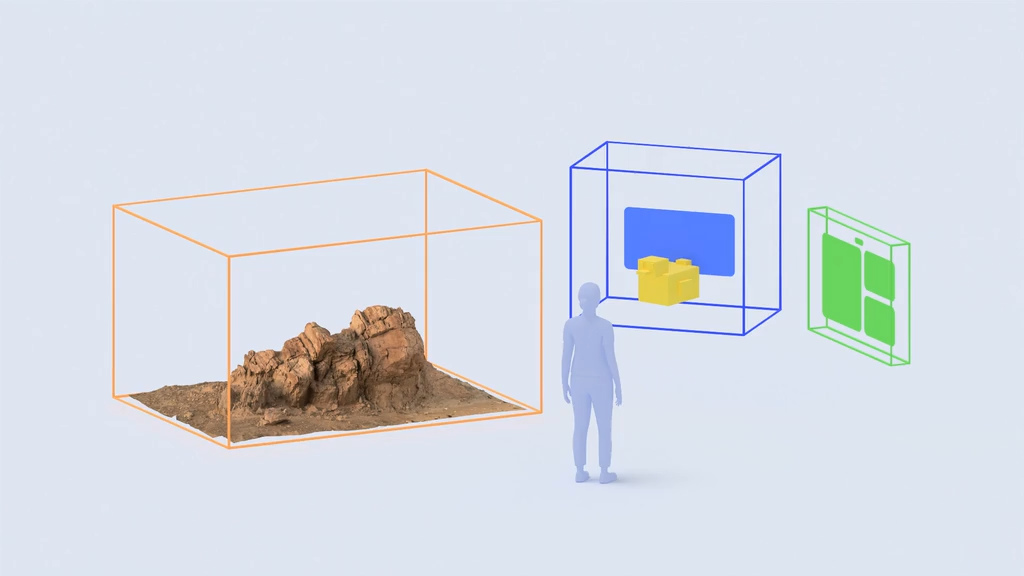
Khronos has released new OpenXR Spatial Container extensions that standardize system-managed spaces for displaying volumetric 3D content. This approach mirrors how traditional desktop operating systems manage 2D applications within windows, but applies the concept to immersive 3D environments. OpenXR remains the dominant open API for AR, VR, and MR development, managed by the consortium behind OpenGL and Vulkan. Its core goal is to let developers build applications that run across different headsets without relying on proprietary APIs. Currently, nearly all major headsets, engines, and runtimes support OpenXR, with the exceptions of Apple Vision Pro and PlayStation VR2 on the PS5.OpenXR Spatial Containers, as shown at SIGGRAPH 2026.The new extensions enable developers to create applications that switch between multitasking modes and full immersion. A single application can host multiple Spatial Containers, whose positioning is controlled by the system. A developer can specify a preferred location for the containers or leave their placement to the system, for example, so that they follow the user during movement. Architecturally, this is similar to the Shared Space model on Apple Vision Pro, where windowed and volumetric apps coexist in a system-managed environment before transitioning to full immersion. It also aligns with the design of Pico OS 6 for the upcoming Pico Space Pro, which uses a unified rendering architecture called the Pico Spatial Engine to run 2D and 3D apps side by side over virtual or passthrough backgrounds.This standardization addresses a significant limitation of current market leaders such as Google's Android XR and Meta's Horizon OS. While these platforms support multitasking of 2D apps, they currently restrict users to running only a single 3D app at a time. The introduction of Spatial Containers offers a path to lifting this restriction. Jared Finder, the XR platform and SDK lead at Google, confirmed in the official Khronos announcement that the company is excited to bring Spatial Container support to Android XR. For Meta, these extensions present an opportunity to revive the concept of Augments, a category of system-managed 3D apps announced for Quest 3 in 2023 but later effectively cancelled.Meta had previously announced that the Augments feature was being rebuilt from scratch after the initial approach proved insufficient. Recent updates to Horizon OS and its developer tooling have focused on overhauling spatial window management and improving 3D apps, suggesting that the company may use the new OpenXR extensions to deliver on the original vision of Augments. Originally, the plan was to build these extensions using Meta Spark Studio, a now-defunct tool for creating AR experiences, which supported importing 3D assets and implementing advanced functionality via JavaScript. Although Meta has not explicitly committed to supporting the extensions in its official statement, the technical alignment with its ongoing development priorities makes this a plausible direction for its ecosystem.The specifications and sample code for OpenXR Spatial Containers are now available to developers. The Khronos OpenXR Working Group is also actively working on additional extensions that will allow applications to use a system-provided renderer optimized for specific hardware, ranging from high-performance headsets to low-power devices. The group expects implementations of these extensions to begin rolling out across the OpenXR ecosystem within the current year. This is a significant step toward a unified standard for volumetric multitasking, one that could reduce fragmentation and enable more complex, multi-app spatial experiences across diverse hardware.
- Public
- 25 Oct, 2026
The Sixth Godot XR Community Game Jam Wraps Up: 28 Entries on the Theme "Adrift"
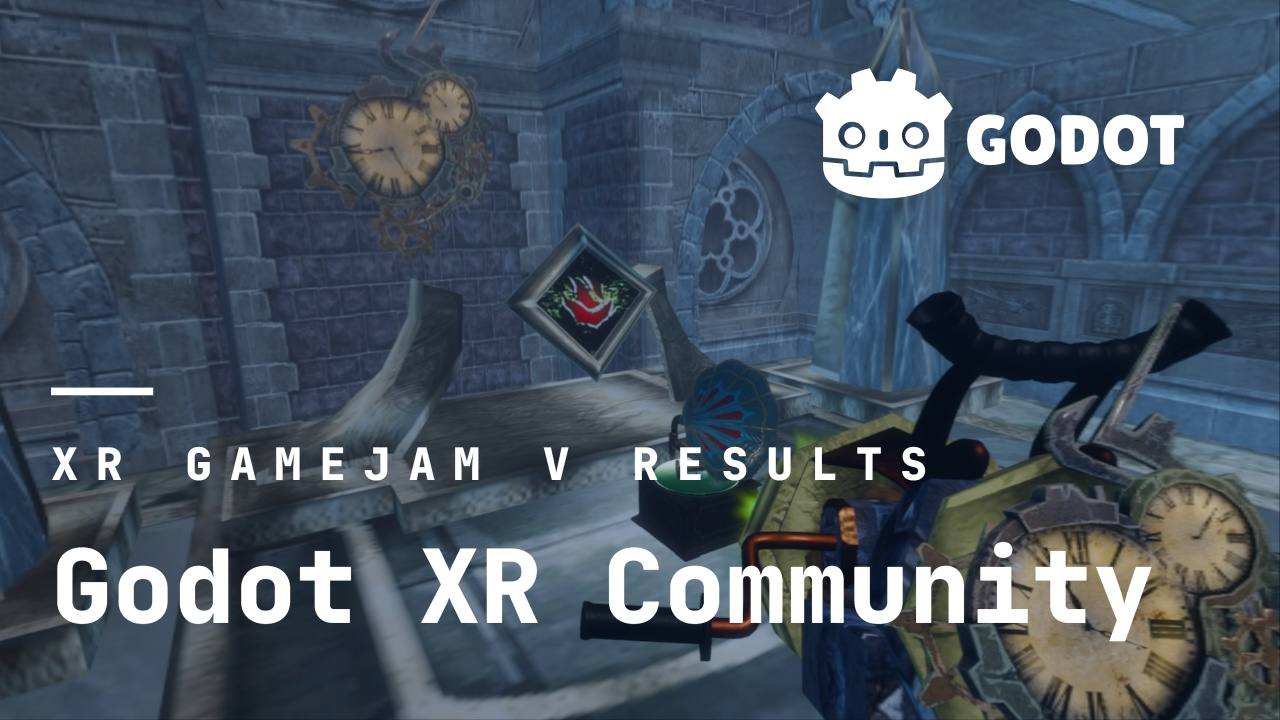
The sixth season of the Godot XR Community Game Jam took place between September 21 and October 5, 2026. Although participant numbers decreased from 98 to 85, the number of submitted projects grew from 22 to 28 games. This indicates a higher concentration of finished, high-quality entries rather than a large pool of unfinished attempts. The central theme of this cycle was "Adrift," which inspired a variety of creative interpretations across the submitted games.The top five entries showcased diverse mechanics within the XR space. In one game, players had to physically pull levers to control a balloon, battling visualized air currents while shooting targets with a mounted cannon. Another offered a drone on a tether that gathered electricity from a storm to power a craft, creating a balance between energy collection and evasion. A physics-based tower stacking game placed players on an island, where they had to build structures from drifting flotsam with precise balance controls.A deceptively simple shooter involved popping balloons within a strict time limit, using earned currency to purchase upgrades like extra time or weapon capacity. This roguelike structure added strategic depth to the satisfying VR gunplay. The winning entry, Wavemaker by Unit327, allowed players to create waves in a pool to push boats through levels. Players could splash with their hands, throw plushies, or pilot a remote-controlled speedboat to manipulate water dynamics across increasingly difficult stages.The competition was intense, with Unit327 securing the victory against steep opposition. The organizers expressed gratitude to all competitors and voters for their contributions to the event. The next edition of the Godot XR Community Game Jam is currently penciled in for early April 2027. An exact date will be announced closer to the start of the event, allowing developers to prepare their projects for the upcoming challenge.