Blog
 Public
- 15 Sep, 2026
Godot CPU Rendering Optimization: How Profiling Turned Two Bottlenecks into a Major Performance Gain
Rendering optimization often looks like black magic from the outside, but the actual process is far more methodical than it seems. Godot's developers shared a detailed breakdown of how they optimize CPU code in the engine's renderer, using concrete examples from the past year. A key principle frames the whole effort: every engine has to balance work between the CPU and GPU, because final performance is always dictated by the slower of the two. No amount of CPU tuning can compensate for inefficient shaders. The engine team makes tradeoffs around this constantly: for instance, 2D batching slightly hurts GPU performance while massively improving CPU performance, and since 2D games tend to hit CPU limits first, batching is almost always a net win. In contrast, 3D games are usually GPU-bound, so Godot performs occlusion culling on the CPU to relieve the GPU. Every optimization also saves battery life on power-constrained platforms.The core loop for CPU optimization is straightforward: identify the bottleneck, understand the underlying system, make a change, then re-measure. Re-measuring matters because optimizations are frequently counter-intuitive. Adding a branch inside a loop to skip work seems faster, but it can block compiler vectorization and make things slower. Similarly, caching a value to avoid redundant calculation can backfire if the real bottleneck is memory reads: in that case, doing the work twice would be faster. Identifying the culprit is the hardest step, and it starts with a profiler. Godot ships two built into the editor: one for GDScript and one for the renderer. For engine code itself, though, developers need an external tool. The article uses Superluminal, a sampling profiler that attaches to a running Godot instance, records data as the engine runs, visualizes which code executes when, and recently gained Linux support. Godot also supports building with Tracy for tracing-based profiling.The first example came from a conversation with a developer working on Heidi's Legacy: Mountains Calling, who found Godot's animation code slow enough to cap content at around 20 animated characters. The setup involved an AnimationPlayer animating the vertices of a Polygon2D displayed on a Viewport on a Sprite3D, an unusual but not inherently expensive technique. Profiling a minimal reproduction (tested on a Ryzen 5 9600X) revealed the culprit immediately. The Polygon2D class was spending most of its time freeing the previous mesh surface and allocating a new one every single frame, because vertex data changes on the CPU each frame. A call graph and the "Source and Disassembly" view pinpointed the exact lines rebuilding the internal mesh, confirming the unnecessary churn.The fix exploited a low-level Godot API for manually updating vertex data in place. When the vertex count stays constant, there is no need to free and reallocate the mesh: you can simply upload new vertex data to the existing mesh. Most of the pull request involved deciding which cases were safe for in-place updates versus which truly required recreation. The result roughly tripled the performance of animated Polygon2Ds, cutting frame time from 35 ms down to 13 ms and lifting the scene from 28 FPS to 83 FPS. After the change, rendering accounted for about 50% of frame time, animation about 30%, and the Polygon2D update 20%. The author noted further gains are possible (re-uploading only changed mesh regions instead of the full mesh), but such partial updates need a real test case to guide them, and since this game animates nearly every vertex each frame, tracking partial changes would likely be a net negative.The second case targeted Godot's D3D12 shader compilation pipeline, which was investigated after reports of slow loading. The pipeline's slowest step was transpilation, and switching from Vulkan to DXIL carried a noticeable loading-time penalty because Vulkan can consume SPIR-V directly. Tracing in Superluminal exposed the reason: heavy multithreading with large gaps where only a couple of threads were active. Zooming in showed the gaps were caused by threads all requesting more heap memory from the OS: they were stalled waiting to allocate from a single global heap. The fix gave each thread its own heap to allocate from instead of repeatedly hitting the shared global heap, eliminating the stalls. This saved 11 seconds of load time in the TPS demo, time during which the CPU had been completely idle. Both examples underscore the same lesson: with the right tooling, the solution becomes obvious once the problem is properly identified.
- Public
- 15 Sep, 2026
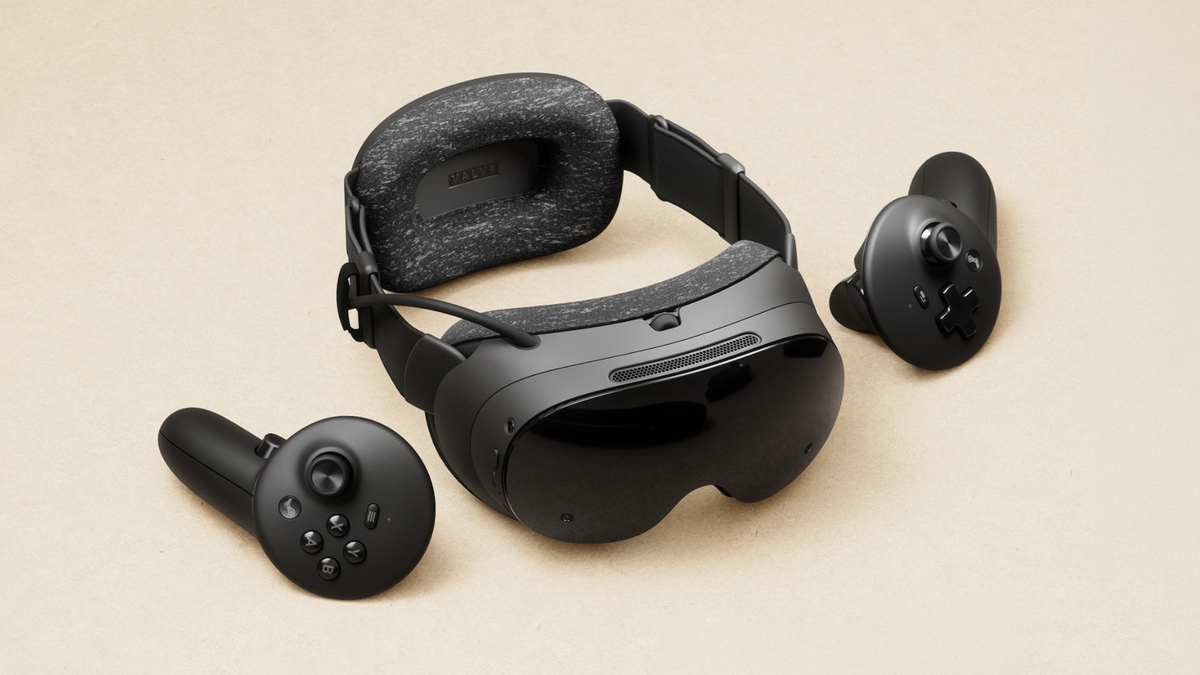
Steam Frame costs $1059 and ships with a standalone version of Half-Life: Alyx - reservations are now open
Valve has officially revealed the price of Steam Frame, its standalone "streaming-first" VR headset, and opened reservations for it. The headset ships in two storage variants: a 256GB model for $1059 and a 1TB model for $1299. Both SKUs include the headset, tracked controllers, and a USB dongle. There is also a microSD card slot, so users are not limited to onboard storage. Reservations are open now, but this is not a conventional preorder: Valve is using a reservation system similar to its Steam Machine launch to curb scalpers.The headset runs Valve's Linux-based SteamOS, adapted for VR. It can run compatible Linux and Windows games locally, including SteamVR titles, using Proton for Windows compatibility and FEX to translate x86 code for its ARM processor. Android games run through a separate compatibility layer called Lepton, letting developers distribute mobile-optimized Android builds directly through Steam. The system does not require or support base stations: it tracks itself and its controllers using four onboard grayscale tracking cameras, two of which handle monochrome passthrough, and it also has eye tracking for foveated streaming.The biggest announcement alongside the price is a native 64-bit ARM build of Half-Life: Alyx optimized to run standalone on the headset, meaning the game needs no PC. Valve says fully integrating eye-tracked foveated rendering was the key breakthrough, combined with over a year of Vulkan graphics driver work, SteamVR tweaks, and Alyx optimizations that also carry over to the Windows PC build, including depth reprojection. Valve made no content changes to the game, so Workshop items work automatically, and Steam Cloud save support lets players switch between standalone and PC VR streaming at will. Alyx is bundled with every Steam Frame for those who don't already own it.The official Steam Frame ergonomic accessory kit, sold separately.Valve has also tested and confirmed 70 other VR titles that run and perform well standalone, granting them a "Steam Frame Verified" tag. Out of the box, the headset offers monochrome passthrough, grayscale tinted blue: it is sharper than Quest 2 in angular resolution but blurrier than Quest 3 and lacks color. To address this, Valve partnered with Arcturus Vision (formerly Arcturus Industries) on a $149 addon that attaches to the PCI-E expansion port. The Arcturus Vision Camera weighs 10 grams and uses dual 32-megapixel Sony RGB sensors for high-quality color passthrough, working automatically across all passthrough apps. The camera ships when Steam Frame does, priced at $149 across the US, Canada, EU, UK, Australia, New Zealand, Switzerland, Japan, Hong Kong, Taiwan, and South Korea.Valve's power supply, sold separately.The Arcturus Vision Camera attached to Steam Frame.For wireless PC VR streaming, Steam Frame creates a direct 6GHz Wi-Fi 6E connection between the headset and the included USB dongle, and uses foveated streaming. Valve has added two further technologies since the reveal to improve stability and quality, though specifics are not detailed in the source. The reservation flow runs a randomized queue: Valve opens registration now, then at 10am Pacific Time on Thursday, 72 hours later, it randomizes existing reservations into a virtual queue, granting equal odds to everyone who registers within the window. Purchase offer emails then go to those whose queue position meets current stock; everyone else waits on an automatic waitlist, with new registrations sent to the back. Valve is not disclosing the number of units produced or the ongoing production rates.

- Public
- 14 Sep, 2026
Zerply, the portfolio and recruitment site for VFX, is shutting down on September 28 after 16 years in operation
Zerply, the long-running portfolio and recruitment site for the VFX and animation industry, is shutting down later this month after 16 years in operation. The closure was announced on the site itself last week, and the statement read, in part: "We ran out of time and resources to make it work. That's the whole story. We're sad to end it this way."Founded in 2010 by IT entrepreneur Christofer Karltorp and web developer Taaniel Jakobs, Zerply began as a general creative recruitment platform before specializing in VFX jobs four years later. It described itself as "show and tell for creatives in high-end VFX and animation," letting artists across film, broadcast, gaming and advertising build online portfolios. Studios could browse those profiles and post vacancies. Though dwarfed by LinkedIn for job hunting, users praised its community spirit.The shutdown has concrete deadlines, so artists with portfolios on the platform should act soon. Zerply will stop working on September 28, 2026, after which it becomes a static page and login is no longer possible. Users are advised to redirect their Zerply URLs to another online profile, such as LinkedIn, IMDb, Vimeo or FrameRate accounts, before that date. The team says it will keep redirects running "for at least a year" after shutdown, since many people have zerply.com links on their CVs.Portfolio data can still be saved, but the window is tighter. Anyone wanting to export their profile data or uploaded assets must submit an export request by September 21, 2026, as the process is handled manually. Users can choose whether to include uploaded media assets, which is useful if the site hosts older demo reels or portfolio material no longer stored locally. Assets can also be downloaded individually until September 28. All user data on Zerply's systems and those of its providers will be deleted within 90 days of shutdown, and new signups plus recurring billing have already been turned off.
- Public
- 13 Sep, 2026
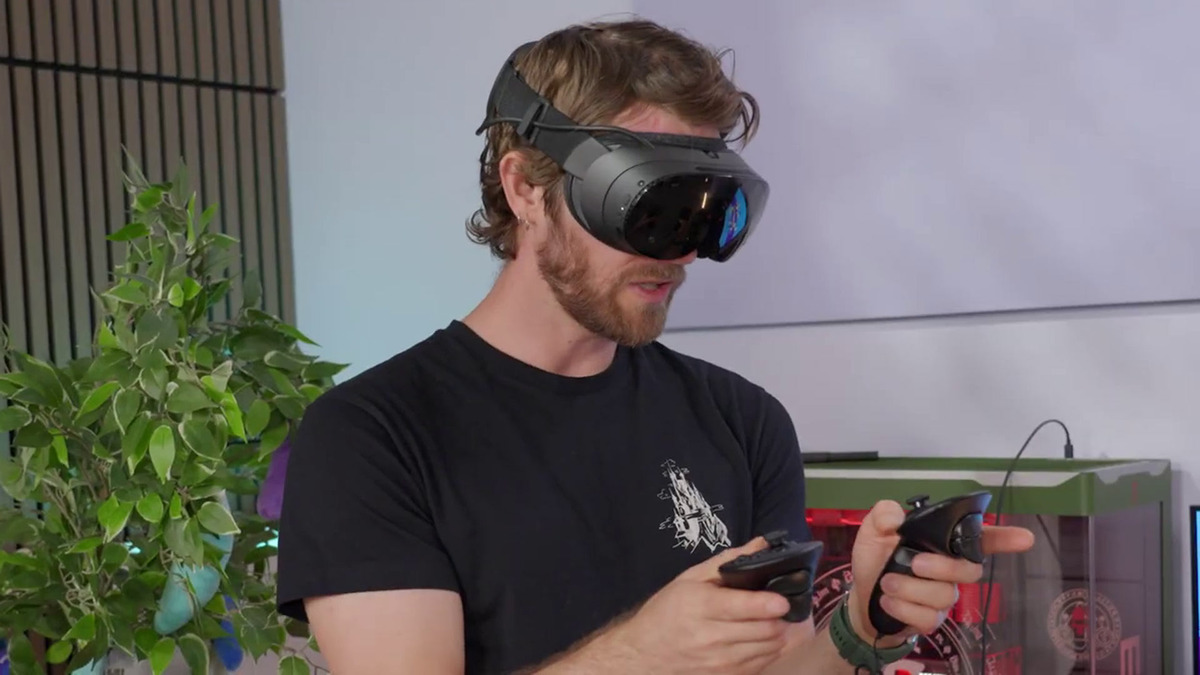
Linus Tech Tips leaks Steam Frame unboxing ahead of official release
Valve's first standalone headset is close to launch, and a premature video from Linus Tech Tips' side channel ShortCircuit bolsters that expectation. The channel accidentally published its unboxing and first impressions video, titled "Our first 30 mins with the steam frame," before quickly setting it to private. Users grabbed copies fast enough to rehost them across the internet, so a mirror of the deleted 17-minute video remains available.Linus' physical impressions largely line up with prior preview coverage. He found Steam Frame's feel essentially on par with the Valve Index, improved by better on-head weight distribution and imperceptible wireless streaming. The supplied WiFi PC dongle appears to seamlessly replace any need for a cable. He also called out perks like expandable SD storage and a physical interpupillary distance (IPD) lock that keeps the setting from getting thrown off during gameplay.The early hands-on wasn't without criticism. Linus was less enthusiastic about the controllers' ABXY buttons, color fringing on the LCD panels despite overall sharpness, and the headset's monochrome passthrough, which shows some obvious stitching lines. At the end of the video he notes that the main LTT channel will post a full review, which will likely arrive alongside other coverage, as long as it doesn't also break embargo.As leaks go, this one isn't especially severe: no worse than Valve leaking its own setup and unboxing video last month, or the flurry of backend changes the public could readily decipher, including a hint that Frame may ship with a free copy of Half-Life: Alyx. Two details still remain under wraps: the price and the release date.

- Public
- 13 Sep, 2026
Golf+ adds Immersive Putting, a mixed reality mode for Quest 3 and 3S
Golf+ has introduced Immersive Putting, a mixed reality mode that lets players practice putting with their own real-world golf club and ball instead of a controller. Powered by the headset's passthrough cameras, room-mapping, and depth sensing, the game maps a virtual green directly onto your physical surroundings and instantly calculates your swing along with the speed and trajectory of each shot. That real-world stroke is then carried onto the virtual green, complete with simulated contours, breaks, grain, and speed. After every stroke the feature delivers feedback such as start line, speed, pace, results, and proximity to the hole, plus trends that help players spot patterns and improve their form over time.The feature doesn't reach every Golf+ player by default and comes with several hard requirements. It runs only on Meta Quest 3 and 3S, since it depends on passthrough cameras and depth sensing that the older Quest 2 lacks. You'll also need your own putter and ball, plus a few feet of clean, clear space in a reasonably well-lit room. Golf+ itself is available on Quest for $29.99 with three included courses, is offered through the Meta Horizon+ subscription, and can now be wishlisted on Steam ahead of its upcoming release on that platform.
- Public
- 13 Sep, 2026
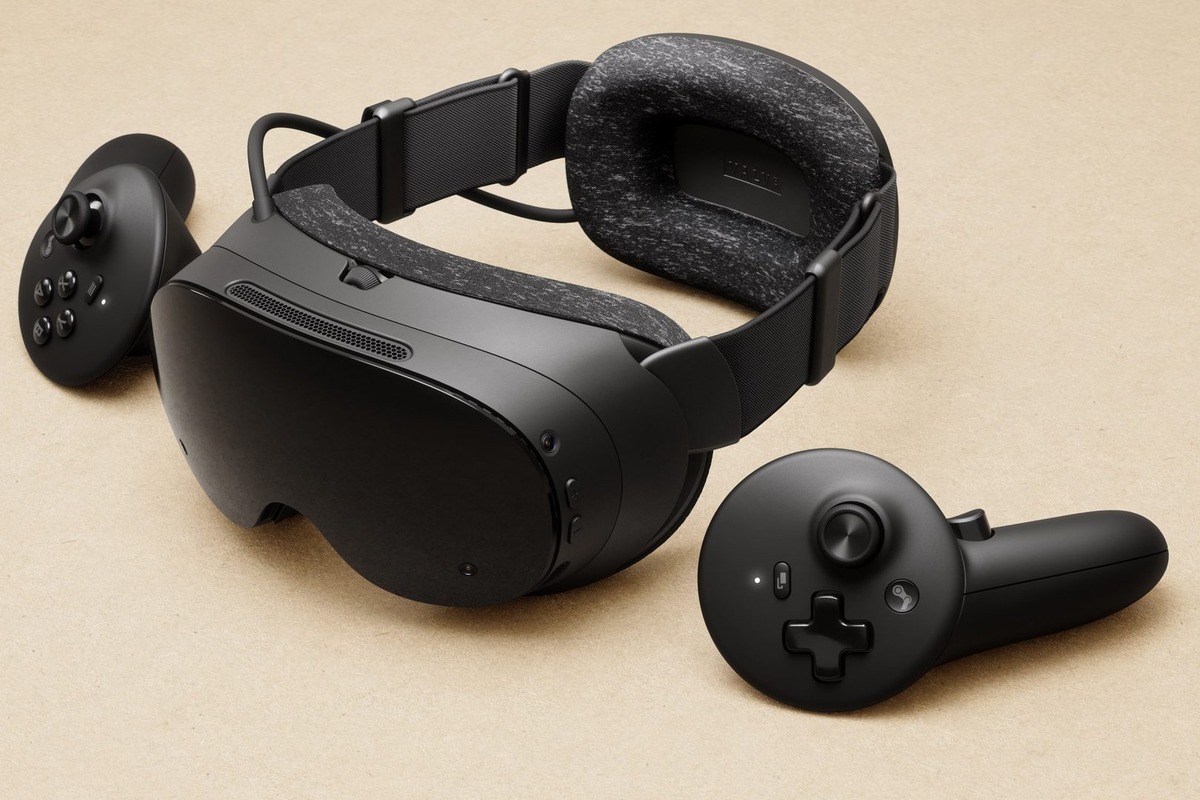
Valve releases SteamVR 2.17 to the stable channel ahead of the Steam Frame launch
Valve has promoted SteamVR 2.17 out of beta and released it to all users, a sign that the launch of its long-awaited standalone headset, Steam Frame, is drawing near. As of September 11, 2026, the update is no longer gated behind the beta branch, and the full changelog is available for developers and regular users to review.The headline change is a redesigned SteamVR Dashboard aimed at delivering a more VR-native experience. Users who opt into the Steam Client Beta get a more capable Dashboard with Steam Deck-style Quick Access controls, plus easier access to achievements, guides, and notes. Valve has also improved day-to-day usability: it simplified overlay management, made battery information more accurate, and added brightness controls.Courtesy of ValveThe update folds standard Steam features into the VR runtime, and Valve has been preparing more than just software. Alongside importing Steam Frame units into the US ahead of release, the company published a "Great on Frame" page listing optimized VR and non-VR titles guaranteed to run on the headset, and has committed to shipping Steam Frame dev kits so developers can optimize their PC VR games.Courtesy of ValveWhat remains unknown is price and an exact release date for Steam Frame. Valve has pointed to the ongoing global RAM and storage crisis as a factor, and given that the Steam Machine console launched at a higher-than-expected $1,050 last month, Steam Frame could ship at a similarly elevated price point.

- Public
- 11 Sep, 2026
Meta's "Project Phoenix" MR Headset Leaks Ahead of Connect
Images of Meta's "Project Phoenix" mixed reality headset appear to have leaked ahead of its expected unveiling at Connect later this month. Serial leaker Luna reportedly found video inside Quest's Horizon OS showing off the headset's prescription lenses, which are set to be released in partnership with Meta's official lens provider, Zenni Optical. It also delivers the first clear look at Phoenix since a setup video leaked in July; though deliberately blurred, it is unmistakably Meta's forthcoming slim and lightweight standalone headset.The new images reveal that Phoenix carries both sideways and downward-facing sensors on the outer surface and underside of the temple. The purpose of the downward-facing sensors is uncertain, though some suggest they could be used for face tracking. As shown in July, the headset also features independent lens spacing, removable nose clips for individual comfort, and built-in hand and eye tracking, which strongly implies front-facing sensors as well as sensors embedded near the eyes.Courtesy of LunaAnother confirmation comes from the design: Phoenix still lacks an official name, price, and release date, but the images confirm it is the next generation after Quest 3/3S. The headset adopts a hybrid layout with a profile close to ordinary glasses: compute is offloaded to a unit that connects by cable and has not yet been shown. A frame near the end of the video shows the tether trailing off the left temple; the QR code is reportedly a mock-up.Courtesy of LunaConnect kicks off on September 23-24, 2026. Phoenix may not carry the "Quest 4" badge, since Meta is pivoting away from metaverse ambitions and the game-focused consumer segment toward prosumers and enterprise users. The company has shuttered internal XR game studios, canceled AAA VR games in development, and positioned Reality Labs to focus on AI wearables, including Meta Glasses. Even with possible Touch controller support giving access to Quest's VR library, Phoenix reads as a general computing platform meant to rival Apple Vision Pro.Courtesy of LunaIn practice, Phoenix appears aimed at reducing friction for XR users replacing traditional monitors, at a price well above the Quest 3S. Meta is also likely to court developers who want to use the headset as a development kit for augmented-reality apps, since Phoenix is expected to front-run any dedicated AR device from Meta.

- Public
- 11 Sep, 2026
Godot 4.8 dev 5 adds mip-level texture streaming
Godot 4.8 dev 5 is one of the last development snapshots before the 4.8 feature freeze, expected later in the month. Because many contributors are pushing their features to completion ahead of that deadline, the list of highlighted changes this time is somewhat lighter than usual. Even so, several of the additions on offer are features the community has been waiting years for.Texture streaming has long ranked among the engine's most requested capabilities. The idea is straightforward in principle: dynamically load and unload images depending on a camera's position, so a game can display far more visible textures at once. In practice, a clean implementation is considerably harder, and there is no single agreed-upon "best" direction.The approach landed in this snapshot, via GH-113429, is mip-level texture streaming. Rather than streaming whole textures, Godot now loads only the necessary mipmap: the smaller, less detailed version of a base texture used when objects are distant or otherwise occluded. The result is a meaningful cut in VRAM usage, which matters most for 3D games with large open worlds.To use it, streaming must first be enabled in Project Settings, which requires an editor restart. Runtime changes are made through the TextureStreaming singleton. Once active, textures can be imported using the new "Texture2D Streamed" import type, which adds per-texture overrides for minimum and maximum resolution, so you can preserve crucial detail case by case. Those per-texture settings override the system-wide defaults.A related fix, GH-104289, addresses a long-standing mipmap issue: shaders such as alpha scissor would overfilter the texture at a distance and it would "dissolve" away, because mipmap levels discarded alpha detail. Textures can now retain their alpha data even when falling back to scaled-down versions, so workarounds like .dds formats with built-in alpha coverage are no longer needed. GH-121080 also rounds out the release: a refreshed 2D toolbar for the editor, brought in line with the earlier game-view toolbar overhaul for a consistent design and clearer usability.
- Public
- 10 Sep, 2026
RayNeo iO Smart Glasses Review: AR Without a Camera, Focused on Audio Input
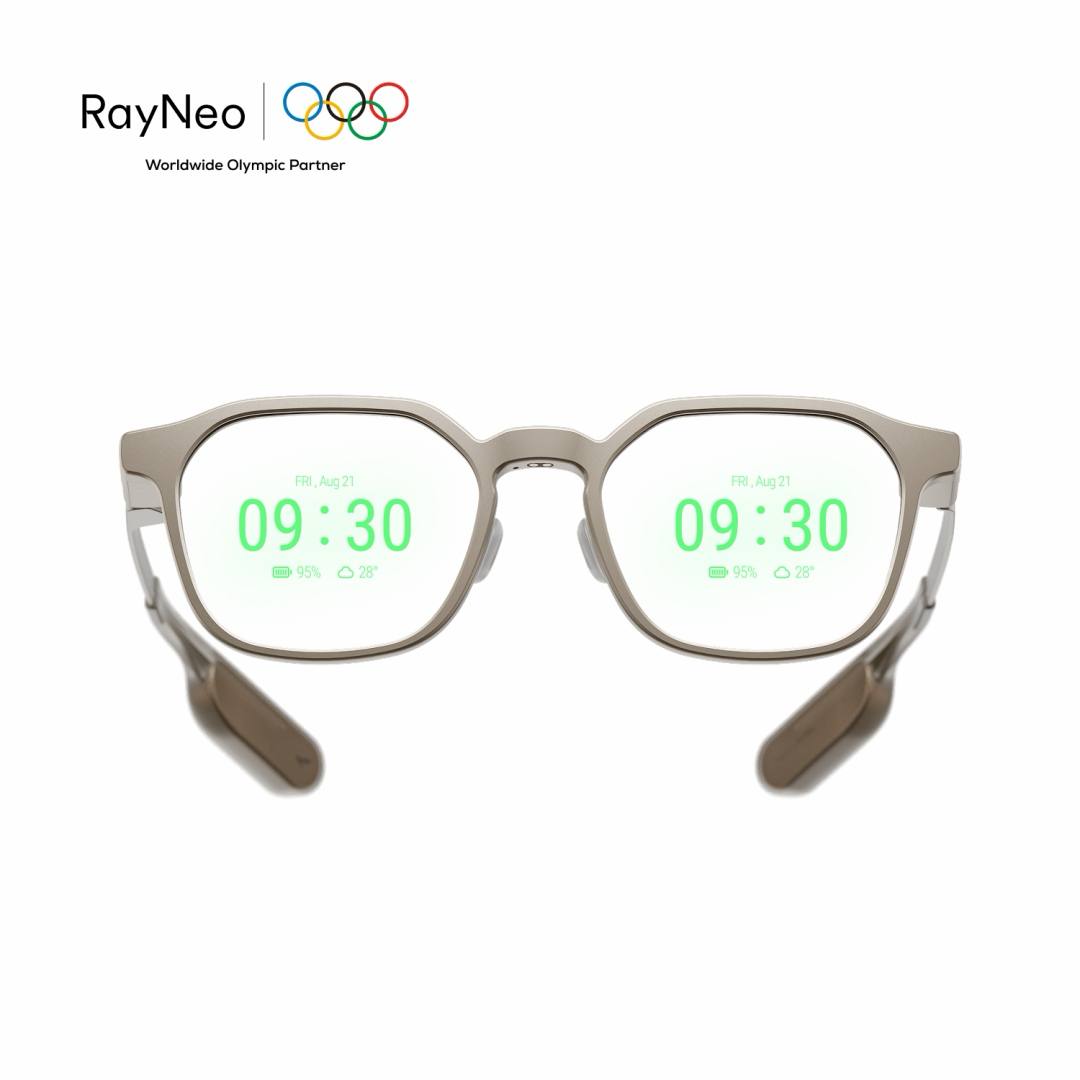
RayNeo has launched the iO Smart Glasses, a camera-free pair built around productivity and AI assistance rather than shooting photos or video. The device is made by a TCL subsidiary, which has previously released products like the X3 Pro. The iO clearly takes inspiration from the Even Realities glasses, which have found success in certain niches: it has a display but no camera, keeping the frame light and privacy-friendly. The main goal is not to capture content like Ray-Ban Meta, but to be an always-with-you companion that listens to conversations and helps with everyday tasks, including live captioning for people who are deaf or hard of hearing.The hardware is impressively thin and light. At just 33 grams, the glasses almost pass for regular eyewear, and the lack of cameras and speakers is key to that slim profile. The only obvious sign that they are smart glasses is the faint green light of the display leaking to the outside. The design is functional rather than fashionable, and the fit varies heavily by face shape. More importantly for a device meant for all-day wear, comfort is a weak point: after about an hour, the glasses began causing real discomfort where they rest on the bridge of the nose and around both ears, and after eight hours they left visible marks on the nose and reddened skin near the ears.The frame's thin legs end in large protrusions that press against the area between the ears and skull, creating an annoying pressure over time. Two transparent rubber covers are included to keep skin from touching the metal, but they make the frame ends even thicker and only worsen the pressure. A replacement nose pad in the box turned out to be the same shape as the stock one, offering no relief for larger noses. Other reviewers have not complained about comfort, so the issue appears to depend heavily on head and face geometry, but for this tester the glasses were comfortable only for about an hour.The dual monochrome display is a strong point. Its field of view is just above 23°, which is enough for notifications but a bit tight for text-heavy views like the teleprompter. Text is clear, brightness reaches 1200 nits for usable outdoor visibility, and the very transparent lenses do not darken the surrounding world. The display sits in the upper part of vision, so notifications do not block natural sight, but prolonged reading causes slight eye strain because eyes are not comfortable looking constantly upward. There is also no privacy: people nearby can read what is shown on the screen, so sensitive information should not be viewed on these glasses.One of the most surprising decisions is the complete absence of speakers. This keeps both price and weight low and makes the experience far less obtrusive, but it means no spoken AI responses, no music playback, and no phone calls: all popular Ray-Ban Meta use cases that are unavailable here. Combined with the lack of a camera, the iO effectively sits in a different product category. What it does have is a solid microphone array that hears not only the wearer but also people around them, and reliably detects who is speaking in a conversation.Battery life is a genuine highlight. RayNeo claims up to two days of normal usage and more than six hours of continuous translation. That endurance, together with the strong microphones and a readable display, makes the iO a distinctive productivity tool. Still, the unresolved comfort issues, the absence of speakers, and the fixed upper position of the display leave a noticeable gap between what the glasses promise on paper and what they deliver when worn all day in the real world: this is worth weighing carefully before buying.
- Public
- 10 Sep, 2026
Silicon Carbide Waveguides: The Tradeoffs Behind the Hype
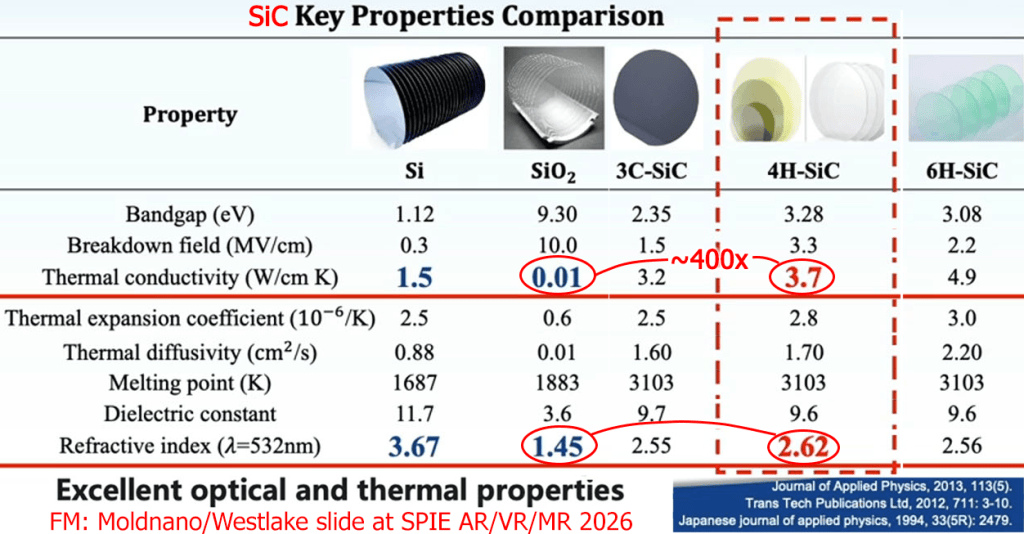
Silicon carbide (SiC) is emerging as a serious contender for the diffractive waveguides that underpin modern augmented-reality glasses. The technology entered the spotlight in September 2024, when Meta demonstrated its Orion prototype built around SiC diffractive waveguides that support a 70-degree field of view. Meta has repeatedly said it hopes the Orion demonstration will spur development of the necessary infrastructure and optical-grade SiC, driving down costs over time. The company also made the technical case for SiC waveguides at SPIE's AR/VR/MR conference in January 2025, in a paper on the evolution of display materials for full AR. Meanwhile, several China-based firms including SEEV, Moldnano, LLVision, and Goeroptics were likely already developing SiC waveguides before Orion and are moving toward production. In the US, Coherent has been developing SiC substrates for AR, and Magic Leap has publicly said it is working on SiC waveguides.The headline optical advantage of SiC is its high refractive index. Typical waveguide glass sits between roughly 1.7 and 2.0, while SiC reaches about 2.6. In a diffractive waveguide, that higher index supports a wider field of view within a thinner waveguide. Meta, Moldnano, and LLVision have all cited that SiC better supports full color in a single waveguide, and all three claim that the combination of SiC with their grating designs greatly reduces the rainbow capture that commonly plagues glass diffractive waveguides. SiC also offers very high thermal conductivity, nearly as conductive as copper and roughly 200 to 400 times more thermally conductive than glass. In theory that would let the waveguide spread and radiate heat, but in practice the waveguide is surrounded by insulating optical coatings, films, lenses, and dimming structures that block that radiation.Beyond optics, SiC is an extremely tough material that resists scratching, bending, and breaking, and it is nearly as scratch-resistant as diamond. Moldnano showed in its paper's supplement that even a thin SiC waveguide withstands a typical eye-safety ball drop test. But SiC is also brittle: when it breaks, it produces very sharp edges, so for eye safety it should be laminated or otherwise contained, much of which will come from the other material layers around the waveguide. Its toughness cuts both ways: the material is very hard to polish smooth and later to etch diffraction gratings into. SiC is also highly thermally stable, so thin waveguides resist warping under thermal cycling, though that stability can become a liability if the waveguide is glued to a less stable material. The most obvious drawbacks all trace back to manufacturing cost: raw SiC wafers are expensive, manufacturable wafers are typically small, and as a crystalline rather than amorphous material, SiC can carry defects that lower yield.The optical drawbacks are serious, and proponents often omit them. Most important for image quality are color dispersion, where different wavelengths see significantly different refractive indices, and the strong birefringence of the crystalline structure; both make diffractive waveguide design highly challenging. High refractive index also means inherently worse Fresnel reflections and more difficult anti-reflective coatings, leading to more visible front reflections and ghost images. In practice, color uniformity across the five SiC waveguides examined is consistently poor, and much worse than glass waveguides from many years ago, regardless of design. Those samples covered fields of view from 70 to 30 degrees, some using three-grating and others two-grating architectures, and were paired with monochrome MicroLED, DLP, and LCOS displays. None of those variables changed the result.

- Public
- 10 Sep, 2026
ADB Wi-Fi 2.0 makes wireless debugging on Android faster and more reliable
Wireless debugging on Android is now faster and more reliable thanks to ADB Wi-Fi 2.0: a new server stack and smarter network handling are built around developer feedback on setup gaps. To make the feature more dependable, Google reworked all three core stack components: the adb server, the adbd daemon, and Android Studio.The result is measurable: auto-connection success rates improved by 32%, and connection speeds increased by 66% for 90% of connections. The feature works across phones, tablets, Wear OS, and TV, with setup guidance covering how to get started on each form factor.Developers can find full details in the documentation or in a presentation from Android Makers by droidcon 2026. Bug reports and feedback are welcomed through the usual channels.