Silicon Carbide Waveguides: The Tradeoffs Behind the Hype
 Public
- 10 Sep, 2026
Silicon carbide (SiC) is emerging as a serious contender for the diffractive waveguides that underpin modern augmented-reality glasses. The technology entered the spotlight in September 2024, when Meta demonstrated its Orion prototype built around SiC diffractive waveguides that support a 70-degree field of view. Meta has repeatedly said it hopes the Orion demonstration will spur development of the necessary infrastructure and optical-grade SiC, driving down costs over time. The company also made the technical case for SiC waveguides at SPIE's AR/VR/MR conference in January 2025, in a paper on the evolution of display materials for full AR. Meanwhile, several China-based firms including SEEV, Moldnano, LLVision, and Goeroptics were likely already developing SiC waveguides before Orion and are moving toward production. In the US, Coherent has been developing SiC substrates for AR, and Magic Leap has publicly said it is working on SiC waveguides.
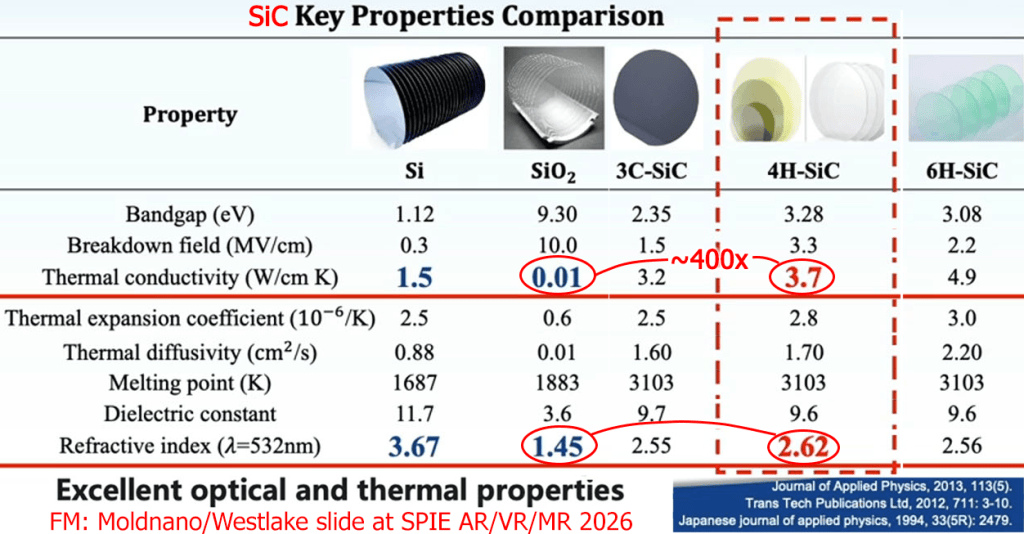
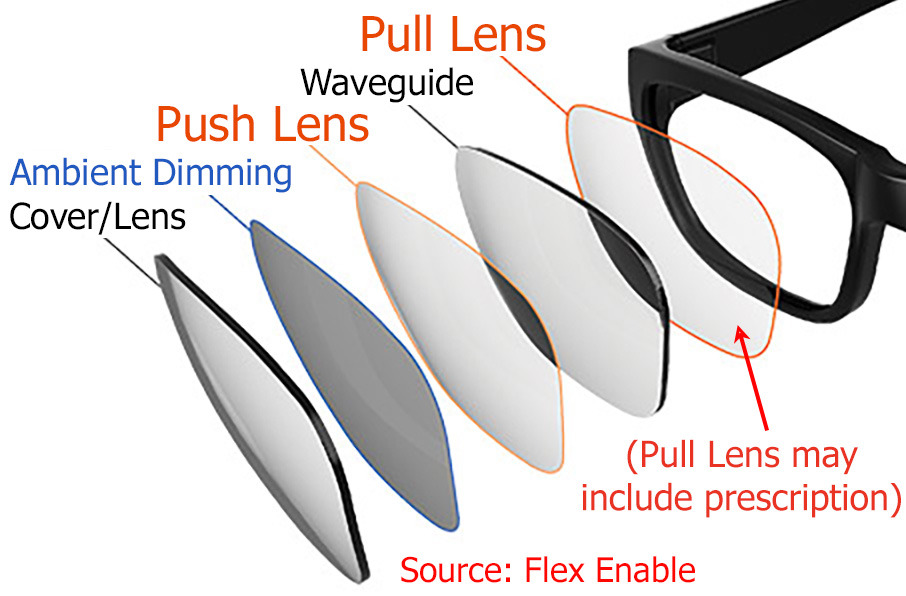
The headline optical advantage of SiC is its high refractive index. Typical waveguide glass sits between roughly 1.7 and 2.0, while SiC reaches about 2.6. In a diffractive waveguide, that higher index supports a wider field of view within a thinner waveguide. Meta, Moldnano, and LLVision have all cited that SiC better supports full color in a single waveguide, and all three claim that the combination of SiC with their grating designs greatly reduces the rainbow capture that commonly plagues glass diffractive waveguides. SiC also offers very high thermal conductivity, nearly as conductive as copper and roughly 200 to 400 times more thermally conductive than glass. In theory that would let the waveguide spread and radiate heat, but in practice the waveguide is surrounded by insulating optical coatings, films, lenses, and dimming structures that block that radiation.
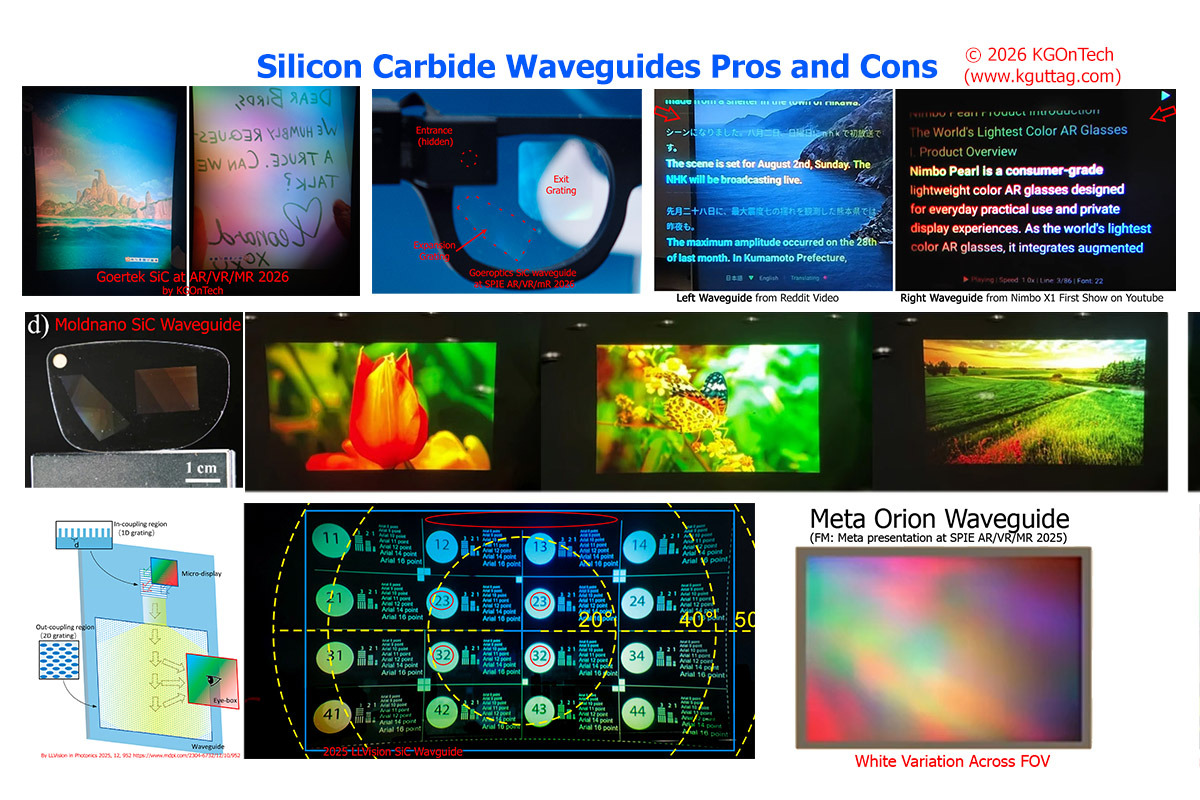
Beyond optics, SiC is an extremely tough material that resists scratching, bending, and breaking, and it is nearly as scratch-resistant as diamond. Moldnano showed in its paper's supplement that even a thin SiC waveguide withstands a typical eye-safety ball drop test. But SiC is also brittle: when it breaks, it produces very sharp edges, so for eye safety it should be laminated or otherwise contained, much of which will come from the other material layers around the waveguide. Its toughness cuts both ways: the material is very hard to polish smooth and later to etch diffraction gratings into. SiC is also highly thermally stable, so thin waveguides resist warping under thermal cycling, though that stability can become a liability if the waveguide is glued to a less stable material. The most obvious drawbacks all trace back to manufacturing cost: raw SiC wafers are expensive, manufacturable wafers are typically small, and as a crystalline rather than amorphous material, SiC can carry defects that lower yield.
The optical drawbacks are serious, and proponents often omit them. Most important for image quality are color dispersion, where different wavelengths see significantly different refractive indices, and the strong birefringence of the crystalline structure; both make diffractive waveguide design highly challenging. High refractive index also means inherently worse Fresnel reflections and more difficult anti-reflective coatings, leading to more visible front reflections and ghost images. In practice, color uniformity across the five SiC waveguides examined is consistently poor, and much worse than glass waveguides from many years ago, regardless of design. Those samples covered fields of view from 70 to 30 degrees, some using three-grating and others two-grating architectures, and were paired with monochrome MicroLED, DLP, and LCOS displays. None of those variables changed the result.