Blog

 Public
- 02 Oct, 2026
Apple tightens control over Full Disk Access in macOS
Apple is tightening how apps obtain Full Disk Access on macOS. The company notes that the feature largely sidesteps its privacy controls so backup apps can work properly, but some developers are using it in ways that put users at risk: an app gains access to everything on a system, including files, mail, messages, and browsing history, without the user's full knowledge. For communication apps, this can also compromise the privacy of the people users talk to.Going forward, Apple will introduce additional controls so that a user who genuinely wants to grant an app this level of access can only do so through a very explicit action. The company says this matters because AI agents are becoming more capable and autonomous, so the risks tied to this access will grow substantially. Apple aims to make sure users clearly understand these risks before granting access, so they can make informed decisions about their data and privacy.
- Public
- 02 Oct, 2026
Unity Plugin Now Available for Grok Build
Unity has released its official plugin for Grok Build, making it the third coding agent to carry Unity's own engineering guidance, after Claude Code and Codex. The move extends a strategy Unity has been building toward for weeks, following the launch of the Unity CLI and its first official plugin. The goal is to meet developers inside the tools and terminals they already use rather than forcing them to a browser download page, at a moment when a growing share of game development starts with an agent already open in a command line.Grok Build receives the same 30+ skills that Unity engineers wrote for the other two agents. The coverage spans UI Toolkit and uGUI, 2D and tilemaps, URP and Shader Graph, audio, navigation and physics, IAP and LevelPlay, multiplayer, web, and localization. The skills are authored by the Unity feature teams that own each system and are revised as those systems ship. All three plugins are maintained from a single repository, so updates reach every agent at once, and the skills remain identical across Claude Code, Codex, and Grok Build.Post on X: https://x.com/tetsuoai/status/2080038493594734780Getting started takes a single terminal command: there is nothing to configure manually and nothing to carry across when moving to a new machine. In the Grok Build CLI, you run grok plugin install Unity-Technologies/unity-agent-plugin --trust. The plugin works with Unity 6 and above, with the rest covered in Unity's official documentation. Because the skills are shared, a team or a developer who switches between multiple agents gets the same Unity guidance for the same question, so the choice of agent stays a matter of personal preference.The release reflects a broader bet: Unity argues that no single coding agent is a safe bet to be the only one users rely on. It points to OpenAI reporting Codex at 15 million active users in August, while Claude Code held its spot as the most widely used AI coding agent. In October, Unity plans to publish its own data on how developers are using the CLI and plugin across these agents, and it says it is exploring additional agents the plugin may become available for, with updates promised soon.
- Public
- 02 Oct, 2026
Gears of War: E-Day Gets the Series' Highest Score in Over 15 Years and Doubles as an Unreal Engine 5 Technical Showcase
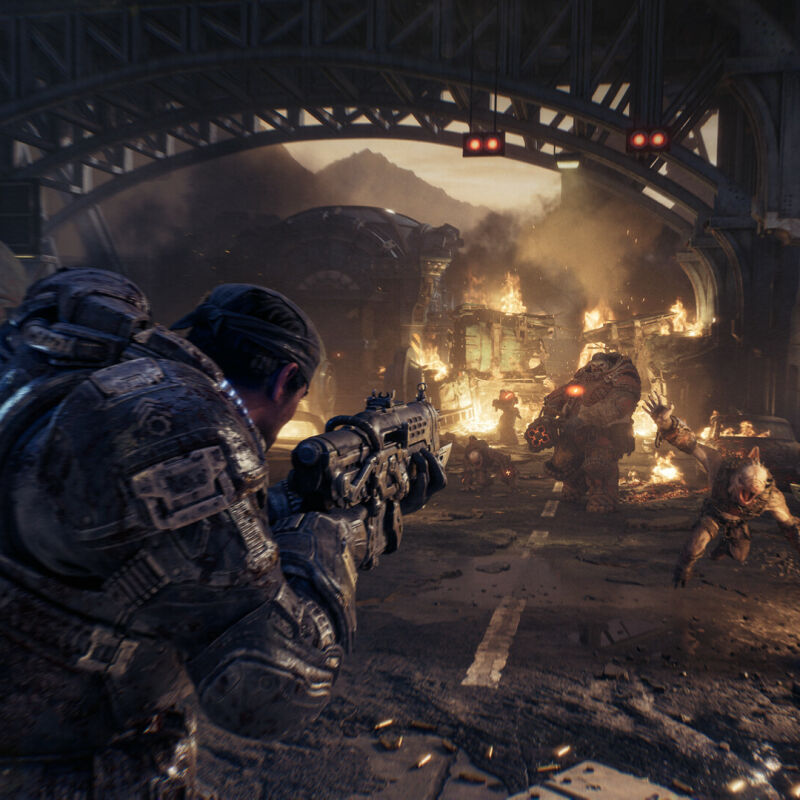
The Gears of War prequel E-Day has received the series' highest critical score in more than fifteen years, and at the same time has become one of the most impressive technical demonstrations of Unreal Engine 5 to date.As of publication, the game holds a score of 87 on Metacritic based on early reviews. That is higher than Gears of War 4, Gears 5, Gears of War: Judgment, and Gears Tactics, and makes E-Day the highest-rated entry in the franchise since Gears of War 3 averaged 91 in September 2011. The original Gears of War and Gears of War 2 remain the series leaders, at 94 and 93 respectively. The score may still fluctuate as more reviews come in, but the early consensus is already clear: the game is praised for bringing back the oppressive atmosphere and physical brutality of the original trilogy, while moving noticeably more smoothly, with more aggressive enemies, destructible environments, and modernized animation.E-Day is the first all-new Gears game built natively on Unreal Engine 5. According to the studio's technical director Kate Rayner, the team started with an "empty hard drive," building characters, enemies, weapons, animations, sound, and environments from scratch without inheriting anything from old content. The result reportedly surpasses Gears 5 in environment and character detail by more than 100 times. Nanite makes it possible to use extremely dense source assets throughout the ruined city of Kalona, preserving fine geometric details that were previously simplified or replaced with textures.E-Day's most significant technical achievement may be its lighting. The game is among the first major releases to use MegaLights from Unreal Engine 5, a new method for rendering large numbers of dynamic light sources with ray-traced shadows. The Coalition deliberately tied it to the prequel's horror influences: dark interiors are cut through by moving flashlights or muzzle flashes, while objects and enemies cast convincing shadows that change depending on nearby light sources. The contrast of light and darkness gives enclosed sections an atmosphere close to survival horror. Lumen complements this with dynamic global illumination, reflections, and ambient occlusion; hardware ray tracing improves the accuracy of lighting, reflections, and shadows, while volumetric fog, smoke, particles, and flying debris give the destruction depth.

- Public
- 01 Oct, 2026
Chaos Vantage 3.4 adds OpenPBR materials and improves the fire and smoke simulator
Chaos has released Vantage 3.4, the newest version of its GPU-accelerated real-time ray tracing renderer for exploring large production scenes in architectural visualization and visual effects. The update focuses on material and lighting coverage: it introduces support for OpenPBR, the open material standard now adopted across a growing range of DCC applications. In Vantage, OpenPBR is implemented as a switchable mode inside the standard V-Ray Material (VRayMtl), with a comparison between the two modes available in the online documentation. The release also adds support for materials from Chaos Scans, the library of scanned real-world materials bundled with higher V-Ray subscription tiers.The renderer's V-Ray compatibility expands further with support for the anisotropy, thin film, sheen, and dispersion parameters of VRayMtl, plus the V-Ray Curvature and TriPlanar textures and partial support for the Distance texture. Workflow improvements include include/exclude object lists for global Ambient Occlusion and Wet effects. The integrated version of NVIDIA's DLSS upscaling and frame-generation technology has been upgraded to DLSS 4.5.The release also updates the real-time fluid simulator first introduced in Vantage 3.1, which has now been renamed the Fire & Smoke simulator. Aside from the name change, the toolset gains new presets to speed up setup of common simulation types. Notably, support for 3D Gaussian Splatting has continued to grow since earlier releases: Vantage 3.2 made it possible to create and import Splats, and Vantage 3.3 added the ability to relight them within the software.Distribution has changed as well: Vantage is no longer sold as a standalone subscription and is now available only as part of the V-Ray Collection or Corona Collection bundles. Chaos described this as part of a strategy to deliver a more unified product experience. The software is rental-only, compatible with Windows 10+ and DXR-capable AMD, Intel, or NVIDIA GPUs, and works with V-Ray Next and later (V-Ray 4+), Corona 12+, and Enscape 4.2+, with a separate Hydra delegate for Houdini.

- Public
- 01 Oct, 2026
Samsung smart glasses from Gentle Monster and Warby Parker clear the FCC and edge closer to release
Samsung's long-awaited smart glasses have passed FCC testing, which is usually one of the final hurdles before launch. The filings show two distinct models, the SM-O200P and SM-O200J, and these codes point to Warby Parker and Gentle Monster frames respectively, as seen on pre-production units examined by Android Police and other outlets.Gentle Monster (left), Warby Parker (right) | Photo: Google & SamsungSeveral frame styles from both partners are expected to use those codes, including three variations from US-based Warby Parker and two so far from South Korea's Gentle Monster. Built in collaboration with Samsung and Google, the lineup is set to be among the first hardware platforms to run Google's Android XR operating system. Much like Meta's glasses, the frames will include onboard cameras, microphones, and off-ear speakers for calls, podcasts, and interaction with Google Gemini.Warby Parker Smart Glasses | Photo: Android PoliceNo official spec sheet is available yet, but the devices are said to feature a Qualcomm Snapdragon AR1 Gen 1 chipset, a single 12MP front-facing camera with an indicator LED, and up to 9 hours of use per charge, with a portable charging case adding extra runtime. Pricing and a launch date remain unannounced outside a Fall 2026 release window.Samsung is positioning the glasses against Meta's expanding range, which spans Ray-Ban, Oakley, and Meta-branded camera models, Meta Ray-Ban Display glasses, and a new audio-only variant that omits the camera entirely. Meta also shipped a mandatory July update to Meta Glasses that detects when the capture LED has been physically removed or damaged, closing a loophole that let users drill out the privacy light. Samsung will soon face the same public scrutiny Meta has drawn, including bans on such devices in public government buildings across several US states and cities.
- Public
- 01 Oct, 2026
Free VFX image viewer DJV 3.6 gets shot review tools
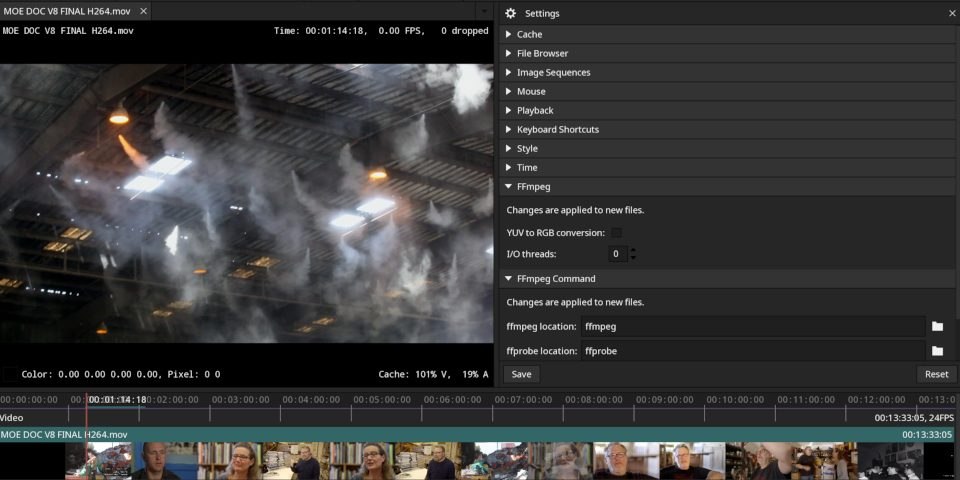
DJV, the free image sequence viewer and video player for VFX and feature animation work, has been updated to version 3.6 by Grizzly Peak 3D. The program was originally created by Darby Johnston, a former Lucasfilm software engineer. DJV plays back high-resolution, high-bit-depth image sequences and videos when reviewing shots in professional pipelines. It supports production image formats including Cineon, DPX, JPEG, OpenEXR, PNG, PPM, SGI, TGA, BMP and TIFF, along with the MJPEG movie codec and FLAC, MP3 and WAV audio. It also supports OpenColorIO (OCIO) for accurate color preview, positioning DJV as a free alternative to commercial tools like Autodesk's RV.The standout feature in DJV 3.6 is a complete new toolset for shot review with annotation capabilities. It is the first feature contributed by a community member. The review mode was built by tools developer Matthieu Barbié (MattRM2), and it enables shot review sessions right inside DJV. Users can mark up frames with freehand annotations that stay attached to the image through zooms, pans and A/B comparisons, or add timestamped text nodes. Review sessions are saved to their own file format and reopen identically. The update also adds support for playlists, Python bindings, and workflow improvements such as reordering the file list by dragging.Other new capabilities in DJV 3.6 include support for camera RAW formats (CR3, NEF, ARW and DNG) and OpenEXR files using HTJ2K compression. These join earlier additions across the 3.x series: DJV 3.1 through 3.3 brought OpenImageIO read/write support and extended OpenColorIO workflows, including the OCIO environment variable and built-in configurations, plus a file browser that displays image sequences as a single item with a frame range.DJV 3.4 and 3.5 added SVG file support, partial image sequences and custom fonts for different languages. The A/B comparison system gained a new "butterfly" compare mode and the option to export comparisons. Movies can now be decoded via the ffmpeg command-line application, letting users supply custom codecs without compiling DJV from source. USD support was removed from compiled binaries but remains available when building from source. Compiled versions of DJV 3.6 are free to download for Windows 10, Ubuntu 22.04 Linux and macOS 14.0+, with source code under a 3-clause BSD license.
- Public
- 01 Oct, 2026
Instagram Direct Rebuilds Its Android UI for an AI-Native Architecture with Jetpack Compose
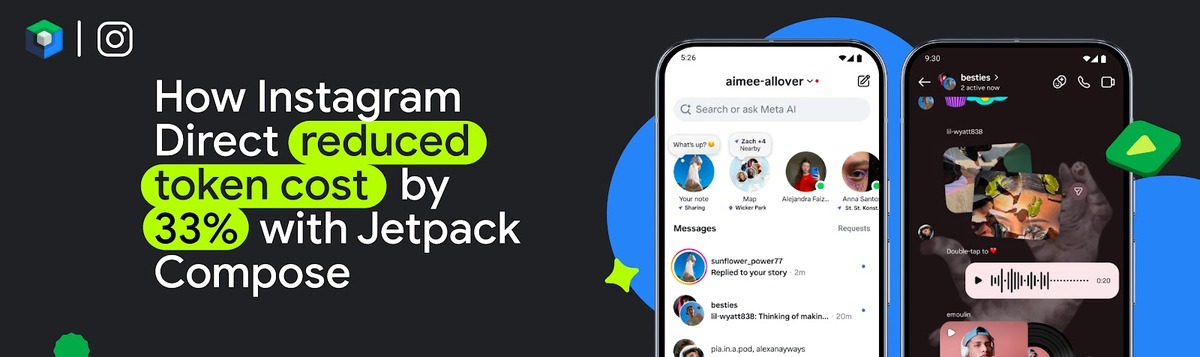
Instagram Direct is one of Instagram's most integral surfaces, handling billions of messages every day. For years, the team squeezed micro-optimizations out of the legacy Android View system, until it ran into a problem: keeping a heavily optimized but legacy surface maintained and expanded was becoming ever more costly, with growing technical debt and engineering overhead, especially as declarative UI and AI coding assistants became the norm. Rather than treat Compose adoption as just another UI modernization, Meta set a more ambitious goal: redesigning the codebase and its architecture to be AI-native by design, thereby multiplying AI's impact far beyond what simply retrofitting existing code could deliver.The results were measured precisely. Jetpack Compose allowed Instagram Direct to reduce the total amount of UI code by 50%, speed up AI-agent task execution by 35%, cut engineer-agent exchanges by 32%, and lower token cost per agent session by 33%. Compose's declarative nature is central to this: code becomes concise, predictable, and structurally easier for AI models to reason about, with fewer side effects, less implicit state, and clearer component boundaries. Those are the properties that let AI produce higher-quality output, and less code to generate directly translates into lower token cost per task.The team learned hard lessons about what happens when AI is pointed at mixed code. In a RecyclerView-heavy codebase, the tempting shortcut is embedding Compose components inside the existing View hierarchy. As a short-term migration step that is valid, but over the long run AI tools take the path of least resistance: when declarative and imperative code are blended, AI tends to merge them incorrectly, introducing subtle bugs, tech debt, and performance regressions. Concrete examples include a feature flag read in imperative code and then captured inside a Compose lambda, or a mutable field living on an item class rather than in its UI state, so it survives RecyclerView re-binding and recycling across rows, producing bugs that are painful to reproduce. Guardrails and skills help but are not enough, because AI hitting friction will route around them.The fix is a pair of practical rules. A list item can keep its own abstraction, but all Compose code must live in the constructor as content, with constructor arguments as its only source of data and no access to class members or mutable state, making it equivalent to a plain @Composable function while conforming to existing architecture. Migration was staged in two steps per screen: identify common patterns and edge cases, then apply them systematically, letting one engineer settle architecture and tricky cases up front while others handled production readiness. Multiple engineers ran their own AI agents against a shared knowledge base of reusable skills and conventions, keeping workflows and best practices in sync across the team and slashing redundant rediscovery of decisions.The scale was enormous. Individual UI components can render in over 160 distinct state permutations, and a single conversation screen handles more than 200 distinct message types. The team gradually migrated several hundred list items to Compose within the existing RecyclerView architecture, rolling them out in small independent groups under A/B tests with zero visible disruption to the messaging experience. Performance remained the number-one goal: metrics were tracked at runtime in production, letting the team run A/B tests comparing migrated Compose UI against legacy UI.Internal analysis compared AI-agent sessions working on Compose UI against the same tasks using Android Views, using a risk score that evaluates code quality and the likelihood of a change causing production incidents. When a file's accumulated risk score doubles, Android Views reduced agent resource efficiency (measured as token consumption, execution time, and engineer-agent interactions) by 30% per landed character, while Compose UI fell only 9%. As a natural next step, the team is replacing the RecyclerView-based core with LazyColumn, keeping Compose components abstracted from their enclosing framework and switchable at runtime via feature flags to preserve A/B testing and an uninterrupted composition tree.
- Public
- 30 Sep, 2026
Meta confirms a cinching strap for active play on its $1,300 VR glasses
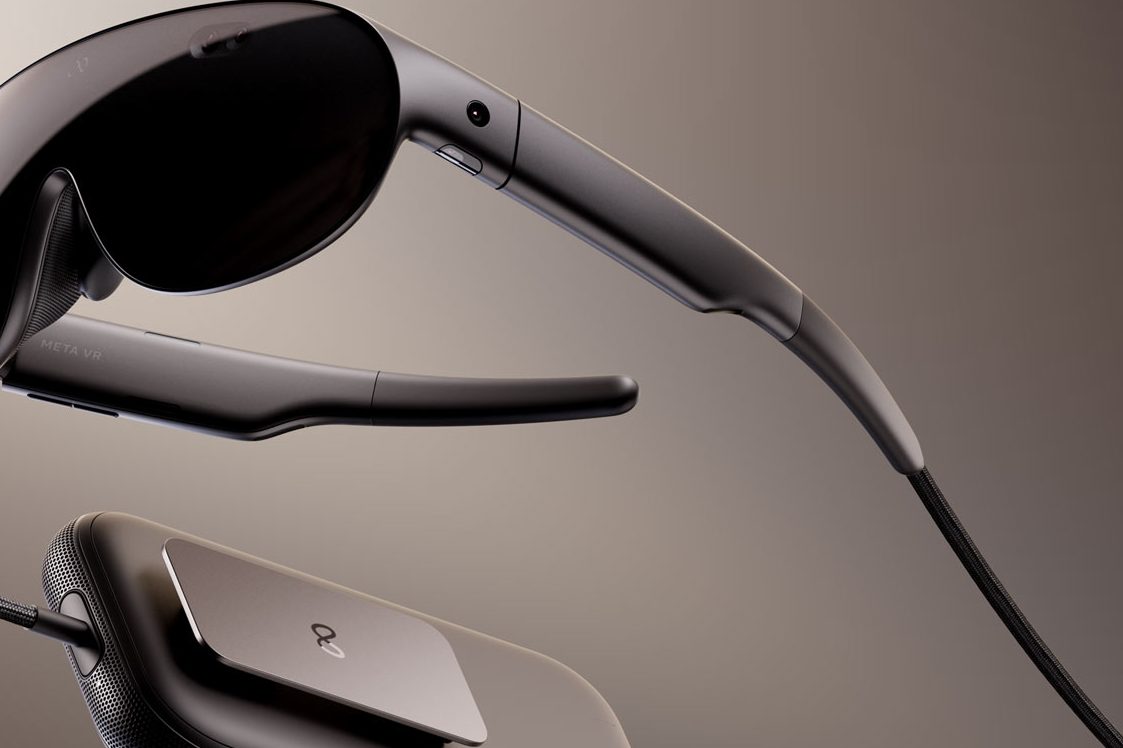
Meta VR Glasses, the company's Spring 2027 launch that runs the same games as Quest via integrated hand-tracking or optional Touch Plus controllers, will get a purpose-built accessory for active play. It is a cinching strap that links the tips of both temple arms behind the head. Instead of the full replacement strap systems common on Quest, it attaches directly to the glasses' temple arms (whose tips, incidentally, detach for added modularity) to pull the headset more snugly against the head.The need comes from the form factor. During a hands-on at Connect 2026, the glasses felt solid on their own, with no nose-slipping or ear-pressure that some glasses-style headsets suffer from. But anything involving fast head or body movement, or looking down for extended periods, calls for a snug fit: both to keep the headset from flying off and to keep its relatively narrow sweet spot in place.Courtesy of MetaThe only other accessories mentioned so far are a light blocker that attaches magnetically for greater immersion, and prescription lenses from Zenni Optical. It remains unclear whether the strap will be included in the box or sold as a separate paid accessory; this, along with additional accessories, is expected to be clarified closer to launch next year.Courtesy of Meta
- Public
- 30 Sep, 2026
Godot 4.8 dev 7 arrives with the final features before the freeze
Godot 4.8 dev 7 is the last snapshot on the road to the beta, and with it comes the feature freeze. From this point on, no new features will be added to Godot 4.8: the team is switching entirely to fixing bugs and regressions in order to reach a stable baseline as quickly as possible. This release wraps up the development cycle and closes the list of new features before the move to the beta stage.The main event of the release is the long-awaited symbol renaming from Tomasz Chabora in GH-117949. For years, this feature sat at the top of the most requested list, and it made it into the engine literally at the last moment before the freeze. Now, renaming a symbol correctly propagates across the whole project, consistently applying the new name everywhere it is appropriate. The tool distinguishes a class identifier from comments and strings, and also tells apart local variables that share the same name in different methods. Because the feature was added at the last second, it is marked as experimental and for now requires an explicit opt-in.Also added is runtime manipulation of CanvasItems by Michael Alexander in GH-122510. Colin O'Rourke taught decals to animate fully in GH-115653: after finishing work on DrawableTexture, he handled them without any surprises. In addition, strictly typed intermediary classes have appeared to combat unnecessary allocations: aterray, together with Ricardo Buring and Mikael Hermansson, implemented them in GH-113970 for PhysicsDirectSpaceState2D and PhysicsDirectSpaceState3D. New methods like intersect_ray_into reuse result objects, eliminating manual type declarations and dictionary lookups.The GUI gets native touch input support for TabBar (GH-122960) and PopupMenu (GH-123576) from Anish Kumar. Hugo Locurcio added sound events in GH-111455 through a new "audio" theme type: now you can trigger audio effects on command and change them via theme override.Separately, expanded accessibility support was announced: AccessKit, previously available only on desktops, is now coming to iOS and Android. The iOS implementation was done by newcomer Ben Humphreys in GH-119750, and the Android one by bruvzg in GH-117785. The iOS version does not yet support editable text fields. In total, 80 contributors made 182 fixes in this release.

- Public
- 30 Sep, 2026
Unity Releases Official External Dependency Manager Package
Unity has released External Dependency Manager (EDM), an official package for handling native Android and iOS dependencies, distributed through the Unity Package Manager (UPM). The launch arrives alongside Google's announcement that it will deprecate External Dependency Manager for Unity (EDM4U) on October 26, 2026. Unity and Google have been collaborating to make the transition smooth for both game developers and SDK maintainers.EDM is built on a fork of EDM4U and brought into Unity as an official package, so anyone currently using Google's tool will find it familiar. Unity will actively maintain it, providing engine compatibility, feature updates, and bug fixes. It is free for Unity 2022.3 and later, and it reads the same XML dependency files that SDKs already use with EDM4U. This means developers and SDK maintainers can switch without rewriting their setup.EDM fully supports the existing XML dependency specification, and Unity provides a plug-in distributor guide for SDK maintainers who want to make it the recommended dependency manager for their SDK. Mobile games typically ship several SDKs for ads, analytics, monetization, and push notifications, each bringing native Android and Apple library dependencies and creating likely conflicts. EDM solves this: SDKs simply declare the libraries they need in a plain text file, and EDM then orchestrates their inclusion so that they resolve through Gradle, CocoaPods, or Swift Package Manager and reach the final build.The initial release prioritizes stability and a smooth transition from EDM4U, while already including fixes and improvements in areas such as CocoaPods and Ruby integration and user experience. Existing projects are expected to migrate without issue, and unexpected problems can be reported through the Unity Editor's Bug Reporter (Help > Report a Bug). Unity frames this as the first step toward making mobile dependency management a first-class part of the engine, with more investment planned.
- Public
- 30 Sep, 2026
State of Kotlin in 2026: 15 Years On, the Language Has Gone Far Beyond Android
Kotlin turned fifteen in 2026, and JetBrains marked the anniversary with the State of Kotlin in 2026 report. The document looks back at the language's first decade and a half to assess how it matured, while tackling the questions developers most often ask: whether Kotlin is here to stay, how well it scales across platforms, and how it fits into the AI era.The report finds Kotlin in use across mobile, backend, and multiplatform development. It also highlights the language's growing role in AI-assisted programming. Among surveyed Kotlin developers, 93% use at least one AI coding tool, 81% already use or intend to try AI coding agents, and the same share report that AI-generated Kotlin code is fully correct or requires only minor fixes.A notable shift is the expansion beyond Android. While Kotlin remains deeply established in mobile development, more than half of Kotlin developers now say they work on backend projects, underlining how far usage has spread from its original home. The report combines data from JetBrains research with independent industry data and real-world adoption evidence.The overall picture goes beyond raw growth: Kotlin's evolution is defined by the diversity of its use, spanning backend, multiplatform, and AI-assisted development. The developer community itself has also become more experienced over the years. The full report is available as a downloadable PDF, alongside tools like klibs.io, which indexes more than 4,200 Kotlin Multiplatform projects and offers AI integrations for coding agents.