Gears of War: E-Day Gets the Series' Highest Score in Over 15 Years and Doubles as an Unreal Engine 5 Technical Showcase
 Public
- 02 Oct, 2026
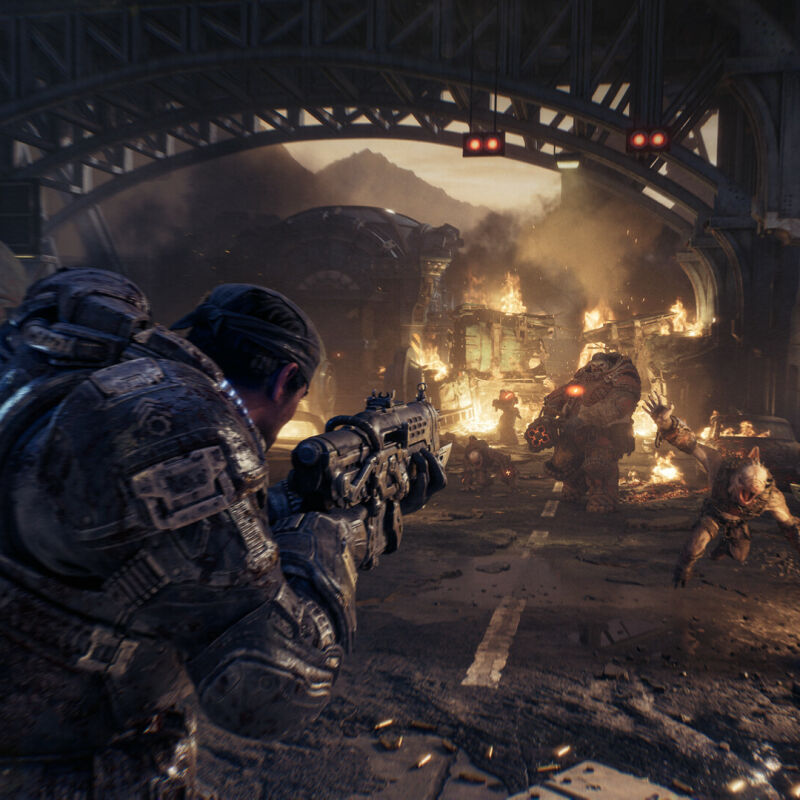
The Gears of War prequel E-Day has received the series' highest critical score in more than fifteen years, and at the same time has become one of the most impressive technical demonstrations of Unreal Engine 5 to date.
As of publication, the game holds a score of 87 on Metacritic based on early reviews. That is higher than Gears of War 4, Gears 5, Gears of War: Judgment, and Gears Tactics, and makes E-Day the highest-rated entry in the franchise since Gears of War 3 averaged 91 in September 2011. The original Gears of War and Gears of War 2 remain the series leaders, at 94 and 93 respectively. The score may still fluctuate as more reviews come in, but the early consensus is already clear: the game is praised for bringing back the oppressive atmosphere and physical brutality of the original trilogy, while moving noticeably more smoothly, with more aggressive enemies, destructible environments, and modernized animation.
E-Day is the first all-new Gears game built natively on Unreal Engine 5. According to the studio's technical director Kate Rayner, the team started with an "empty hard drive," building characters, enemies, weapons, animations, sound, and environments from scratch without inheriting anything from old content. The result reportedly surpasses Gears 5 in environment and character detail by more than 100 times. Nanite makes it possible to use extremely dense source assets throughout the ruined city of Kalona, preserving fine geometric details that were previously simplified or replaced with textures.
E-Day's most significant technical achievement may be its lighting. The game is among the first major releases to use MegaLights from Unreal Engine 5, a new method for rendering large numbers of dynamic light sources with ray-traced shadows. The Coalition deliberately tied it to the prequel's horror influences: dark interiors are cut through by moving flashlights or muzzle flashes, while objects and enemies cast convincing shadows that change depending on nearby light sources. The contrast of light and darkness gives enclosed sections an atmosphere close to survival horror. Lumen complements this with dynamic global illumination, reflections, and ambient occlusion; hardware ray tracing improves the accuracy of lighting, reflections, and shadows, while volumetric fog, smoke, particles, and flying debris give the destruction depth.