Unity Simulation Pro Launches in Early Access for Robotics
 Public
- 22 Sep, 2026
Unity has launched Unity Simulation Pro in Early Access, a robotics simulation package aimed at teams building and validating robotics systems. The package is compatible with Unity 6.3 and newer, and it requires a Unity Industry license. The goal is to consolidate capabilities that teams previously had to assemble on their own: rebuilding a robot's physical description by hand, writing sensors from scratch, and maintaining integrations with open standards such as ROS. By packaging all of this into one supported toolkit, Unity Simulation Pro is meant to reduce time spent on simulation infrastructure so teams can focus on validating the robotics systems themselves.
The package covers a wide range of use cases: sensor simulation, robot training, and virtual commissioning. Unity frames it as a foundation for moving robots from the lab to the real world, built on real-time rendering, accurate physics, and sensor simulation. Early adopters highlight different applications. TIER IV used its Unity-based simulator AWSIM to test, validate, and optimize Autoware autonomous driving software. AWSIM scenarios can demand eight or more cameras running simultaneously, which standard optimization techniques could not handle. The team instead built specialized optimizations: staggered rendering across cameras to flatten frame spikes, time-scale controls to allocate more resources per frame, asset optimization, and the flexibility to use different rendering pipelines within a single project, balancing accuracy against frame rate.
TIER IV also relied on the Unity job system and built-in Physics to hold real-time performance across vehicle, traffic, and pedestrian simulation. For hardware-in-the-loop testing, the team analyzed raw sensor packets and reproduced equivalent output from Unity. This allowed camera sensor setups to be tested in the loop before deployment to a physical test vehicle, cutting physical test vehicle hours and on-road testing cost. The Korea Institute of Industrial Technology (KITECH), meanwhile, built a digital twin of a metal casting plant from point cloud scans to generate training data for AI that understands human-robot proximity on a manufacturing floor. The team layered physics, sensor, and simulation systems on top, used a sensor rig with custom components matching the real rig so every observation shared one simulation clock, and leveraged Articulation Body components to replay recorded joint trajectories with inertia and contact computed together.
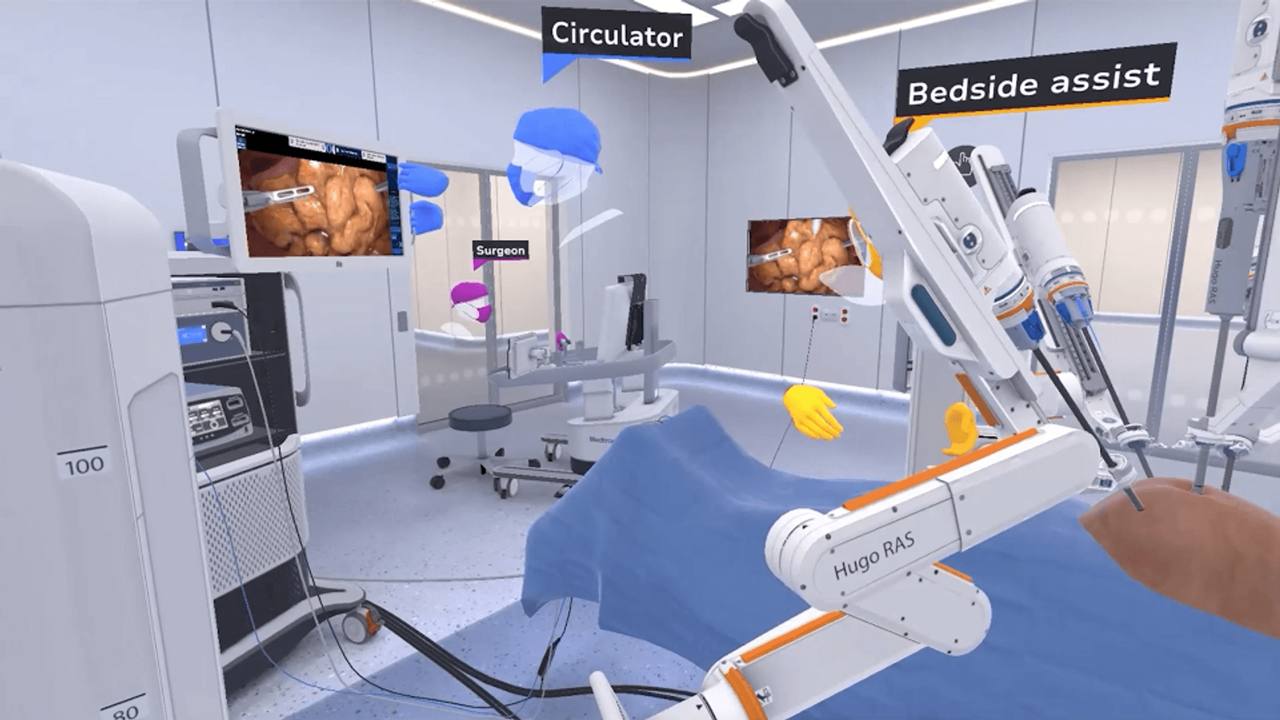
That physical fidelity let KITECH automatically generate over 100,000 pre-labeled training frames in 14 weeks. This avoided the need to manually stage dangerous proximity scenarios on an active factory floor while supporting reliable sim-to-real transfer. Medtronic built a data-logging and playback pipeline in Unity around a digital twin of its Hugo robotic-assisted surgery system, capturing 195 procedures across five global sites. The recordings became a reusable dataset: engineers could load a recorded procedure, scrub through it, isolate a moment, and inspect it from any angle. The same data also fed deterministic replays used to train new AI models and inform the design of next-generation devices.
Unity says it is especially interested in teams running robot validation, sensor testing, or synthetic data generation at scale across manufacturing, logistics, warehousing, and advanced robotics sectors. The development team is inviting feedback on Unity Discussions.