Organic Zombie Web: A Generator of Creepy Organic Webs in Blender Built with Geometry Nodes
 Public
- 17 Nov, 2026
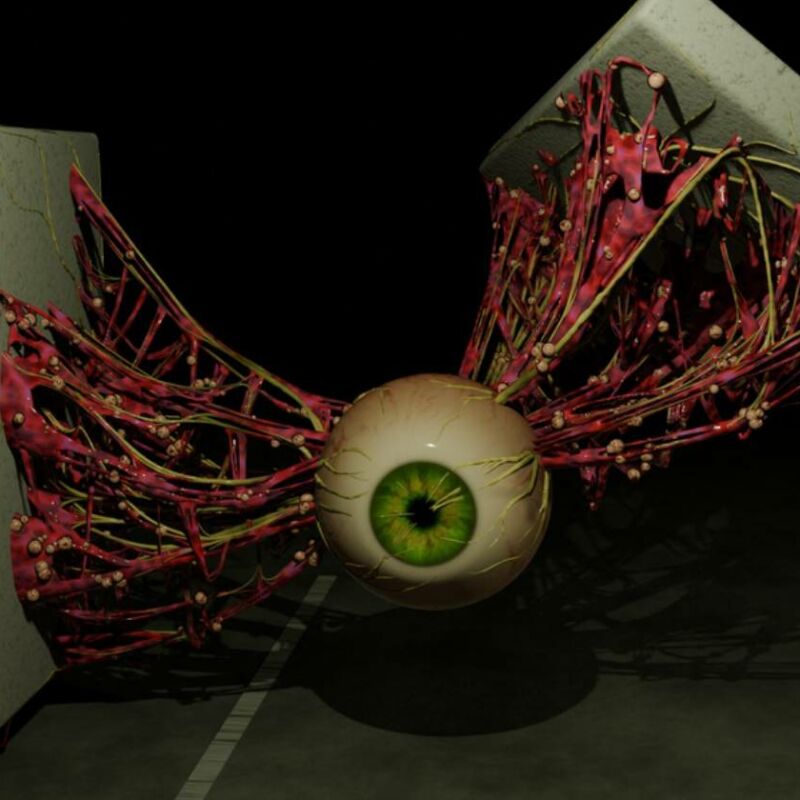
Organic Zombie Web is a new Blender tool built with Geometry Nodes. It creates thick, slimy webs that look like living tissue. These webs suit post-apocalyptic and horror environments and can cover almost any surface. The generator was created by Deepak Kushwaha, who usually works on sci-fi projects such as a functional portal and a cyberpunk lab. The tool is publicly available for download.
There are no simulations here: everything is built on mathematical operations. As a result, the generator is lightweight and designed to run in real time. It ships with its own materials, but they can be swapped for custom ones so the web matches the look of a project. Once the result is final, it can be converted into a regular mesh.
Under the hood, the generator is organized into multiple layers, all built around three components: Web, Surface, and Subject. The first layer connects the surface to the subject and stretches a web between them. The second attaches additional webs to existing ones, making the structure more complex and random. The third takes the generated surface and builds yet another web layer on it to add detail. Shape and distribution are controlled with curves, Set Position, Sample Nearest Surface, and other nodes.
Veins can be added to the web to give it a living look, as if it were threaded with veins and arteries. Their color, noise, and other properties are adjustable. An instancing system scatters extra details across the web. This can be a single object, such as spheres, egg-like shapes, or mushroom-like growths, or an entire collection with multiple variations. The distribution of instances is adjustable as well.
General controls include thickness, width, density, randomness, and sag, as well as how far the web hangs down and how much noise distorts its shape. Together these parameters produce a wide range of results, from sparse individual strands to dense, overgrown masses.