Revopoint MIRACO 2: A Portable 3D Scanner with Gaussian Splatting and Scan-to-CAD
 Public
- 18 Nov, 2026
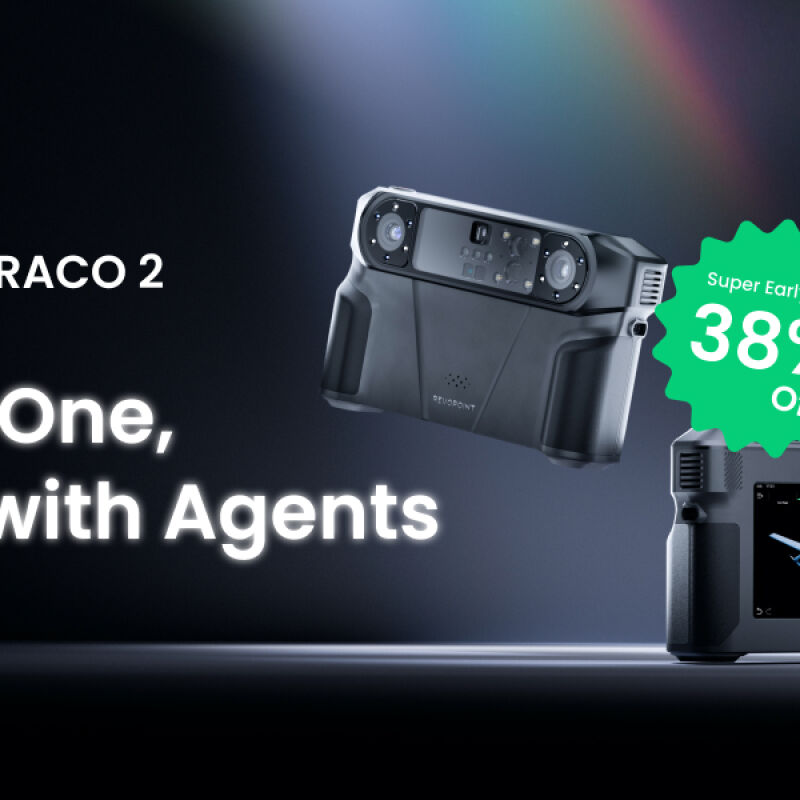
Revopoint will launch MIRACO 2 on Kickstarter on November 18, 2026. It is a portable all-in-one 3D scanner that handles small mechanical components, detailed objects, people, sculptures and larger physical spaces. The 960-gram handheld device computes depth, processes point clouds, shows scan previews and supports basic editing on its own. It is powered by an eight-core CPU and a six-core NPU. The scanner works in three configurations. In Standalone Mode, scanning, previewing, processing and adjustment are done on a six-inch 2K AMOLED touchscreen. In Wireless PC Mode, the scanner connects to a workstation over Wi-Fi 6, while Wired PC Mode uses USB-C 3.0 for a stable, performance-focused workflow. With a GPU-powered PC, Multi-Line Laser scanning reaches up to 120 frames per second. A limited number of Super Early Bird pledges start at $1,425, with savings of up to 38%.
The scanner has six modes for different sizes, materials, levels of detail and environments. A 34-Line Blue Cross Laser covers larger surface areas, and a 15-Line Parallel Laser targets fine details. A Single-Line Blue Laser handles narrow gaps and recessed geometry. Full-Field HD captures detail without slower precision-laser passes, and VCSEL Rapid suits larger subjects. Hybrid HD pairs detailed capture with dependable tracking at up to 10 million points per second. Single-frame accuracy in Multi-Line Laser Mode reaches 0.02 mm. Reflective metals, dark objects, intricate structures and human bodies are listed among the supported subjects. The recommended minimum scan volume is 10 × 10 × 10 mm. With the optional Photogrammetric Metrology Kit, the maximum grows to 5 × 5 × 5 meters. When connected to a PC, the laser modes support markerless tracking of textured objects.
Raw point clouds usually need to be fused, cleaned up, compared, or reconstructed before they become useful for design, manufacturing, or inspection. Revopoint targets this stage with Revo Agents, an agent-powered 3D reality ecosystem. Instead of manual step-by-step processing, it is driven by natural-language commands. The planned workflow includes real-time point-cloud fusion, automated Scan-to-CAD conversion, and Scan-to-Inspection tolerance analysis. For example, a user could ask the system to turn a specific part of a scan into CAD geometry. A scan could also be compared against a reference model to find dimensional differences. The aim is to cut repetitive work between capture and engineering. Human validation of CAD geometry, tolerances, and inspection results still matters.
For game development, VFX, XR, digital preservation, and visualization, MIRACO 2 uses a dual RGB camera system. A 2MP near-field camera handles nearby subjects, and a 50MP far-field camera captures larger objects and environments. Connected to a PC, the device supports physically scaled 3D Gaussian Splatting. It exports .splat models at one-to-one scale with real-world dimensions for XR experiences, spatial documentation, and digital twins. 3DGS preserves real spaces in full visual detail without rebuilding them as polygons. Conventional polygon meshes remain necessary for editing, animation, simulation, and game production. AI Segmentation removes unwanted environmental points, and AI Cropping isolates subjects for further processing.
The same device can support several workflows. A designer could rebuild prototype components in CAD, and a quality control team could check a manufactured part against its reference model. A VFX artist could capture an object for production, and an XR creator could preserve a location as a scaled Gaussian Splat. MIRACO 2 is rated for indoor and outdoor use in ambient light up to 100,000 lux. Its 10,000mAh battery lasts about three hours and supports 65W fast charging. Two configurations will be offered: 16GB of RAM with 256GB of storage, or 32GB of RAM with 512GB of storage.