Daviator accelerates VASP on NVIDIA GPUs: batched k-point calculations and mixed precision
 Public
- 18 Nov, 2026
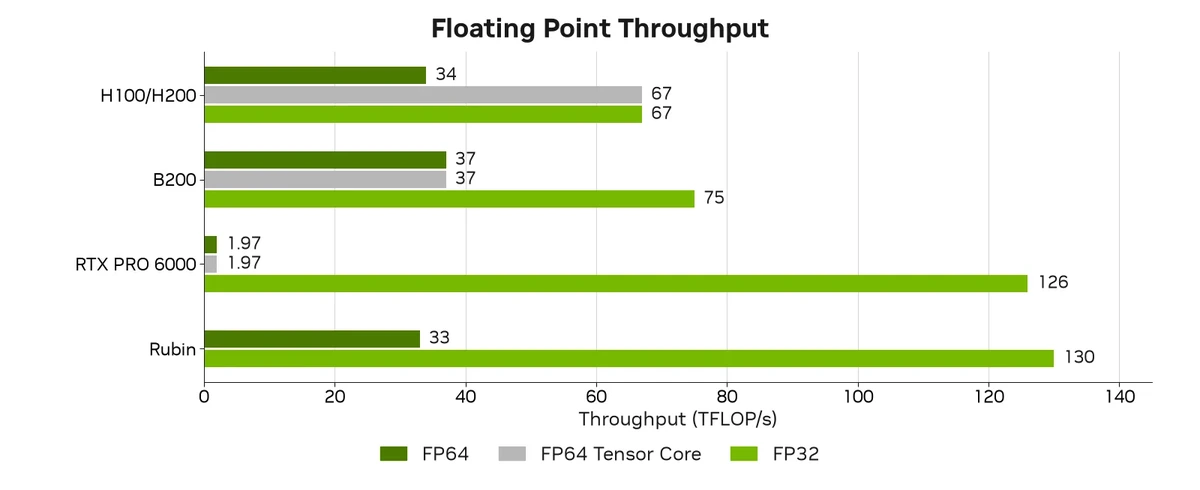
Training machine learning interatomic potentials (MLIPs) requires tens to hundreds of millions of DFT calculations of energies, forces, and stresses. Most often they are produced with VASP, the dominant plane-wave DFT code. These workloads typically use small unit cells and dense k-point grids, which leave GPUs underused. VASP's OpenACC port handles k-points sequentially, so for small systems hundreds of tiny kernels are launched at every step, and launch overhead eats up all the time. A single-atom iron system with 752 k-points ran 8x slower on GPU than on CPU, and researchers had to route jobs by size by hand. FP64 is also stagnating: FP64 throughput has held flat across Hopper, Blackwell, and Rubin, while FP32 keeps growing. The RTX PRO 6000 has a 64:1 FP32:FP64 ratio.
Daviator is an NVIDIA library of GPU kernels that replaces per-k-point loops with batched operations. It is built around a batched Davidson eigensolver using batched FFTs, GEMMs, and custom kernels. Fewer launches push SM occupancy toward saturation, and data stays in GPU memory. VASP keeps the SCF loop, mixing, symmetry, and I/O, while Daviator plugs in at well-defined call boundaries. It is enabled through the NVIDIA ALCHEMI VASP microservice with LDAVIATOR=True in INCAR and intercepts the Davidson solver (ALGO = Normal). Existing input files need no changes. The example is a single Fe atom with ISPIN = 2, NBANDS = 12, PREC = Accurate, and a Gamma-centered 30x30x30 mesh.
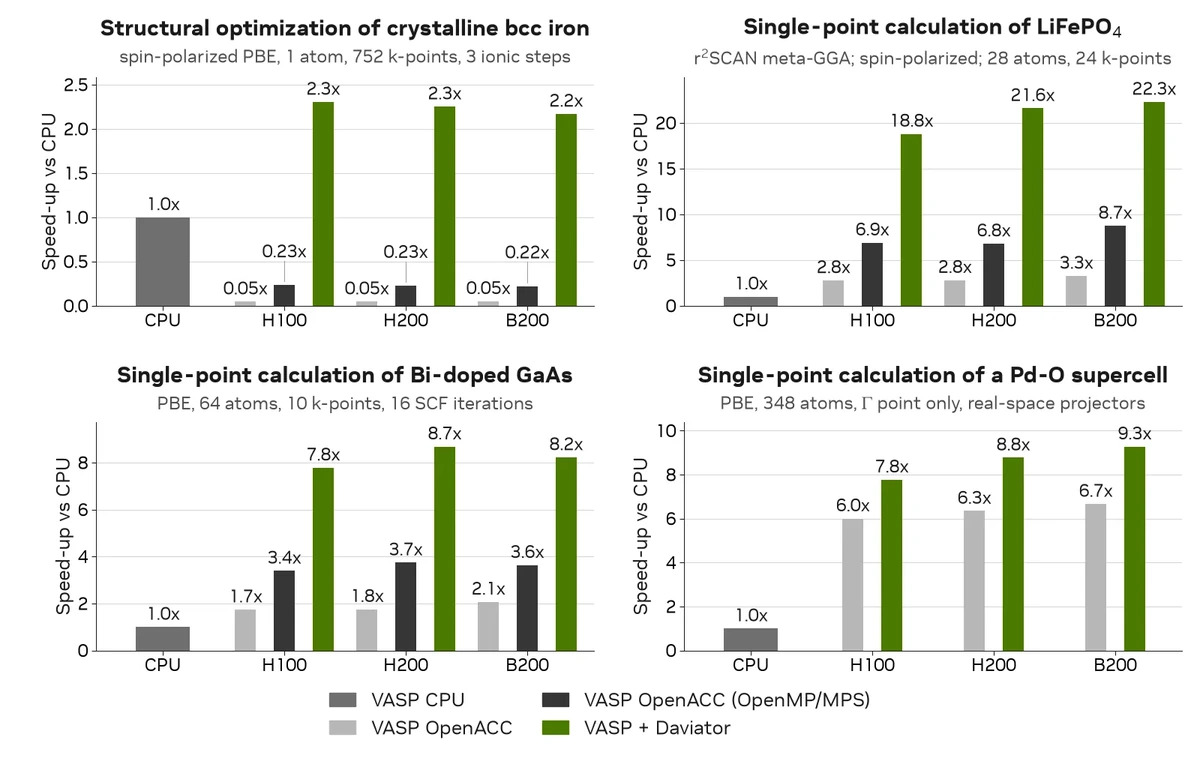
Some kernels are specialized for batch sizes and may compile on first use. Therefore, job scripts should set CUDA_CACHE_PATH to fast storage such as /tmp/cudacache rather than $HOME, and set CUDA_CACHE_DISABLE=0. Runs launch as usual, e.g. mpirun -np 1 vasp_std. For now only a single node is supported; multi-node support, vasp_ncl, and vasp_gam are planned. The baselines were VASP 6.6.0 on CPU and with OpenACC on H100/H200 and B200. One iron atom runs more than 2x faster than on CPU, LiFePO4 with r2SCAN sees a 22x Davidson speedup, and 64-atom Bi-doped GaAs cuts time by more than 85%. Even 348 atoms with one k-point run faster, so jobs no longer need to be routed by size. Projected dataset workloads show time-to-solution up to 22x faster and cost up to 75% lower than on CPU.
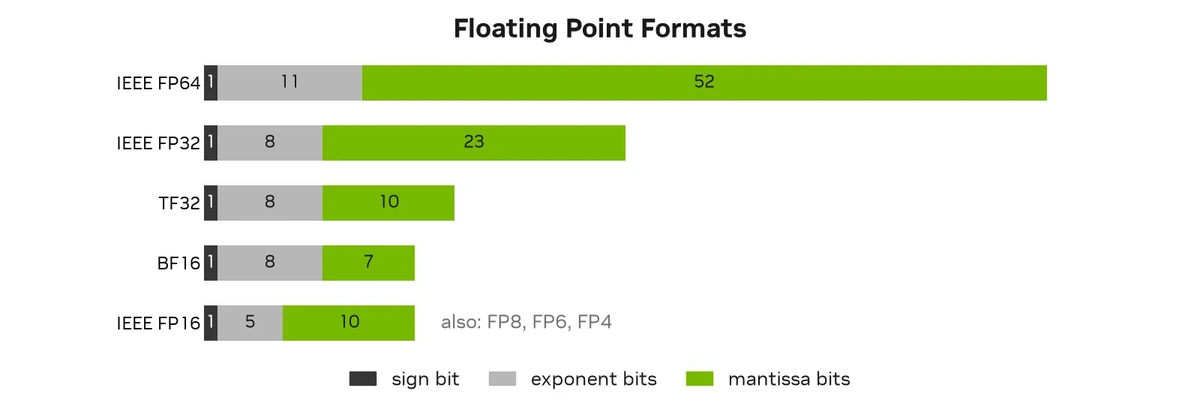
Batched Daviator still runs in FP64, and a mixed precision Davidson solver is hard to build. If you move kernels to FP32 and compare the result against FP64, you only learn "pass" or "fail". Meanwhile, soft failures such as energy drift, wrong convergence, or diverging MD trajectories can look entirely plausible. So the approach uses a generic floating-point type with a configurable number of mantissa and exponent bits. With it, each kernel's minimum required precision is found, and a decision is made: move it to FP32, rework it, or keep it as an FP64 "island". Results depend on the input and the threshold. Instrumentation should also cover dependencies and math functions, and the slow instrumented runs can be parallelized across HPC resources. Implementation starts with FP64↔FP32 conversions around the hot path and type-configurable kernels, and then the FP64 regions are shrunk from iteration to iteration.
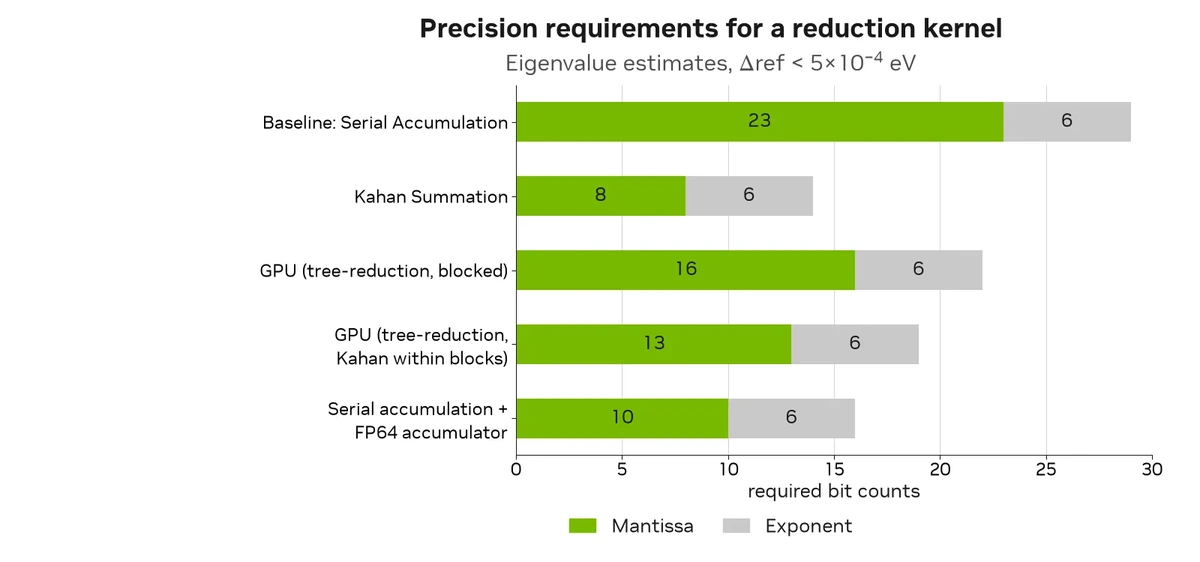
The Verificarlo-based analysis showed that FFTs, Hamiltonian application, and orbital updates can be moved to FP32. The subspace eigenvalue problem, energies, convergence measures, and the tall-skinny GEMMs used to build the subspace matrices stayed in FP64. These Rayleigh-Ritz GEMMs feed a sensitive eigensolver, so a split-k algorithm is used: dot products are computed in FP32 chunks, and the final summation is done in FP64. VASP's EDIFF threshold defaults to 10-4 eV and can go down to 10-6 eV and lower, while FP32 offers about 7 significant digits. The mixed solver converges to 10-4-10-6 eV depending on the input, and below the FP32 noise floor the calculation continues in FP64. On GaAsBi-64, FP32 gives a 2x speedup at EDIFF = 10-5 eV, and FP32→FP64 at 10-8 eV runs 1.5x faster than pure FP64.
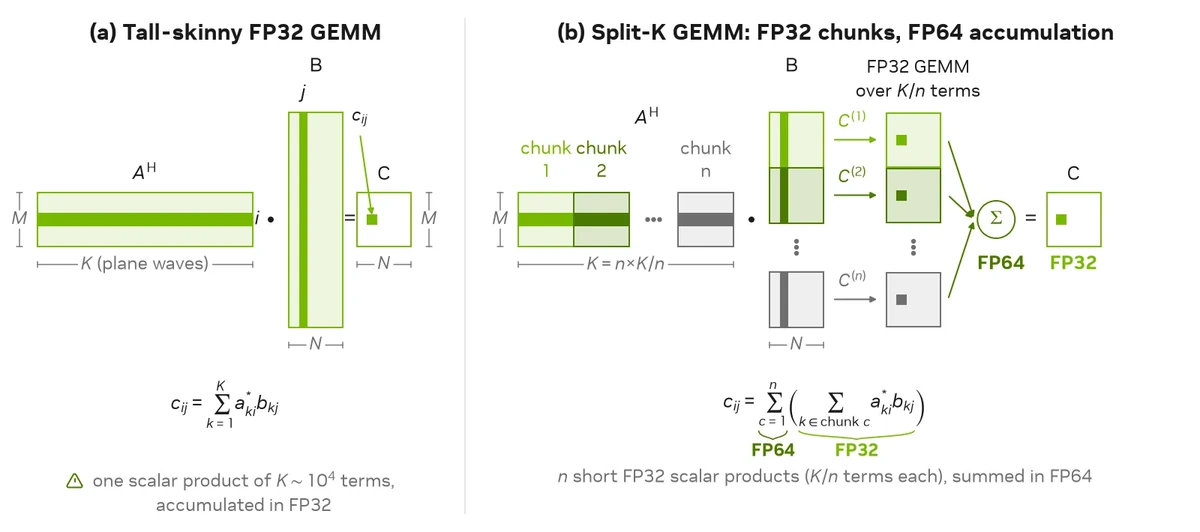
On H100 and H200, where FP64 Tensor Cores match FP32 throughput, the gains are marginal. On the RTX PRO 6000, however, the FP32 Davidson solver runs 3x-7x faster, and the whole calculation roughly 2x faster. Mixed precision is enabled with the LDAVIATOR_MIXED_PRECISION parameter (0 means FP64). Each ionic step starts with data stored in FP32 until DAVIATOR_EDIFF_FP32 or DAVIATOR_SWITCH_TO_FP64_AFTER_STEP is reached; 10-4-10-5 suits most inputs. The example sets EDIFF = 5e-07, LDAVIATOR = True, LDAVIATOR_MIXED_PRECISION = True, DAVIATOR_SWITCH_TO_FP64_AFTER_STEP = -2, and DAVIATOR_EDIFF_FP32 = 5e-05. A VASP license is required, and Daviator with mixed precision will run on any NVIDIA GPU through the ALCHEMI VASP microservice.