Optimizing Deep Rock Galactic: Survivor for Mobile
 Public
- 19 Sep, 2026
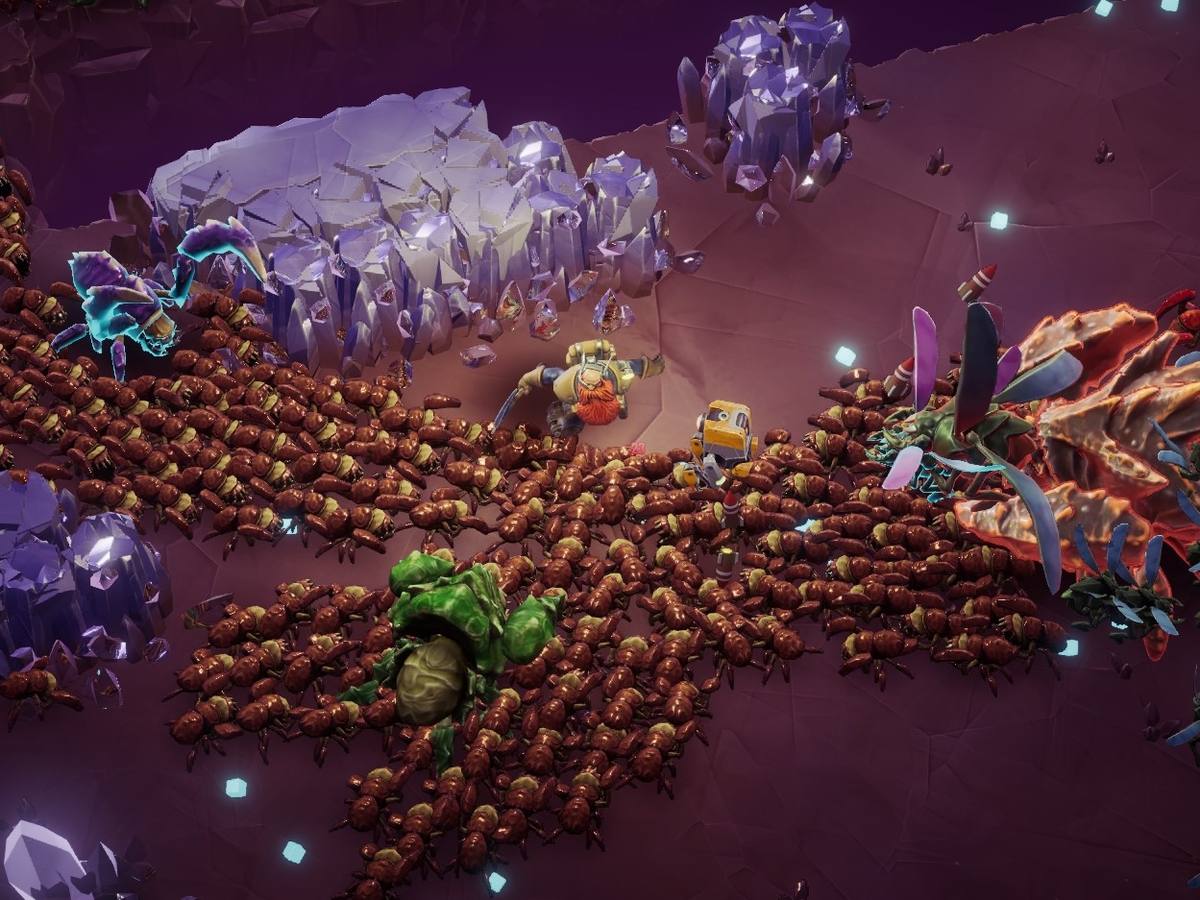
Bringing Deep Rock Galactic: Survivor to mobile meant taking a bullet-heaven PC game and making it run on hardware with a fraction of the GPU, CPU, and memory budget. The port was handled by Piktiv while the PC branch was still in active development, and the teams diverged enough that the merge ran one way only: from PC into mobile, never back. That split gave Piktiv the freedom to be destructive with the original systems, tearing apart established approaches and rebuilding them around a very different set of optimization goals. The core constraint was memory: nearly every target device carried 4 GB of RAM, except one iPad with only 3 GB. On that device the team had roughly 1,850 MB to work with, and going over meant a crash.
The performance work focused on the systems whose cost scales with enemy count. Damage numbers were originally GameObjects using TextMesh Pro, but generating a text mesh for a thousand enemies at once became a bottleneck. The fix was a standard Unity particle system with a spritesheet holding the digits 0 through 9. Pathfinding moved off the built-in NavMesh system, which struggles when thousands of agents each do their own pathfinding, and onto a flow-field approach where cost scales with area size rather than agent count. Physics queries were optimized with a KD-tree for spatial lookups, such as finding every enemy in a grenade's blast radius, though that required frequent rebuilds as enemies moved. Enemy rendering replaced roughly a thousand skinned mesh renderers with baked vertex animation: each keyframe is stored in a texture and played back by a GPU shader, cutting CPU cost to nearly zero and enabling GPU instancing on a single shared mesh and material.
The deeper technical details explain how these replacements work. The flow field inverts the cost model of pathfinding: a grid is laid over the level, and starting from the goal, tiles draw arrows pointing toward already-arrowed neighbors until the whole field is covered. The cost then depends on the area covered, not the number of agents, and it can be limited further by computing a bounding box around all enemies plus the player and only updating inside that region. The KD-tree divides space recursively so a point-and-radius query can quickly return everything inside it, standing in for heavier physics queries. These systems fed into a chain of Burst jobs, 10 to 15 dependencies long, that move all enemies outside the regular physics system, which significantly raised the frame-rate floor.
Addressables were central to fitting the 3 GB iPad limit. Because the game never shows more than one biome at a time, Piktiv broke out biome-specific graphical assets and settings so they load only when needed. The tradeoff is that Addressables introduce asynchronous behavior into previously synchronous code, and rebuilding a system to be async can be a major architectural challenge, but here it was the right fit. Testing relied on an automated measurement system running six scenarios across all biomes: a baseline with the player idle, a thousand enemies approaching, or 500 enemies plus automatically firing weapons. CPU, GPU, and memory were measured throughout, and the Unity Profiler drove early CPU audits. One scenario that spawned about 4,000 blue pickup cubes over ten seconds was a serious hit before optimization, after which it became unmeasurable. Level geometry, procedurally built from individual objects, was also batched with custom draw commands since the fixed top-down camera makes the visible box easy to compute.
For teams considering a similar port, the takeaways are less about any single trick than about data layout and collaboration between systems. Shuffling data in and out of components gets expensive when thousands of entities run every frame, so keeping everything in native containers and passing those same containers through the whole pipeline pays off. And a game that should have used ECS or the Data-Oriented Technology Stack doesn't need a full rewrite: this project leaned on the Burst compiler and native data types without converting the whole game. Deep Rock Galactic: Survivor is available on Steam, Xbox, the App Store, and Google Play.