How THE IRONY handles pre-baked dismemberment and heartbeat-driven blood spray in Unity
 Public
- 26 Nov, 2026
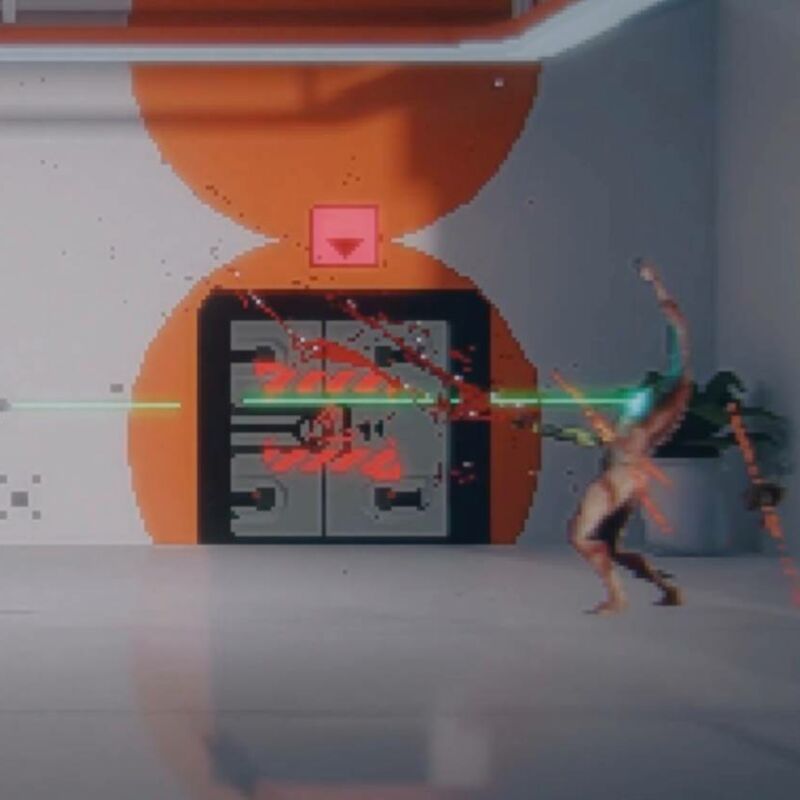
THE IRONY is a side-view sci-fi action horror game from indie studio SYLOPON. The game is built in Unity and clearly draws on Dead Space. Its core idea is strategic combat centered on dismemberment, translated into a side-view perspective. Visually, the game mixes gritty 3D with pixel-style art. When a character loses a limb, blood sprays from the exposed wound, and the stains on floors and walls depend on the character's posture and the surroundings. Those stains do not fade: they stay on level surfaces for the entire playthrough.
To keep runtime costs down, much of the work was moved to the Unity Editor. Severed meshes and spatial search data for surfaces that can receive blood are prepared in advance. During gameplay, a dismemberment event simply swaps in the prepared meshes, while blood trajectories and their collision points with the level are computed at runtime. The developers also considered real-time cutting, as in Metal Gear Rising: Revengeance. Spreading that work over several frames would lower the per-frame load, but the moment the cut completes would then depend on hardware and system load. Execution sequences in THE IRONY require limbs to come off at exact timings, so they chose pre-baking.
Cutting planes and masks for each body part are set up in a custom tool, the Dismemberment Editor. It lets the team inspect cross-sections on both the torso and the detached piece, tweak their UVs, and bake the result. Each body part costs extra production time and asset memory, but the exposed surfaces and their textures can be checked before release. At runtime, the severed part is pulled from an object pool, copies the character's bone pose at the instant of the cut, and starts physics simulation from that position. As a result, no mesh recalculation is needed when switching from animation to physics.
At first, the blood came out as one constant stream, and in a side view the pulsing of the artery didn't read at all. The fix: a pressure curve that decays over time is multiplied by a heartbeat curve, so spray volume and velocity rise and fall with each beat. To make the particles read as a single liquid, a compute-shader renderer writes particle density into a 3D grid and runs Marching Cubes over it: at a chosen density threshold it extracts a triangle surface, and nearby particles merge into a organic, natural-looking stream. If the stream becomes thinner than the grid spacing, holes can appear in it. In those cases, a tube-shaped surface is built along the flow direction instead, so there is no need to raise the resolution of the whole grid and pay for it in performance.
Stains were tuned for the side-view camera. Wall smears come from repeatedly stamping brushes with randomized position, size, and opacity so the pattern doesn't repeat, while ceiling brushes are stretched along the depth axis, otherwise the stains would look too narrow. Color depends on the surface under the blood and on how much of it has accumulated: a thin layer lets the surface show through, overlapping droplets darken toward deep red, and pooled blood gets reflective edge highlights that emphasize its thickness. Floor pools spread quickly when blood lands, slow down as they approach a target radius, and grow if more blood falls nearby.
Under the hood, it works like this: on impact, blood is stamped with brushes into a separate bloodstain mask keyed to the lightmap UVs, and brush size and shape drive pattern variety. Coverage is computed in world space, so stains flow naturally from one surface to an adjoining one, for example across a wall-floor seam. Bounding boxes of static surfaces are organized into a Bounding Volume Hierarchy (BVH) in the editor. At runtime, only the branches that overlap a brush's area of influence are traversed, and multiple stains on one surface are recorded in a single batch. As a result, new blood accumulates quickly while existing stains are preserved.