Foundry Releases Mari 8.0: More Than 50 New Nodes and an Updated VFX Reference Platform Specification
 Public
- 15 Oct, 2026

Foundry has released Mari 8.0, the latest version of its professional 3D texture painting software. A public beta was available starting in July 2026, and the final release focuses heavily on expanding the Node Graph, the node-based environment for authoring materials. The update includes more than 50 new nodes designed to streamline complex workflows. Most of them are dedicated to mathematical operations, but the release also includes specialized nodes for A/B comparisons, advanced color grading, and hex tiling textures. These enhancements give artists greater precision and flexibility when creating high-fidelity surface details for production assets.
A standout feature of this version is the new Tri-Planar Tiled node, which addresses common problems with UV distortion and seam placement. Unlike the existing Triplanar Projection node, which requires up to three separate images, Tri-Planar Tiled projects a single 2D texture onto a 3D model along the X, Y, and Z axes. This is particularly useful for models with serious UV issues or those with no UVs at all. The node offers extensive blending controls, including a Smart blend mode to preserve high-frequency details, noise-driven blending options, and customizable falloff ranges and curves. In addition, the new Hex Tile node minimizes visible texture repetition by tiling and blending textures in a hexagonal grid rather than a standard rectangular one. This hex tiling capability is now also supported in other key VFX tools, such as Houdini, Redshift, and RenderMan.
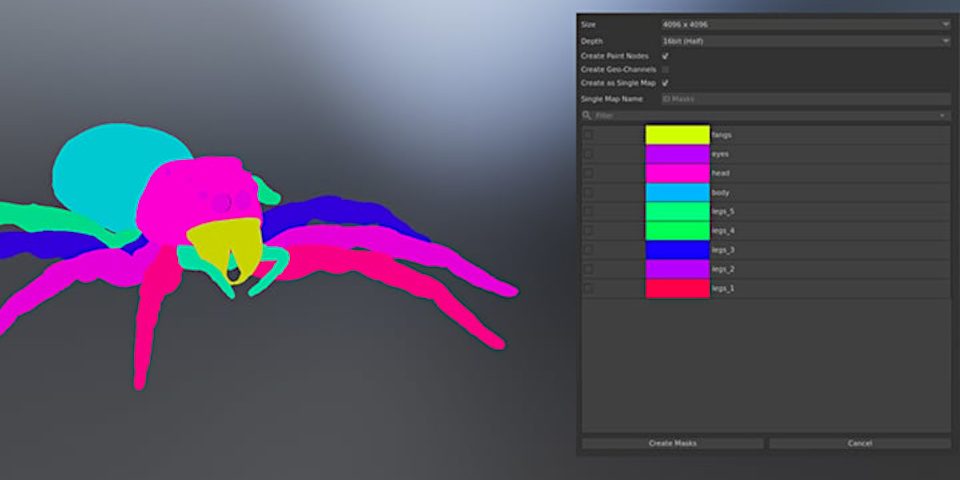
Further improvements to the Node Graph include a Compare node for A/B wipe comparisons between different node streams, allowing for easier iteration on material looks. The Color Remap node centralizes color grading adjustments, providing a single location for hue, saturation, exposure, and gamma changes. New Transform nodes offer mathematical and spatial control for procedural materials, including a Coordinate Transform node for driving inputs and a UV Radial Transform node for manipulating UV coordinates. The release also adds 49 new math nodes covering basic arithmetic, trigonometry, conditional logic, and advanced randomization. Mask generation has been significantly enhanced: it is now possible to create color ID masks from active canvas selections or Selection Groups. New Color Mask and Multi Color Mask nodes allow isolating a single color or stacking multiple target colors from surface colors, and a mask port can now be added to any node in the graph.
Workflow improvements in Mari 8.0 include trackball rotation-style navigation for the virtual camera, offering an alternative to the standard Orbit tool. Archived projects are now clearly identified in the library with visual indicators on thumbnails, and the Shelf search box supports logical operands for more precise term inclusion or exclusion. The software has also moved to the CY2025 specification for the VFX Reference Platform, a step forward from the previous stable release, which was five versions behind. Additionally, Mari 8.0 now includes read-only support for cameras in USD files. The software is compatible with Windows 11 and Rocky Linux/RHEL 9. Mari remains available on a rental-only basis, with individual subscriptions priced at $86 per month or $689 per year. Team subscriptions cost $1,289 per year, a $60 increase since the release of Mari 7.5.