Cinema 4D 2027.0: Advanced Scattering System, Liquid FX, and Nodes for AI
 Public
- 15 Oct, 2026

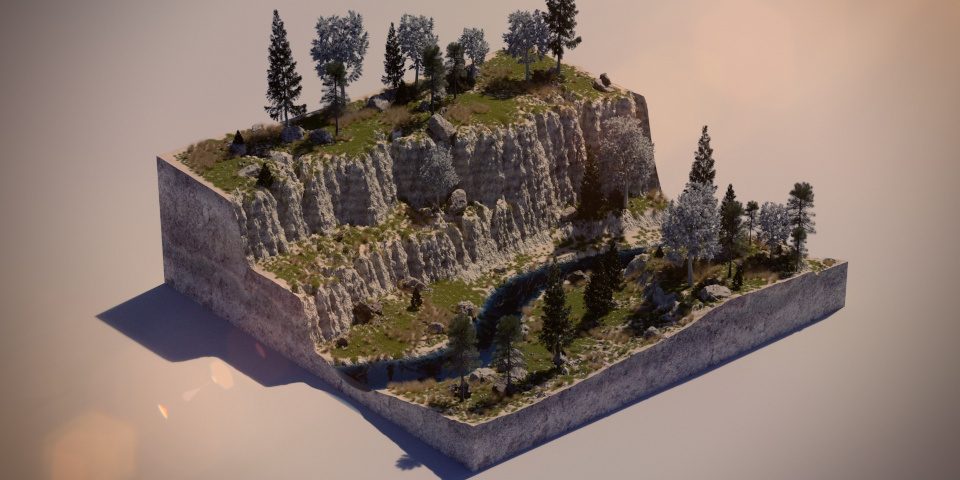
Maxon has officially released Cinema 4D 2027.0, the latest version of its professional 3D software suite for motion graphics, visual effects, and visualization. The update marks a significant step forward for layout artists and architectural visualization professionals by introducing a dedicated scattering system. Maxon describes this feature as one of the most requested among its users. It allows efficient population of complex environments with assets such as vegetation, rocks, debris, and even crowds. The system is built directly into the MoGraph toolset, providing a faster and more intuitive alternative to previous methods that relied on the Cloner object and Fields.
The new scattering system comprises two primary components: the Scatter Generator and the Scatter Tag. The Scatter Generator lets users distribute objects across surfaces, along splines, or according to UV layouts. Artists can fine-tune the distribution using texture maps for scatter and density, while Filters and Proximity settings allow precise restriction of objects to specific areas of the scene. Additional controls handle clustering and introduce random variations in position, scale, and color. The Scatter Tag complements this by allowing per-object overrides of scattering settings, offering granular control. This dedicated approach significantly simplifies the workflow compared to the manual setups required in earlier versions.
Liquid simulation capabilities have also been substantially enhanced with the addition of dedicated Liquid FX features. While liquid simulation was introduced in version 2025.3, it had limitations when working with large-scale scenes. The new update addresses these issues by adding tools for generating spray, foam, and bubbles. The Liquid FX Emitter analyzes existing simulation particles and emits new ones at fast-moving curved areas, creating realistic foam at wave crests and bubbles where air is trapped. The Liquid FX Modifier works throughout the liquid volume, directly converting existing particles into Liquid FX particles. This is particularly useful for effects such as rising bubbles in a glass.

The Scene Nodes system receives critical updates that bridge 3D creation with artificial intelligence. New Scene Nodes Field and Effector objects allow users to build custom fields and MoGraph setups from node graphs. Maxon highlights that the Field object is more efficient than the Python Field and more powerful than the Formula Field. Crucially, both new node types are compatible with the MCP Server introduced in Cinema 4D 2026.4. This compatibility enables control of these nodes by third-party AI tools such as Claude Desktop or ChatGPT Desktop, opening new possibilities for automated and AI-assisted animation workflows.
Workflow and pipeline integrations are further improved with support for importing a wider range of CAD data formats, including 3MF, 3DXML, IFC, and files from Autodesk Inventor, Siemens NX, Solid Edge, and PTC Creo. Motion designers can now paste cameras, lights, primitives, planes, text, and nulls directly into Autograph, Maxon's free motion graphics application. The software ships with Redshift 2027.0, which includes a new Fur procedural, updates to Redshift Live, and ACES 2 support. Cinema 4D 2027.0 requires Windows 11 or macOS 15.0+ and is available for rent at $109 per month or $839 per year.