Trimble releases SketchUp 2027.0 with procedural tools and USDZ support
 Public
- 30 Oct, 2026
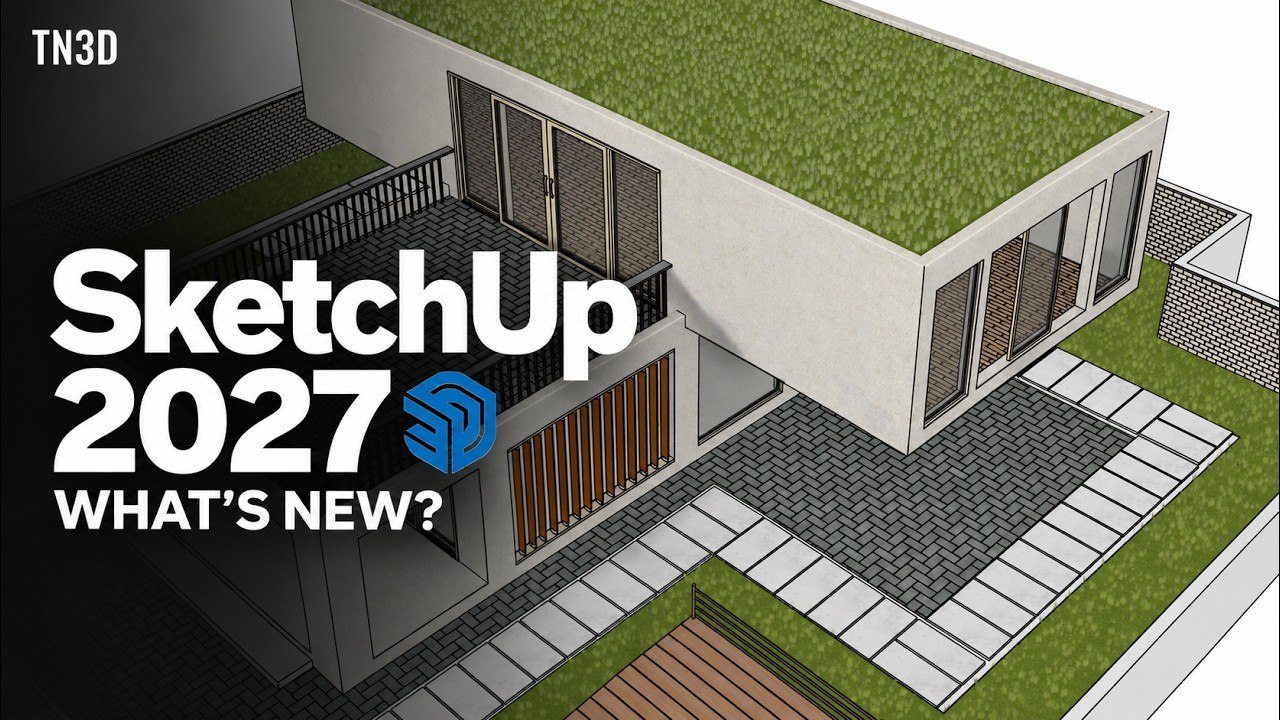
Trimble has officially released SketchUp 2027.0, the latest version of its architectural modeling software, which is also widely used by concept artists for roughing out hard-surface assets. This major update brings significant changes relevant to entertainment and development workflows, most notably the introduction of SketchUp Procedures. This new set of procedural tools allows users to create components that remain editable in a non-destructive manner, offering a distinct advantage over traditional fixed geometry approaches. The feature is described as an evolution of existing workflows, providing greater flexibility for artists who need to modify complex structures without starting from scratch.
The new procedural capabilities include the Copy Along tool, which lets users distribute objects along a specified path. In addition, the existing Follow Me tool, which extrudes a face along a path, and several of SketchUp's Solid tools used for Boolean modeling now support these Procedural Components. Beyond procedural generation, the desktop edition introduces a new set of hatch patterns that can be assigned to the interiors of objects when they are revealed along a section plane in cutaway renders. The Add Location command has also been upgraded to support coordinate reference systems, allowing users to assign precise geolocation data directly to their models.
Workflow improvements in SketchUp Desktop include a new interactive placement method for Live Components and the ability to sort component instances by tags in the Outliner. LayOut, the companion application for generating 2D documentation from 3D models, receives a new paperless canvas that allows drawing at a 1:1 scale. An Image Adjustments panel has been added to LayOut, letting users make simple adjustments such as opacity, hue/saturation, and brightness/contrast directly in the viewport, eliminating the need to switch to an external editor for minor tweaks.
SketchUp and LayOut now share a common interface on Windows and macOS, based on the existing Windows UI and supporting dockable toolbars and trays for panels. Hidden line rendering performance has been improved, reducing the time required to generate vector linework for complex models, although specific speed metrics were not provided. File import and export options have been expanded to include support for USDZ files in addition to USD, along with new tessellation quality, annotation, and metadata controls for DWG and DXF imports. The software is compatible with Windows 11 and macOS 15.0 or higher. Subscription plans range from $19.99 for the basic Go tier to $859 per year for the Studio tier, which includes a Revit importer.