TDK's Meta-Optics Mirror and Coherent Lissajous Scanning: The Return of Laser AR Glasses
 Public
- 14 Nov, 2026
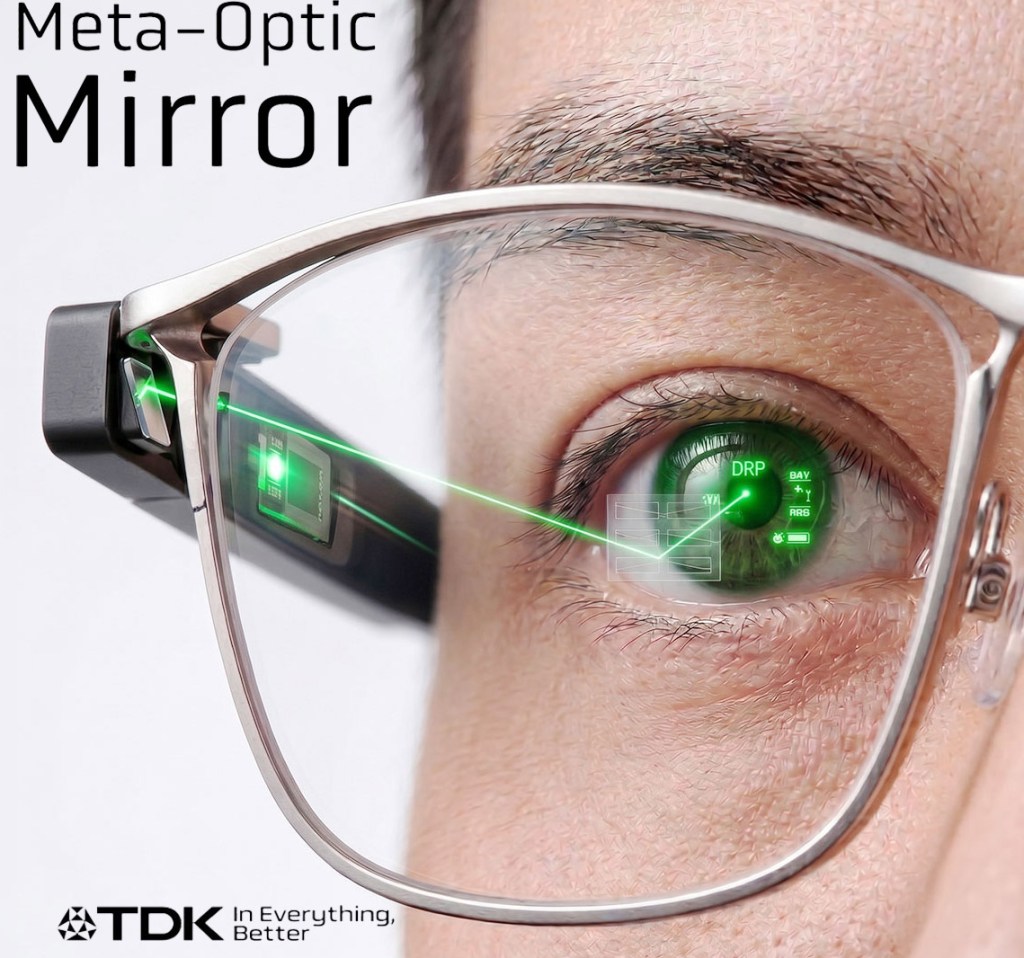
On October 2, 2026, TDK announced its Meta-Optics Mirror, a new kind of "free-air combiner" for AR glasses. The launch follows two deals earlier that year. In May 2026, TDK acquired the core assets, IP and staff of Oqmented, a company that built vacuum-sealed MEMS mirrors for Lissajous laser beam scanning (LBS). In June 2026, TDK signed a business cooperation agreement with laser maker QD Laser to develop retinal-projection optical engines for smart glasses. The two companies have worked together since at least 2020. QD Laser, a Fujitsu spin-out, has been showing LBS direct retinal scanning since at least 2016.
The deal changes TDK's direction. Oqmented had focused on waveguide-based LBS. In that setup, the waveguide expands the pupil, and the output behaves more like a flat-panel display: the light is no longer "Maxwellian," meaning it is no longer focus-free. TDK's mirror instead targets direct retinal projection, the path earlier pursued by Microvision, Bosch, North Focals, Intel Vaunt and Eyeway Vision. Waveguides offer a much larger viewing range and avoid the drawbacks of a free-air laser path from a temple projector to the eye. In free air, dust on a surface or a single hair crossing the beam can cast a large, sharp shadow over part of the image, and users may also have concerns about eye safety. TDK's website still lists the waveguide approach, so the company seems to be developing both paths.
The mirror relies on nanostructures between 200 nm and 1 µm in size that steer light from the scanner toward the eye. A plain mirror would reflect light from a temple projector at an angle that misses the eye entirely. The structure is made with a semiconductor-like process on a thin substrate. It can be embedded in an ordinary eyeglass lens, probably sandwiched between two lens halves the way waveguides are built today. In TDK's layout, the projector beam runs nearly parallel to the frame to a second mirror near the lens. From there it strikes the nano-reflector at a very shallow angle, which keeps the free-air path short. The current version works only in green, and the structure sizes are likely wavelength-dependent, as they are in diffractive waveguides. TDK says it is accelerating work on a full-color demo and aims for mass production "within the next few years." The term "meta-optics" here means flat optics with subwavelength structures and has nothing to do with the company Meta. Waveguide gratings with complex sub-100 nm substructures blur the line between gratings and metasurfaces anyway.
At MicroLED and AR/VR/MR Connect 2026, TDK showed a short working demo of what Oqmented originally called "Progressive Lissajous Scanning." TDK's website now calls it "coherent" Lissajous scanning, the same term Meta used at SPIE AR/VR/MR 2025, although TDK says it came up with the idea independently. In Lissajous scanning, a single mirror is driven by two sine waves, and the beam traces a path resembling a figure 8. Oqmented's fast axis runs at 20-40 kHz. Raster LBS is different: its vertical axis runs at about 60-120 Hz, while the horizontal axis runs at 20-60 kHz. In Lissajous scanning the slow axis is much closer in speed to the fast one, so the beam follows strongly curved, diagonal paths. Traditionally, pixels are written pseudo-randomly, whenever the beam happens to pass through them, with the laser modulated for both brightness and beam velocity. As a result, during saccadic eye movements the eye sees partial frames and the scan pattern itself.
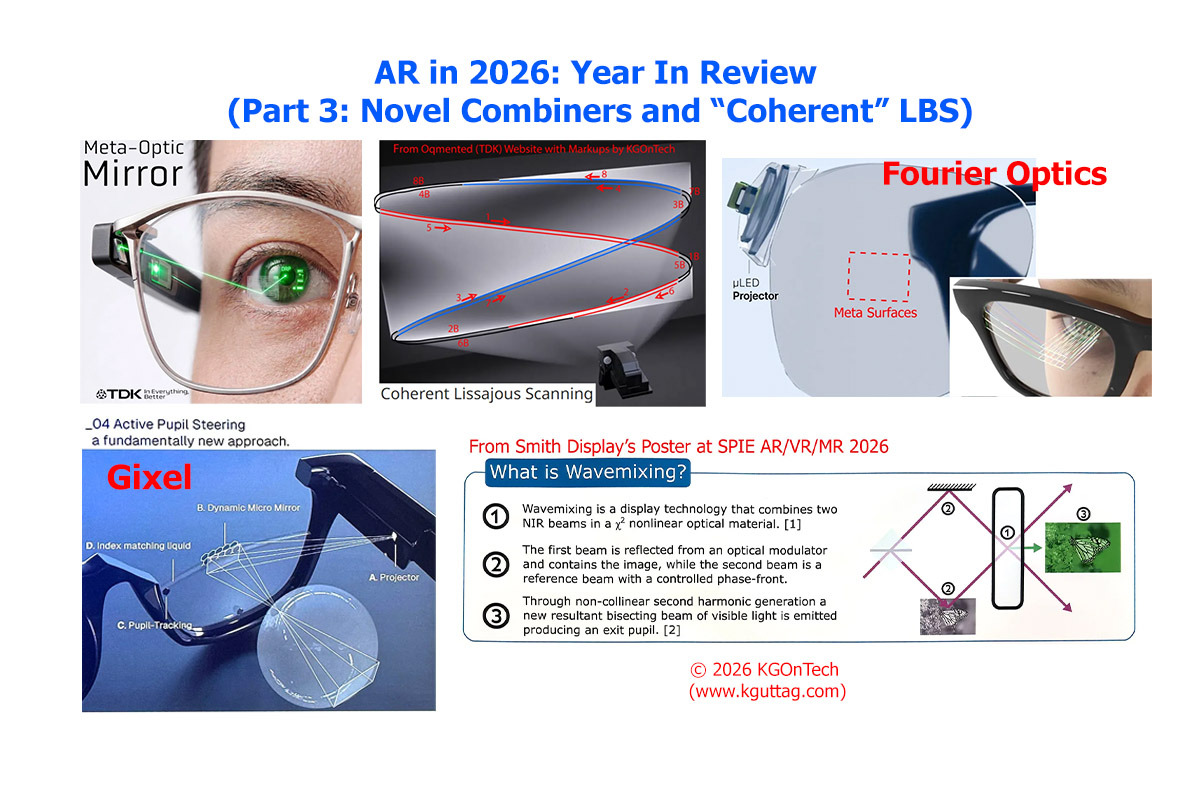
The coherent variant keeps the same mirror motion but draws pixels in sweep order, forming curved, raster-like segments. The laser is blanked while the beam slowly turns around at each edge of the sweep. This removes the saccadic breakup, but the fundamental limits remain. A rectilinear pixel grid has to be resampled onto curved scan lines that never land exactly on a pixel, and under basic Nyquist theory this costs roughly a factor of two in effective resolution per axis. To keep most people from noticing flicker, every point must be refreshed, even in the worst case, more than about 90 times per second. With a 40 kHz fast axis, that works out to around 300 effective lines after resampling. For comparison, NTSC used a line rate of about 15 kHz for 720×480 interlaced at 60 Hz, without any resampling onto a curved grid. LBS systems have historically had to trade flicker against resolution.
The low-resolution Oqmented/TDK prototype on display did eliminate the breakup, but some flicker was still visible. Among other combiner efforts, CREAL is working on an HOE combiner. More radical approaches are also emerging, such as Gixel's active mini-mirrors and Smith Display's non-linear crystal combiner.