Sirius becomes a DuckDB core extension and brings analytical SQL to the GPU
 Public
- 24 Nov, 2026
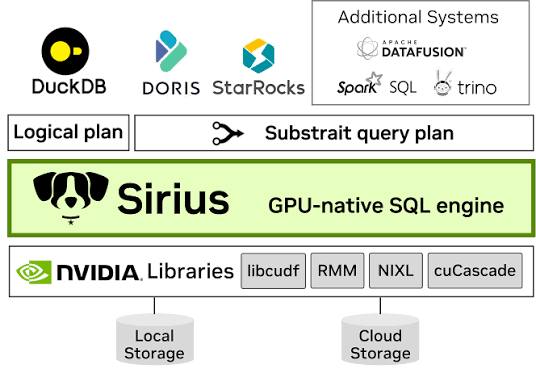
Sirius, an open-source GPU-native SQL engine built by the University of Wisconsin-Madison together with NVIDIA, is now available as a DuckDB core extension. It was released jointly by NVIDIA and DuckLabs. Supported analytical queries run on NVIDIA GPUs, with no need to rewrite SQL or change database schemas. The two engines split the work. DuckDB stays the SQL interface: it parses and optimizes queries. Sirius then executes the resulting query plan on the GPU as a whole and returns results through the same connection. As a result, existing scripts and applications keep working unchanged.

Sirius requires DuckDB 2.0 and an NVIDIA GPU with a compatible driver. A minimal walkthrough starts by opening a file-backed database with the command duckdb getting_started.duckdb and generating sample data through the separate TPC-H extension: INSTALL tpch; LOAD tpch; CALL dbgen(sf=0.01); CHECKPOINT;. The CHECKPOINT statement matters here: it persists the data to disk so Sirius can read native DuckDB tables. Next, INSTALL sirius; LOAD sirius; downloads the roughly 700 MB extension and activates it for the current connection. The correct CUDA backend for the installed driver is picked automatically. After that, ordinary SQL runs as before. A GROUP BY over the table lineitem, which sums l_quantity by l_returnflag, executes on the GPU and returns the expected totals. A dataset this small demonstrates the workflow only and is not meant to show a performance gain. The same approach applies to your own DuckDB tables and supported Parquet workflows. Queries that use unsupported features automatically fall back to DuckDB's CPU engine.
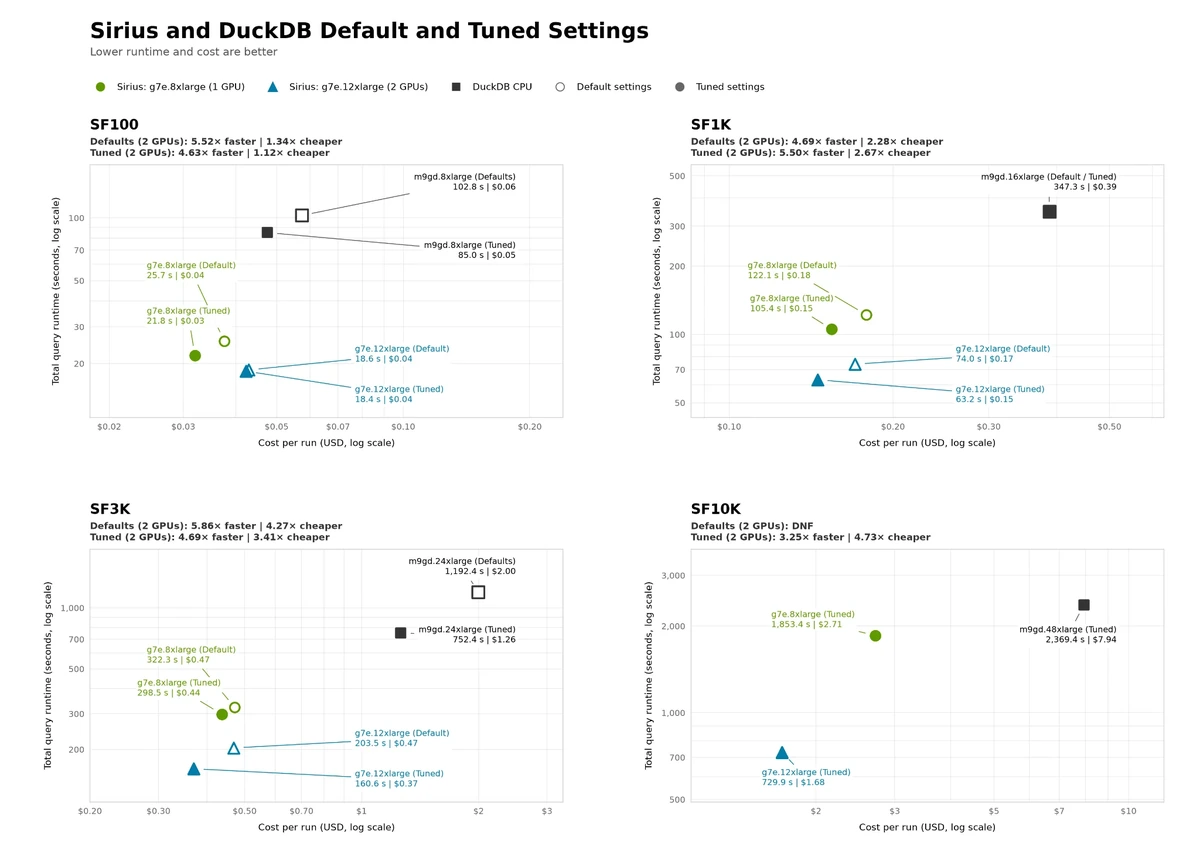
Performance was measured with cold runs of TPC-H-derived queries on data stored in Amazon S3, at scale factors from SF100 (100 GB) to SF10K (10 TB). Several conditions apply to these numbers: - Both engines used pinned development builds. - Sirius timings exclude result fetch/export, while DuckDB timings include CSV output. - Cost figures cover only measured instance runtime. They exclude startup, validation, storage, S3 charges and idle time.
With tuned settings, Sirius on AWS instances with two NVIDIA GPUs was 3.25x to 5.50x faster than the best tested CPU DuckDB configurations. Key results: - **SF1K:** runtime fell from 347.3 s to 63.2 s. - **SF3K:** runtime dropped from 752.4 s to 160.6 s, a 4.69x speedup, with about 71% lower query-time compute cost. - **SF10K:** the workload finished in 729.9 s versus 2,369.4 s, a 3.25x speedup, with about 79% lower cost.
The best configuration depends on workload size. At SF100, one GPU was the cheapest and two GPUs were the fastest. At SF10K, the tuned two-GPU configuration beat the tuned single-GPU configuration on both runtime and cost. Tuning is essential at this scale: the default two-GPU configuration never finished. The Sirius repository includes a benchmark runner, query definitions, configuration details, and setup instructions for reproducing the results on other hardware. Results will vary with query structure, dataset size, hardware, and cache conditions.