RizomUV 2027.0: Headless Mode and Advanced Texel Density Control for Production Pipelines
 Public
- 09 Oct, 2026
Rizom-Lab has released RizomUV 2027.0, the most significant update in the software's history, despite the version number skipping 2026. The release targets professional pipelines in game development, VFX, and motion graphics, enhancing usability, performance, and customization. The update introduces a new headless mode designed specifically for batch processing assets, automated build steps, and execution on render farms. This allows technical artists to integrate UV unwrapping directly into automated workflows without manual intervention, streamlining production for large-scale asset libraries.
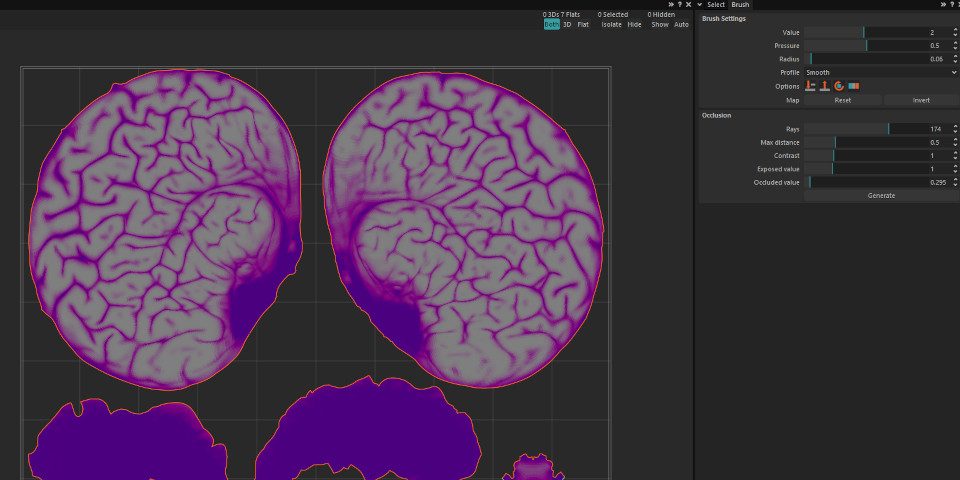
A key feature for game dev and real-time artists is the new map-based workflow for controlling texel density. Density maps can now be generated from ambient occlusion data, which allows the software to reduce texel density in recessed areas of a surface. This mechanism affects both UV unfolding and packing scale, giving artists precise control over texture budget allocation. In addition, the existing edge selection tools have been updated: edge loops can now continue through UV seams, and parallel selections can propagate across cuts, offering greater flexibility during the unwrapping phase.
The user interface has been fundamentally redesigned to improve day-to-day production efficiency. All panels can now be moved, docked, and set to floating mode, which makes it possible to create custom UI presets for different screen layouts. Artists can group frequently used tools into custom toolbars, and a new global search function provides quick access to tools and settings via hotkeys. The viewport has also been reworked to improve UI scaling and make it easier to preview selections and packing states. For complex assets, the Scene Outliner now supports polygon groups and materials from imported OBJ and FBX files.
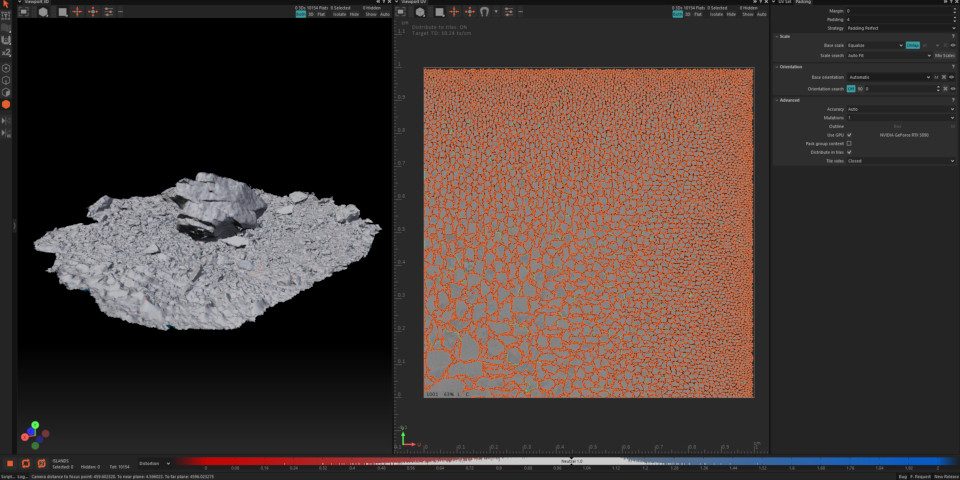
Performance has been improved through parallel processing of UV islands in a scene: the software automatically assigns the fastest available solver core to each task. A new Live Update setting shows the effect of adding or removing edge constraints in real time, eliminating the need to apply changes manually. For pipeline integration, the default scripting language is now Python: Linux and macOS use version 3.13 in accordance with the VFX Reference Platform spec, while Windows uses Python 3.12. The command log now records each work session as a script, allowing artists to save and reuse workflows that technical directors can later convert into more complex tools.
Import and export capabilities have been expanded with support for the glTF 2.0 format. Mac users now have access to USD support, which had previously been available only on Windows since version 2023.0. The software can now store more data, including UV constraints and pins, inside FBX files, and large FBX files can be opened selectively, similar to USD. RizomUVLink, the live connection used by DCC bridges and studio tools, now runs on macOS and Linux in addition to Windows. However, third-party plugin developers are responsible for updating integrations for DCC applications, since Rizom-Lab does not maintain them.
RizomUV 2027.0 is compatible with Windows 10 and later, macOS 11.0 and later, and Linux distributions including RHEL, Rocky, Alma 8/9, and Ubuntu 24.04. Licensing options differ between Indie users (artists or companies earning under €100,000 per year) and Pro users. Indie users can choose between a rent-to-own model or a perpetual license, both node-locked to two computers. Pro users operate under a rental-only model with the option of floating licenses. The Virtual Spaces edition starts at €149.90 for a perpetual license, while the Real Space edition starts at €299.90.