Realistic Cloth Simulation on a Dancing Skeleton in Blender
 Public
- 04 Nov, 2026
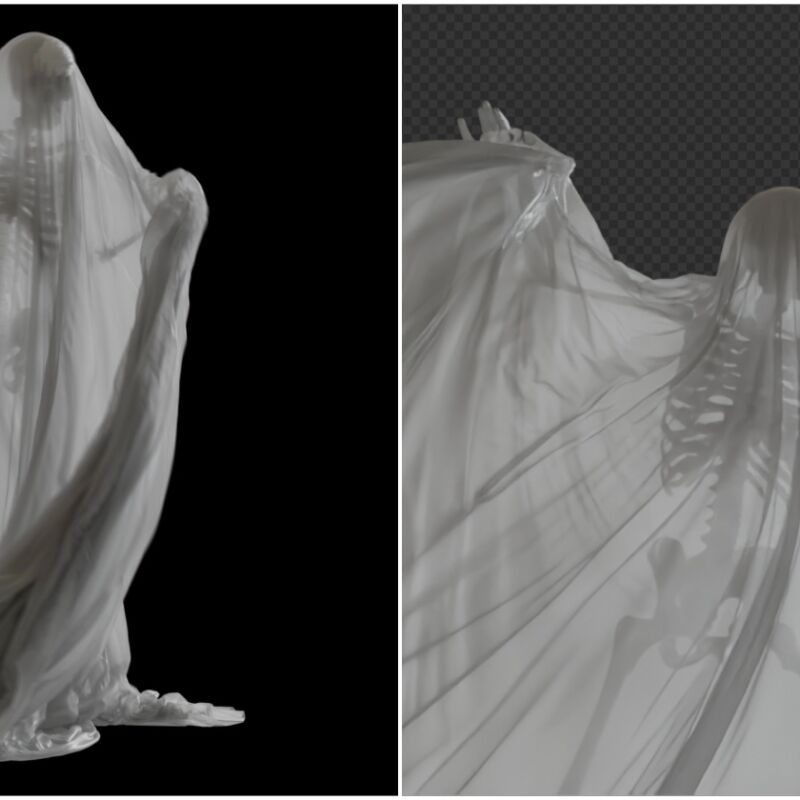
The project began as a concept for a dancing ghost but evolved into a revival of a previous skeleton model. The artist rigged the character using AccuRIG and combined dance animations from Mixamo, ActorCore, and Action Forge via Blender's Action Mixer tool. After baking the animation into keyframes, the bones were removed to leave a clean mesh ready for simulation. The primary goal was to create fabric thin enough to reveal the skeleton's silhouette when backlit.
For the cloth physics, the open-source ZOZO Contact Solver was employed. This GPU-accelerated engine handles complex interactions between cloth and solids. To ensure accuracy, a highly subdivided circle made of triangles was created. A sheer fabric material preset in .toml format was loaded into the solver before running the simulation. The high mesh density significantly impacted performance, requiring nearly two hours to solve the simulation. Despite the long wait, the resulting motion was deemed satisfactory for the final look.
The visual presentation relied on a procedural sheer shader material sourced from BlenderKit. Lighting was carefully constructed using an HDRI and an area light to enhance the silhouette effect through the translucent cloth. The scene was rendered in Cycles at 100 samples. The rendering process took between 30 and 40 minutes on a system equipped with an AMD 9950X CPU, 64 GB of RAM, and an RTX 5070 Ti GPU with 16 GB of VRAM.
This workflow demonstrates the practical application of specialized physics add-ons in Blender. The combination of baked keyframes and high-density mesh simulation allows for detailed cloth behavior without real-time constraints. The use of open-source tools like ZOZO provides accessible alternatives for complex simulations. The final output showcases how technical setup, including mesh density and solver presets, directly influences the realism of fabric movement in animated scenes.