NVIDIA cuPhoton.xBeam moves black hole interferometry data correlation to the GPU
 Public
- 14 Nov, 2026
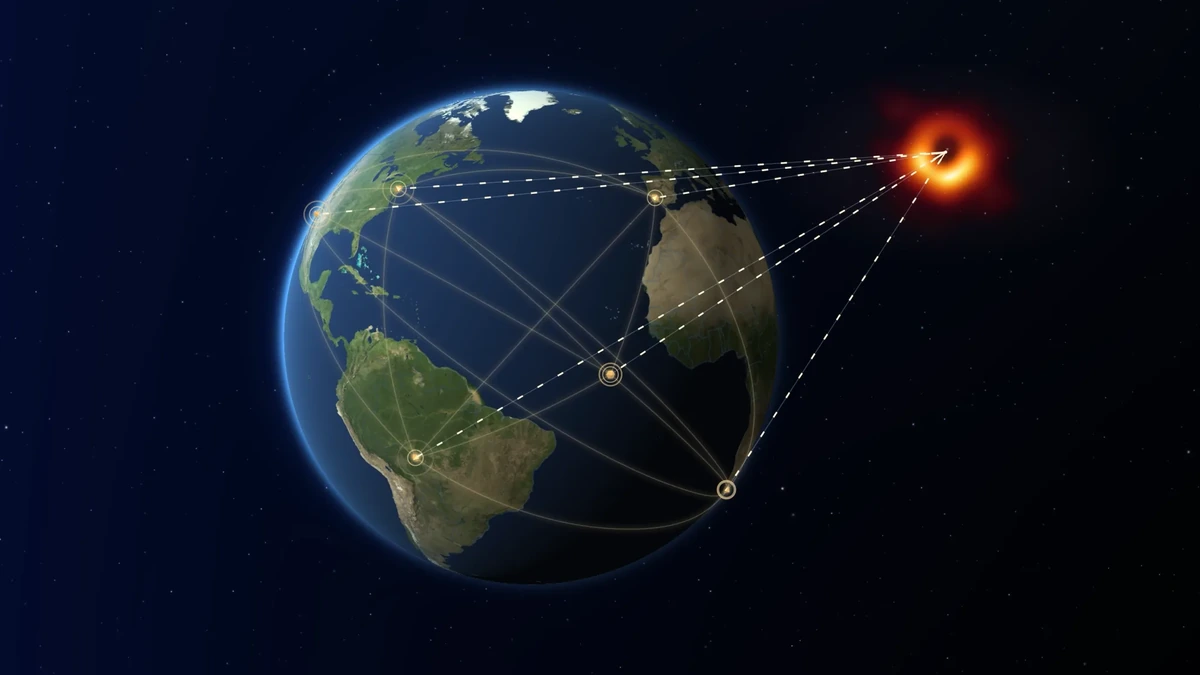
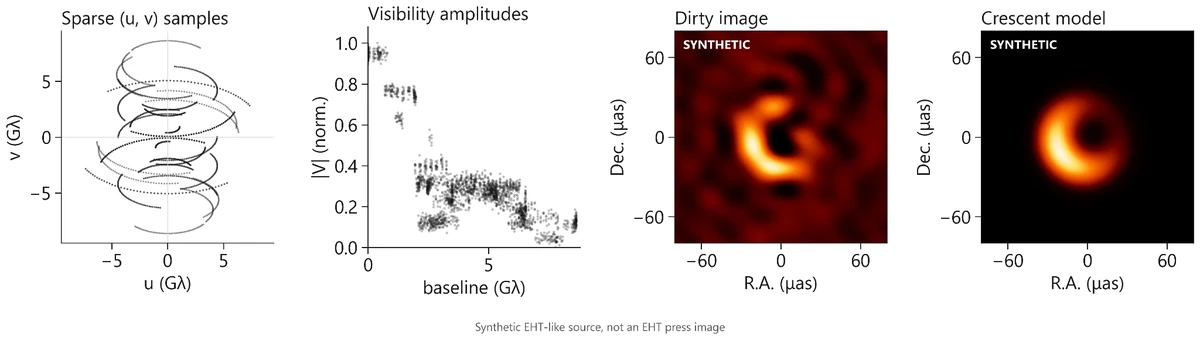
Imaging a black hole means resolving something tiny: the observed ring of M87* spans just 42 microarcseconds. The Event Horizon Telescope (EHT) links 13 radio stations, including sites in Hawaii, Chile, Spain, Mexico, and the South Pole, through very-long-baseline interferometry (VLBI). Each station records two polarizations at up to 64 gigabits per second, producing petabytes of voltage data. Correlating telescope pairs yields visibilities, which are sparse Fourier samples of sky brightness along tracks traced by Earth's rotation. Reconstruction algorithms must then solve an inverse problem from those samples. Variable sources such as Sgr A*, which change during an observing session, make this harder still. The next-generation EHT (ngEHT) plans to add more sites to improve image quality and track changes over time.
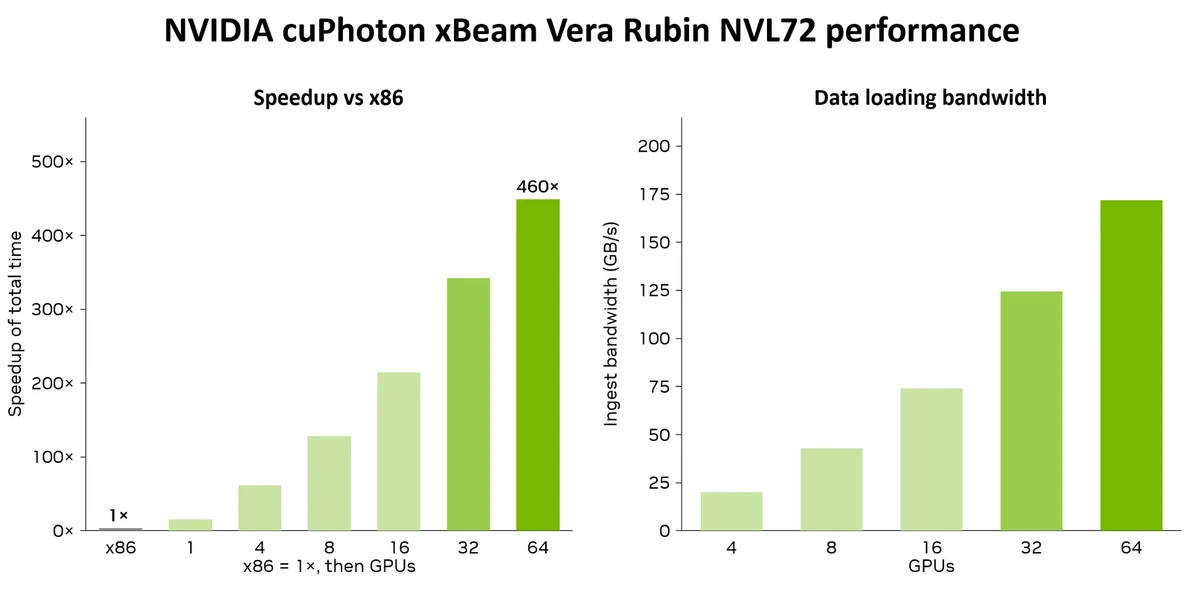
NVIDIA's cuPhoton.xBeam is a GPU-based FX correlator. From raw recordings, it produces one complex visibility per station pair, frequency channel, and short time interval. The correlator was developed with the Harvard-Smithsonian Center for Astrophysics and MIT Haystack Observatory. On an NVIDIA Vera Rubin NVL72 system, it processed a 10 TB dataset in 70 seconds. This required 64 GPUs and GPUDirect Storage in compatibility mode. That is about 460x faster than an x86 CPU baseline, which took 31,992 seconds (8.89 hours). Downstream calibration and imaging, such as 3D gas models built with Gaussian splatting, are not part of cuPhoton. xBeam does not compute delays from station positions or trace light paths. Results are validated against DiFX, the open-source CPU correlator, and tools such as HOPS, rPICARD, and eht-imaging consume the output.
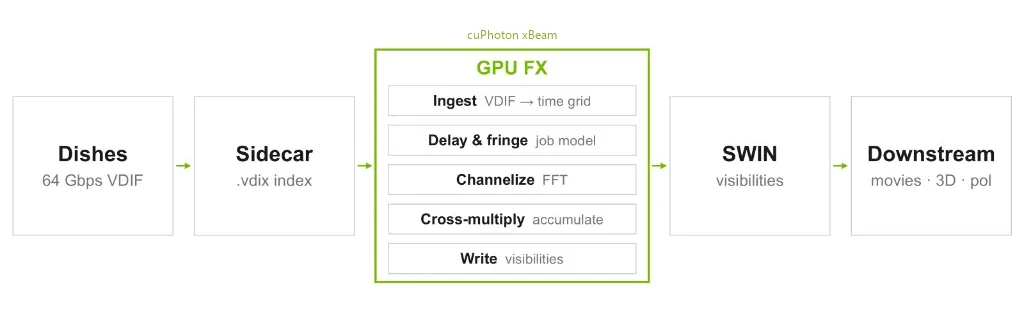
The pipeline has five stages. At the ingest stage, each VDIF frame is placed at its correct time. A .vdix sidecar is written alongside it, indexing frames by timestamp, thread, and physical location without copying the data itself. Missing or invalid data is explicitly marked along the way. At the delay and fringe correction stage, the data is aligned to the nearest whole sample before the FFT, and fringe rotation is applied. The remaining fractional delay is compensated by a frequency-dependent phase correction.
The delay comes from the job file. It is composed of a geometric polynomial around t0, a per-station clock offset and drift, and a per-band clock offset. Within one FFT, the delay can be constant, linear, or parabolic, set by the fringe_approximation_order parameter (0, 1, or 2). At the channelization stage, an FFT is run for each station. At the cross-multiply-and-accumulate stage, one station's spectrum is multiplied by the complex conjugate of the other's. Invalid input is masked, and the result is normalized by exposure weights. The output is in DiFX SWIN or xbeam-v1 format.
Version 0.1.3 accepts a normalized JSON job (schema version 1) or a supported DiFX .input file. It lists stations, clocks, frequencies, VDIF datastreams, baselines, and scans. The output directory must be new. The command cuphoton xbeam inspect-vdif RECORDING.vdif --json reads headers only. The command build-vdif-sidecar with parameters --index-dir, --backend cufile (or posixif GPUDirect Storage is not available) and --devices creates reusable indexes while the source files stay unchanged. The command cuphoton xbeam correlate JOB.json with --backend cupy runs correlation on the GPU. By default, data is read through POSIX into pinned host memory, and with --vdif-io cufile - via GPUDirect Storage. Options include --scan, --first-integration and --integration-count. From Python, you can call load_job and correlate with CorrelationWindow and yield records one at a time, but SWIN writing is available only from the CLI.
For recordings with gaps, there is a profile --profile interop-real-usb-buffered-window-replay-v1. With it, samples within a retained buffer continue to be consumed using the existing time reference until a new anchor appears. The profile also determines which FFT blocks contribute and how weights are reported. It does not recover lost samples, and full weight does not guarantee complete data. Without the profile, frames are aligned by header timestamps, missing slots are marked invalid, and visibilities and weights may differ. Scaling splits a scan in time. On one node, --devices 0,1,2,3 launches one process per GPU, writes results into RUN/shards/, and merges them. Across nodes, each process sets --shard-count and --shard-index, for example 64 with indices 0-63, using identical scan and integration settings. Then merge-shards then joins the partial SWIN outputs.