Meta is releasing "Hologram" avatars, with Ray-Ban Display glasses getting them first
 Public
- 28 Sep, 2026

Meta's long-promised photorealistic avatars are finally about to ship, and the company is calling them Holograms. Rolling out over the next few months, they appear first on the Meta Ray-Ban Display smart glasses, the model with a single see-through display in the right eye. Previously known as Codec Avatars, Holograms are also coming to the newly announced Meta VR Glasses, though those won't arrive until Spring 2027.
The creation process differs sharply from Apple Personas, which scan your face with Vision Pro's built-in depth sensors and RGB cameras. Instead, you use Meta's iOS or Android app and the phone's selfie camera, following on-screen prompts: improvising an answer to "What's your favorite kind of day?", reciting a short statement and then laughing, smiling, and turning your head side to side.

On Display, Holograms are driven entirely by voice, so the AI does the heavy lifting to make your digital copy move naturally. The feature ships first in early access, but only in the US and only for WhatsApp video chats. In practice the simulacrum is close but not exact, and a tiny ghostly Hologram icon in the lower-left corner of the chat signals that you're talking to an avatar rather than a real person. Because the right-eye display is so small, the call looks like a flatscreen experience, aimed more at smartphone users than at Display wearers themselves.
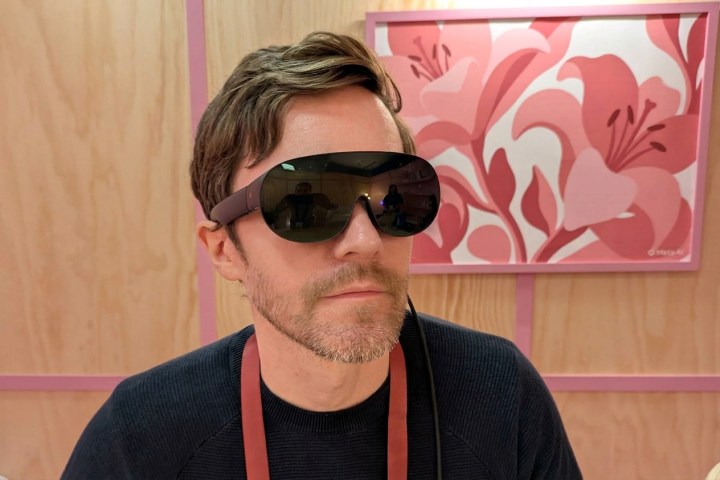
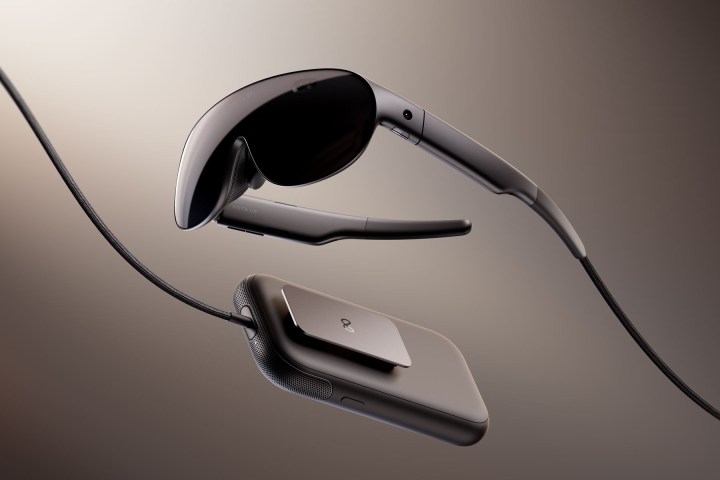
VR Glasses change the picture: they add both eye and face tracking via downward-facing sensors, a detail confirmed in the demo but left out of the keynote. The result is a full-body avatar, created the same way as the smartphone scan but capturing the user from head to toe. The avatars have a distinct 2.5D quality: the stereoscopy feels 3D only when viewed straight-on from a distance, but there is no real depth, so they can't walk around a room, fist-bump, or hand over a virtual object.
All the hand poses, hair movement, and the flapping of a shirt hem as the avatar shifts poses are generated by AI. The flat-depth design looks like a deliberate choice, distancing the product from Meta's earlier metaverse ambitions and yielding avatars that are good enough for one-on-one chats. Compared to Apple Personas, Holograms lack true 3D depth, while Personas remain realistic floating heads with actual depth and uncannily good face tracking.