A Medieval Town in Unreal Engine 5: Modular Assets, Trim Sheets and Displacement Instead of Geometry
 Public
- 25 Nov, 2026
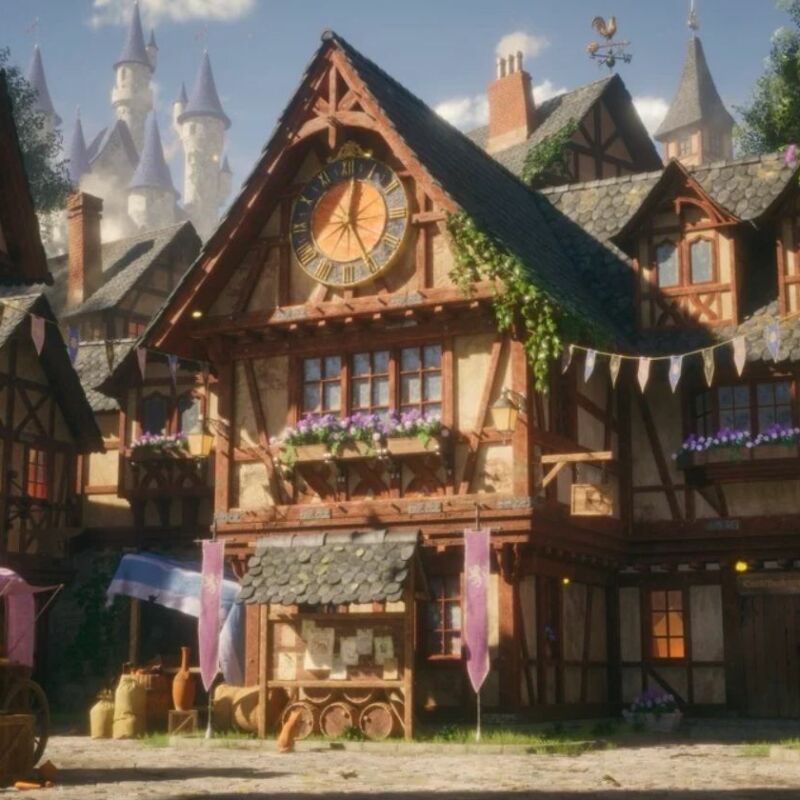
A densely packed, sunlit medieval town built in Unreal Engine 5 shows how a full game environment pipeline fits together, from references and blockout to final renders. The scene was made by Wang Yifan, a fourth-year Digital Media Art student at Xihua University in Sichuan. The work took about five months and is his first complete environment in UE5. The toolset was 3ds Max, ZBrush, Substance 3D Painter, Substance 3D Designer, SpeedTree, RizomUV, Marmoset Toolbag and UE5. The medieval theme was chosen because it offers a wide range of asset types: stone walls, timber structures, roof tiles, cobblestone paths, props and vegetation.
The composition recreates a scene by 3D environment artist Shannon Welsh. The Witcher 3: Wild Hunt and Kingdom Come: Deliverance served as style references, and photos of Western European medieval towns informed how stone and timber were used there. References were gathered by stage: layouts and streets first, then specific assets, then photos of stone, wood and metal for materials. Once the composition was locked, a whitebox defined road directions, building placement, the focal point and proportions. Only after that did asset production begin, to avoid costly rework once models were finished.
Each asset's method depended on how often it repeats, how visually important it is, and what it costs in performance. Repetitive pieces such as walls and beams were modeled as low-poly in 3ds Max, textured with trim sheets and tileable materials from Substance 3D Designer, and assembled into buildings in UE5 through Blueprints. Unique hero props, like the wooden cart and the central bell, went through a full pipeline: mid-poly in 3ds Max, high-poly sculpting in ZBrush, baking in Marmoset Toolbag, texturing in Substance 3D Painter. Roof tiles used a Designer material with UE5 Displacement, with real geometry only along eave edges where the silhouette matters. Cobblestones used the same approach in three variants: intact slabs, mossy gaps and puddles.
Optimization was done by hand in 3ds Max: silhouettes, curves and details visible to the camera were kept, while flat and hidden faces were simplified. UVs were unwrapped in RizomUV: hero assets got dedicated UV space, while reused modules relied on trim sheets to cut down on UV and texture work. Designer handled procedural base materials and reusable logic, while Painter covered localized wear, stains and unique details. Wear was placed logically: mud and dust at building bases, chips on protruding edges, moss and dirt in the gaps between stones. The cart combines wood grain with worn edges, fabric folds and stains, and oxidized metal, all tied together by an overall layer of dust and the ambient color.
All vegetation was made in SpeedTree: grass and small plants were scattered in batches, while large trees were placed by hand so they support the composition. Buildings, barrels and crates were also placed manually, while fruit in baskets, leaves and twigs were dropped with gravity simulation and then adjusted. Repetition was broken up with rotation, scaling and different material states, for example intact and damaged walls with exposed bricks. UE5 vertex painting was used to blend these states locally, and decals added stains and damage. The core composition was finished before the medium and small details.
The sunny afternoon mood was first explored with broad reference images from ChatGPT and Gemini to judge sun direction and color temperature, and then rebuilt in UE5 for the actual scene. Lighting used Directional Light, Sky Light, Post Process Volume, Lumen and a light Volumetric Fog, which adds depth and atmospheric perspective. A LUT made in Photoshop was imported into the project, and then color temperature, exposure and shadow hue were tuned so the image stays warm without turning yellow or crushing the blacks. Renders were made with Movie Render Queue. The main lesson: modeling, UVs, materials, vegetation, assembly, performance and lighting all depend on each other. Beginners should move early from practicing individual programs to small complete projects.