Kotlin Benchmark 2.0: Harder Tasks, Closed-Source Code, and a Network-Isolated Sandbox for AI Agents
 Public
- 23 Nov, 2026
JetBrains has released the second version of the Kotlin Benchmark, a set of real repository-level tasks for evaluating how well AI agents write Kotlin code. The first release in July contained 105 tasks. The updated version better reflects what Kotlin teams actually work on. The new tasks come from projects in different Kotlin domains, and solving them requires changes across multiple files. Another 30 tasks come from private repositories. Each agent-model configuration gets 30 minutes per task. This is enough to work through complex problems while keeping the full evaluation run manageable.
The stricter setup is needed to keep agents from reward hacking. When a task comes from a public issue that has already been closed, an agent can simply find the existing fix instead of deriving one from the code. Preliminary runs showed agents doing exactly that. Open-source tasks now run in a stricter sandbox: the only allowed outbound traffic is calls to the model itself. Dependencies are cached in advance, and repository history is hidden. Agents are also told explicitly that the network is disabled, so they do not keep trying to connect. Closed-source tasks keep network access, because their fixes are not published anywhere.
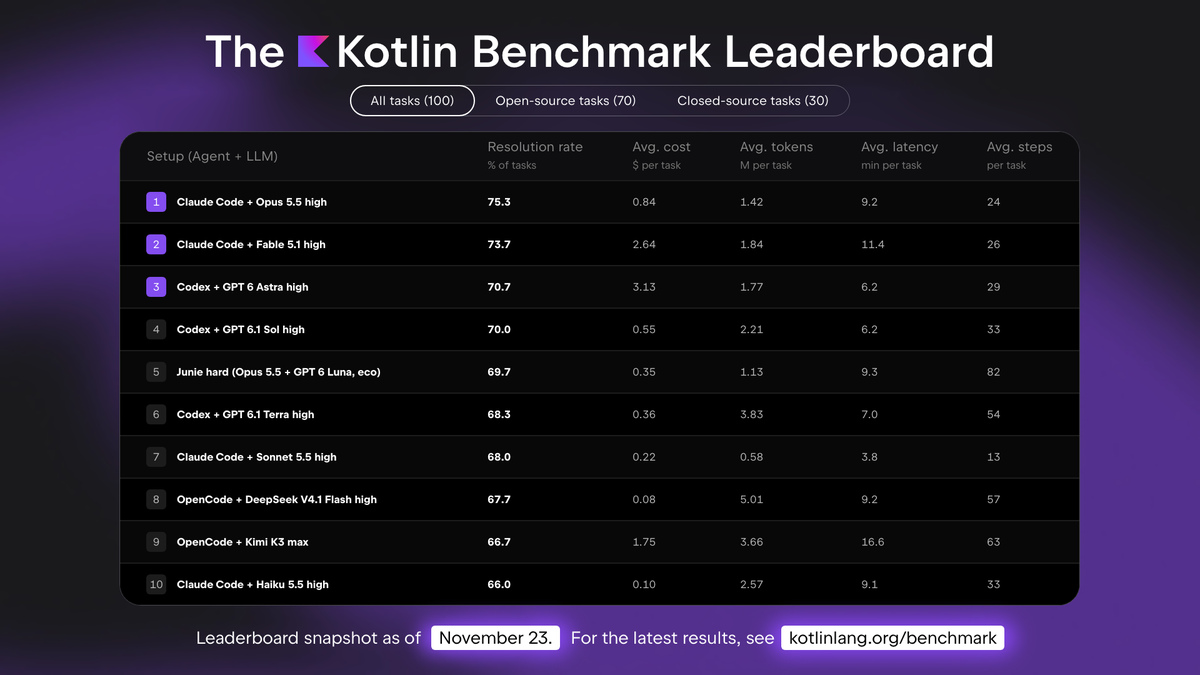
The sandbox cannot rule out data contamination, because public repositories and their fixes may already be in a model's training data. That is why the 30 private tasks were added to the suite. On the full combined suite, Claude Code with Opus 5.5 scored highest at 75.3%, with an average cost of $0.84 per task. The other 12 configurations resolved between 54.3% and 73.7% of tasks, at $0.02 to $3.14 per task.
On the open-source set, Claude Code with Fable 5.1 led with 86.2%, at an average cost of $2.38 per task. Claude Code with Opus 5.5 followed at 84.8% for $0.68 per task. Junie using Opus 5.5 and GPT 6 Luna scored 79.5% for $0.33 per task. The closed dataset consists of Kotlin server-side tasks. There, Antigravity CLI with Gemini 3.8 Flash scored best at 60%, costing $1.74 per task. OpenCode with Deepseek V4.1 Flash was close behind at 58.9%, for just $0.08 per task.
The new suite is harder, so scores are not comparable with the first release. A lower number does not mean a model got worse, and comparisons should stay within one benchmark version. A task counts as solved only if the generated patch passes the required tests. Results are a comparison signal, not a guarantee for every codebase. The practical approach is to shortlist configurations from the leaderboard and then validate them on representative tasks from your own projects. The leaderboard will be updated as new models are evaluated. The methodology, public tasks, and harnesses are available on GitHub, and JetBrains plans to publish follow-up analyses showing where agents fail and what Kotlin and its tooling should improve.