How RUST LTD Built a Deep Firearms Simulation for H3VR2
 Public
- 26 Sep, 2026
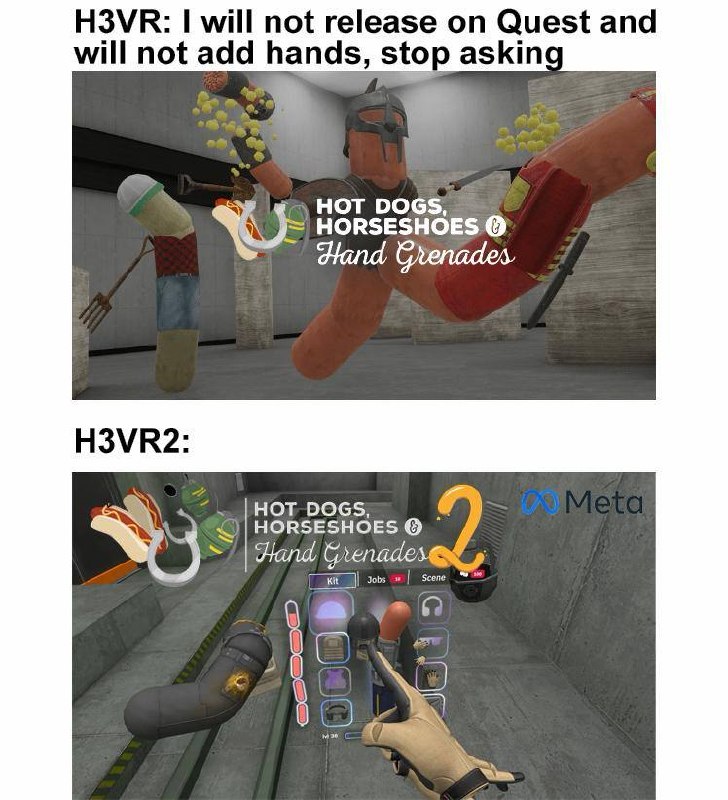
Hot Dogs, Horseshoes & Hand Grenades 2 (H3VR2) is a standalone VR physics firearms sandbox built around an extraction roguelike mode called Facility, alongside a Challenges Range and the sandbox collection itself. Rather than porting the original game, RUST LTD chose a ground-up rewrite, opening a fresh Unity project instead of carrying forward a decade of technical and design debt. The team spent nearly six months on pure architecture and tooling before beginning full content production, reasoning that systems had to scale to a five- or ten-year pipeline of content additions, and grew to more than twenty people working across five time zones.
The simulation is built around feeding in real-world data. The team starts with classical research, actual books and technical documentation, then constructs models that converge the real data toward behavior that reads as realistic while still working in game. With hundreds of guns, cartridges, and materials planned, this systematic approach pays off downstream: adding a new cartridge means looking up projectile mass and cartridge characteristics instead of inventing a magic gameplay number. In practice the work approaches real gunsmithing, with values such as spring constants, component masses, and cartridge pressure-curve data entered directly, and a firearm cycles incorrectly if one of those values is wrong.
NVIDIA PhysX is used only for a restrained slice of the stack. Because game physics engines struggle with tiny components moving inside a local reference frame while the parent object is carried or thrown, the internal firearm components run in bespoke simulations that effectively live in their own universes, with forces and impulses translated back to the larger game space. At the game-space level, physics is used more directly, with the Sosig characters operating as perpetual physics ragdolls. At the small scale, component simulation is custom; at the other end, ballistics and much of the agent system run on a separate layer built with ECS for Unity and Burst.
ECS and Burst let the team spawn huge numbers of ballistic entities for firearms, explosions, and other systems, which raised fidelity rather than just meeting the original target. That enables smaller sub-step sampling for more accurate collision, better air-resistance modeling, and higher-fidelity penetration as projectiles move between materials. Performance was treated as a first-class concern from the start: the core simulation runs on ECS and Burst for the CPU, while sophisticated gun models consume much of the frame budget, forcing polygon count, texture memory, bandwidth, and environment structure to stay lean.
The move to Unity 6.3 was a step change compared to the original. Beyond quality-of-life gains like nested prefabs, the most impactful updates were SRP Batcher performance, shader compilation improvements, and on-tile post-processing. Shader compilation shrank large uber shaders on disk, and on-tile post-processing let the team remove a hand-written HDR tone-mapping pass that had previously been baked into shaders because a separate post-effect blit was too costly on standalone VR hardware. General Editor stability also mattered, since the project pushes a large amount of custom tooling.
Maintaining hundreds of mechanically distinct weapons relies on powerful Inspector tooling and data-driven authoring. Custom inspectors are calculation-, validation-, and analysis-centric tools built specifically around firearms, and the assets themselves become the single source of truth for configuration. Odin Inspector is central to this: it lets every programmer write custom inspectors with minimal work and hides the roughly 95-98% of a firearm's configurable surface that is irrelevant to any given gun. Technie Collider Creator 2 also saved hundreds or even thousands of hours of authoring physics hulls by preferring primitives and using convex meshes only where necessary.