How the "Grabber Tools" in Red Matter 2 Turn the Controller Into the Most Immersive Interface in VR
 Public
- 05 Sep, 2026
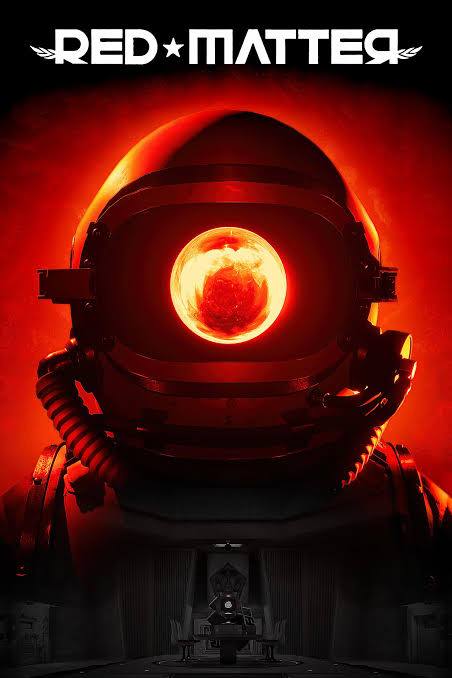
Red Matter 2, the retro-future adventure puzzle game released in 2022, contains a deceptively simple design choice that does far more for immersion than it appears to at first glance. The game has no visible hands, no floating menus, and no conventional heads-up interface. Instead, everything is driven through a set of "grabber tools," and, as it turns out, those tools quietly remove a whole range of small disconnects that gradually break the sense of presence in VR.
At the most basic level, the grabber tools take on the exact shape of the player's real controller. Whether you play on Quest, Index, or PSVR 2, you see a custom tool whose body, button layout, and even center of gravity match the hardware physically in your hand. That means the in-game hand is held exactly the way your real one is, eliminating the classic mismatch where a game renders an open hand while your fingers are actually wrapped around a controller. Because the tool mirrors your real controller, you can simply look down and read the buttons: an instant reminder of the controls, with no menu and no peeking outside the headset.
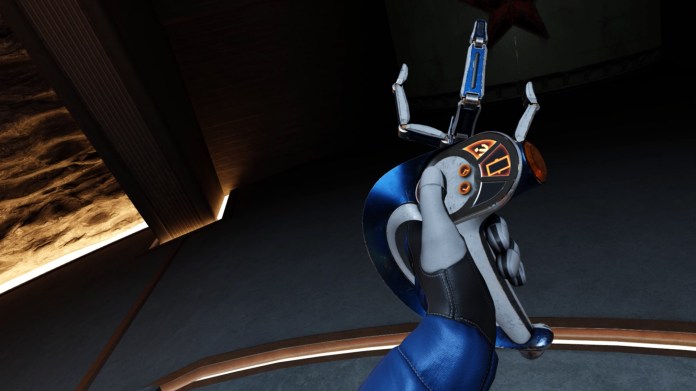
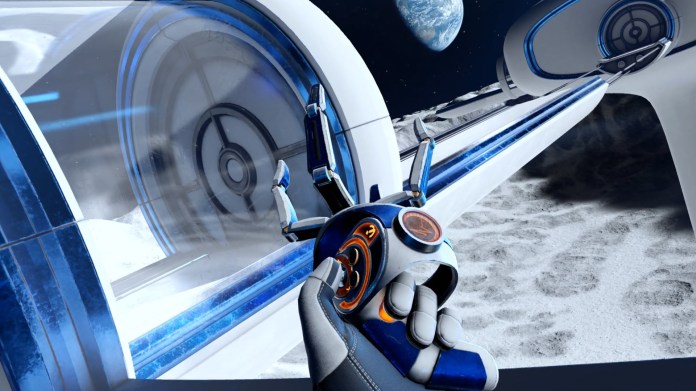
This button-mirroring is the core of what the developers call a diegetic interface: an interface contextualized inside the game world rather than overlaid as floating text that has no place in the narrative. Red Matter 2 Game Director Norman Schaar put the philosophy bluntly: "The best UI is no UI at all." The grabber tools also serve as a literal interface in the world: the player physically connects them to terminals to gather information. Under the surface, this is simply a more believable replacement for the familiar "press X to interact" prompts of flat-screen games.
The tools also resolve a deeper physical disconnect. A rendered human hand implies five-finger dexterity that a VR controller cannot actually provide, since the controller offers essentially a single point of grab. The grabber tool honestly reflects that one input point: because you can't manipulate its fingers, your only option is to grab at a single point, so the limitation stops feeling like your own failure and instead feels like learning to operate a futuristic device. On top of this, the grabber acts as a mechanical pivot between your hand and objects, an "insulation gap" that visually explains why you feel no force against your fingers when moving heavy props driven by the game's inertia-based weight system.