Autodesk Arnold 7.5.4: interactive Imager shader and expanded viewport support
 Public
- 29 Oct, 2026

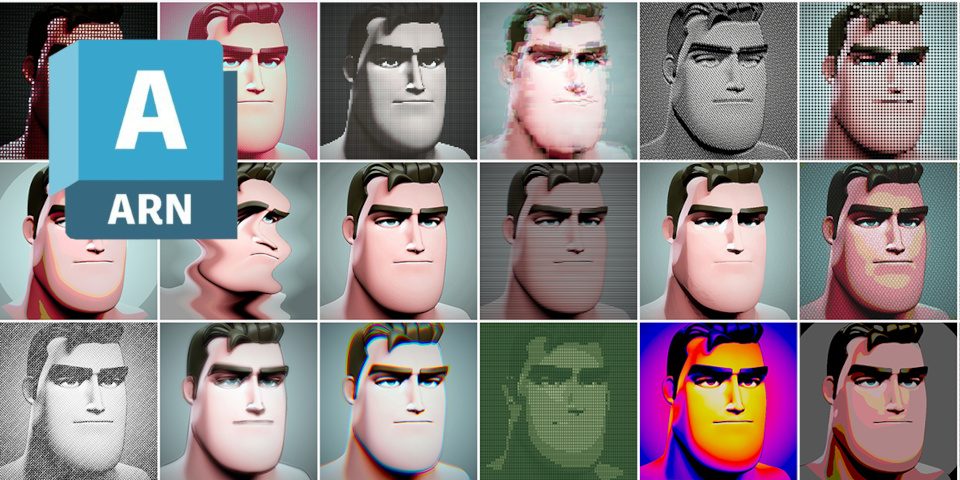
Autodesk has released Arnold 7.5.4, the latest version of its production-grade rendering engine. This substantial update adds a new Imager shader that lets artists design post-processing effects interactively right in the viewport. The Imager shader works by reading a shader network and evaluating it in real time, writing the result directly into the beauty render. In essence, it is a small compositing network built entirely from ordinary Arnold shaders. It allows for the creation of slap comps and various stylized effects, such as screen-space distortion, color remapping, and tiling. The shader supports any standard Arnold shading node and OSL shaders that output a value, but it does not support nodes that output closures, such as the OpenPBR Surface shader. This feature provides a flexible way to achieve retro and stylized looks without leaving the primary rendering environment.
Complementing the Imager shader is a new Rim Light shader designed to enhance non-photorealistic rendering (NPR) workflows. This standalone node outputs the same rim lighting effect generated by the Toon shader but offers greater control over the visual appearance. By decoupling rim lighting from the Toon shader, artists can layer it as an adjustable component rather than relying on a fixed effect. This change provides more precision for designing NPR looks. Additionally, the update includes new options to pause and resume renders without losing previous progress, which is particularly useful for long-running jobs. A new max_render_seconds option has also been introduced to stop batch renders after a fixed duration, allowing for timely delivery of noisier but completed frames.
The Advanced Viewport system, previously limited to Maya, is now available across all supported host applications. For 3ds Max and Cinema 4D users, this marks the first time they can render directly into the standard viewport on both CPU and GPU. Houdini users gain a new Accelerated Viewport option when rendering on the GPU inside Solaris, while Katana users receive a new accelerated rendering setting for GPU workflows. In Maya, the underlying technology has been updated to make the Accelerated Viewport more responsive and visually sharper during interactive navigation. It now also supports motion blur and Maya's cached playback system, which significantly speeds up the playback of animated characters. These changes streamline the iteration process for artists working in diverse DCC environments.
Performance improvements are evident in several areas, particularly for scenes involving deforming meshes or motion blur with varying motion keys. GPU renders of scenes containing large numbers of objects or instances now start faster and react more quickly to interactive edits. Autodesk reports that the delay for interactive edits in a scene with 100,000 instances has been cut to a third. The Global Light Sampling system now offers an option to use more indirect lighting samples to reduce noise in complex scenes, though this comes at the cost of increased calculation time. The native Noice denoiser has been updated, and the integrated NVIDIA DLSS technology now uses the newer DLSS 4.5 Ray Reconstruction model for improved image quality.
Outside the core application, the experimental Flow Render cloud service, launched with Arnold 7.5.1, has received several updates. It now supports setting a per-frame time limit, ensuring render jobs can be completed by the deadline despite noisier output. Flow Render also supports custom OCIO configurations and UDIM tile tokens in texture filenames. Currently free for all Arnold users, it offers up to 40 hours of rendering per month, targeting indie artists who want to avoid tying up local machines. All integration plugins have been updated to support the new features, including MAXtoA 5.9.5, C4DtoA 4.9.5, HtoA 6.5.4, KtoA 4.5.4, and MtoA 5.6.4. Arnold 7.5.4 is available for Windows 10+, Linux with glibc 2.28+, and macOS 12.0+, with GPU rendering supported on Windows and Linux with compatible NVIDIA GPUs. The software is rental-only: a single-user subscription costs $55 per month or $430 per year.