AndroidX Security State libraries let apps check device security on a per-component basis
 Public
- 18 Sep, 2026

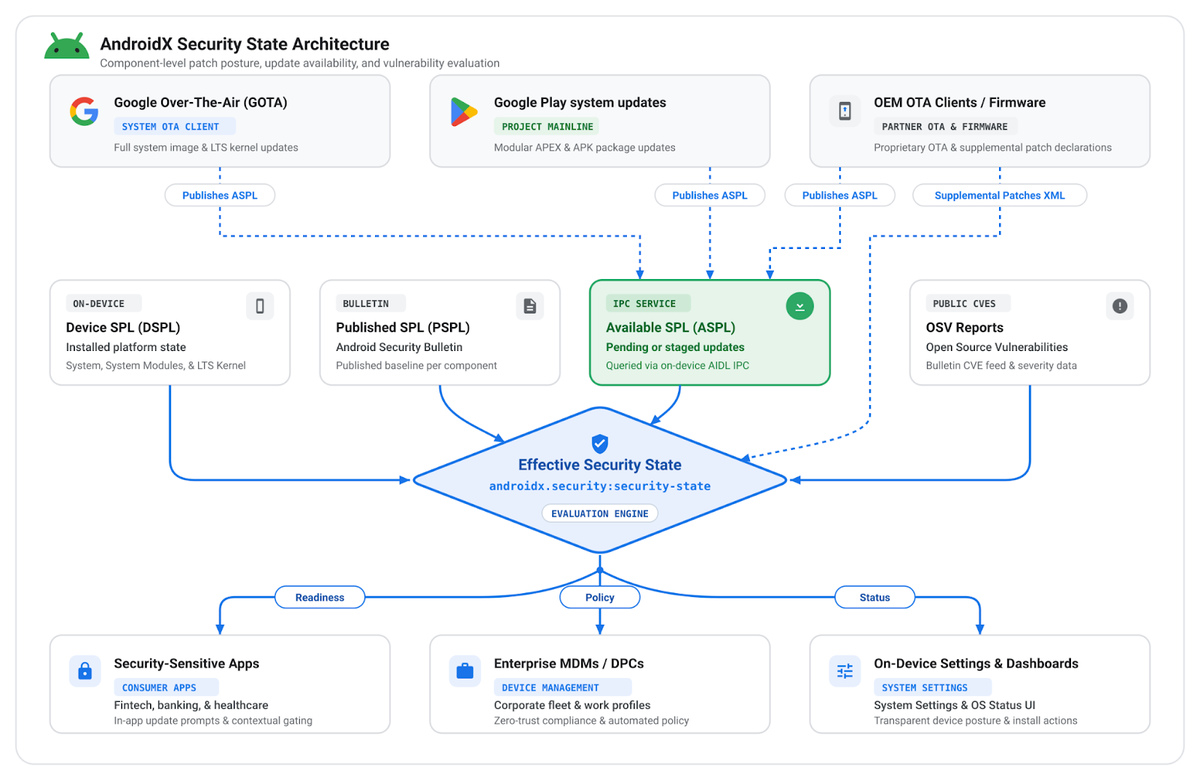
Google has released stable versions of two AndroidX libraries, Security State 1.1.0 and Security State Provider 1.0.0, which give developers a unified way to inspect device security. Instead of relying on a single, coarse Security Patch Level (SPL), apps can now check protection on a per-component basis and see which fixes are still pending installation.
The androidx.security.state library targets security-critical and consumer apps, such as banking, fintech, and healthcare apps, as well as Mobile Device Management (MDM) solutions. Its companion, androidx.security.state.provider, is intended for OEMs and Over-The-Air (OTA) client developers, and lets them expose update availability through standardized mechanisms.
Rather than granting device access on an all-or-nothing basis, apps can combine DSPL, PSPL, and ASPL to make contextual security decisions. A banking or enterprise app, for instance, can compare the device's current security patch (DSPL) against pending updates (ASPL) before starting sensitive flows, such as high-value payments or credential enrollment. If an update is waiting, the app can require the user to install it first.
For finer control, developers can query whether specific high-risk vulnerabilities (CVEs) have been patched, for example, confirming that critical NFC or Bluetooth fixes are applied before authorizing tap-to-pay or proximity data sharing. Feedback and issue reports are accepted through the public Android Issue Tracker.