3ds Max 2027.3: Agentic AI Control, Arnold in the Viewport and 4D Gaussian Splats
 Public
- 19 Nov, 2026
Autodesk has released 3ds Max 2027.3, an update to its modeling and animation package used for architectural visualization, motion graphics and VFX. The headline addition is a set of experimental agentic AI workflows: the software can be operated through natural-language prompts instead of mouse clicks. In addition, Arnold can now run directly as a viewport renderer, the Gaussian Splatting tools can now play back, edit and export 4DGS, and glTF files can finally be imported without third-party plugins.
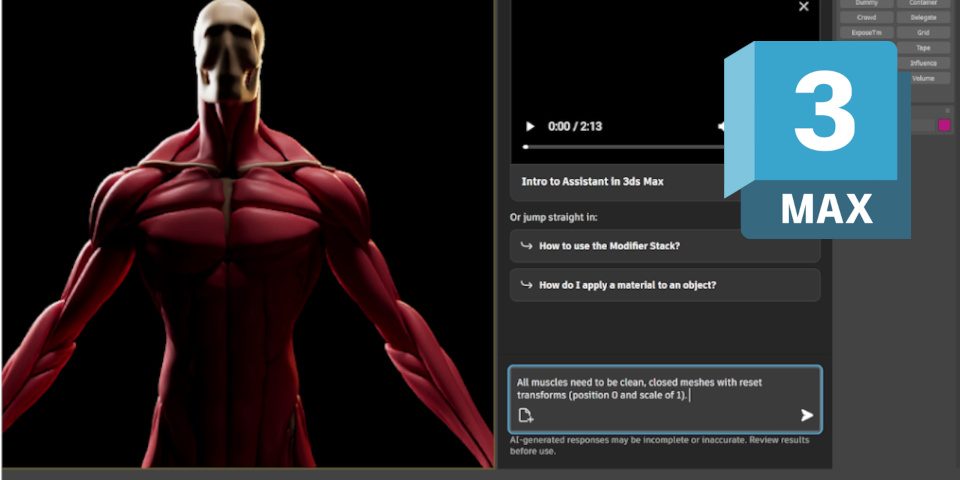
Agentic control comes in two forms. The built-in Autodesk Assistant, introduced back in 3ds Max 2027, now works at three levels. In "Help me" mode, it answers technical questions. In "Analyze my scene" mode, it inspects a scene without changing anything in it, for example to find broken texture paths. The new "Do work for me" mode, still a tech preview, modifies the scene itself by running MAXScript. It targets tedious work, from renaming objects to complex tasks such as pre-flight checks on a creature rig that convert muscles to closed meshes. Scripts must be previewed and approved before running. Safe Mode is on by default and blocks scripts from acting outside the scene, and every Assistant action can be undone in a single step. Prompt history and generated data are stored in the cloud for 45 days for debugging and service optimization, but are not shared with third-party AI developers.
The second route is an integrated MCP server, which lets external AI tools such as Claude or ChatGPT control 3ds Max. It carries similar safeguards: scripts can be previewed before execution, run in a sandbox, or write access can be disabled entirely. Autodesk publishes a comparison of the capabilities and costs of the Assistant and the MCP server, along with documented limitations for both.
Arnold no longer needs an ActiveShade window. The new Arnold Viewport renders interactively inside the active viewport while gizmos, grids and wireframe overlays remain drawn on top. NVIDIA DLSS handles upscaling and denoising for responsiveness, with a CPU fallback for machines without an NVIDIA GPU, making it useful for look development and lighting. The feature debuted in Arnold 7.5.4, which also brought shaders for interactive compositing and stylized rendering plus pausable renders.
Gaussian Splatting, added in 3ds Max 2027.2 with import, relighting and rendering, gets a major expansion. Sequences of PLZ or SPZ files can be loaded as an animated 4D Gaussian Splat and played back from the timeline, and splats now display directly in the viewport without an IPR viewport. New point-object tools split large 3DGS scenes into smaller exportable pieces and flatten point data, an Edit Point modifier enables non-destructive editing, and splats can be exported in PLY format as well as imported.
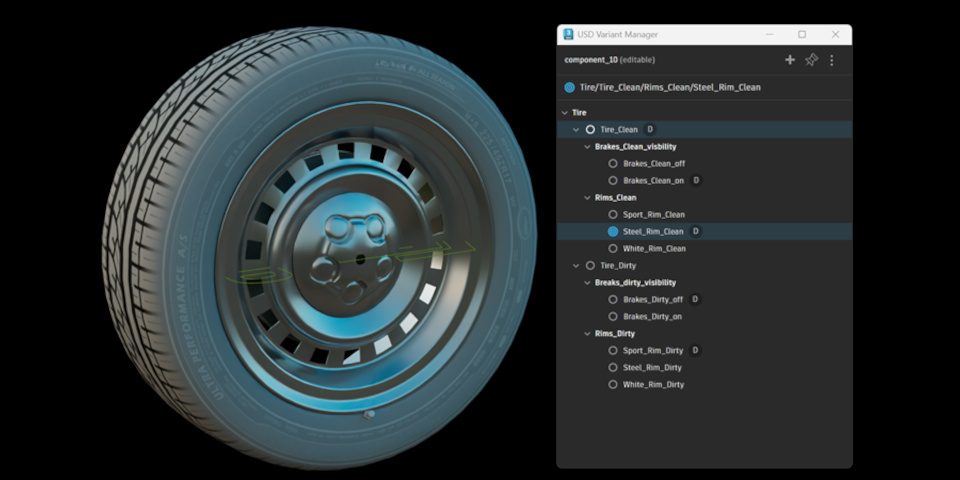
File handling and plugins also improve. Integrating the Khronos Group's open-source glTF Importer and Exporter adds native glTF import alongside export. The Substance 3D plugin, at version 3.1.1, supports the OpenPBR material standard, while USD for 3ds Max 0.17.8.1 adds a Component Creator that turns selected objects into a USD asset and a USD Variant Manager. 3ds Max 2027.3 runs on Windows 10 and later and is rental-only at $255 per month or $2,010 per year; in many countries, artists earning under $100,000 a year on projects valued under $100,000 qualify for an Indie subscription at $330 per year.